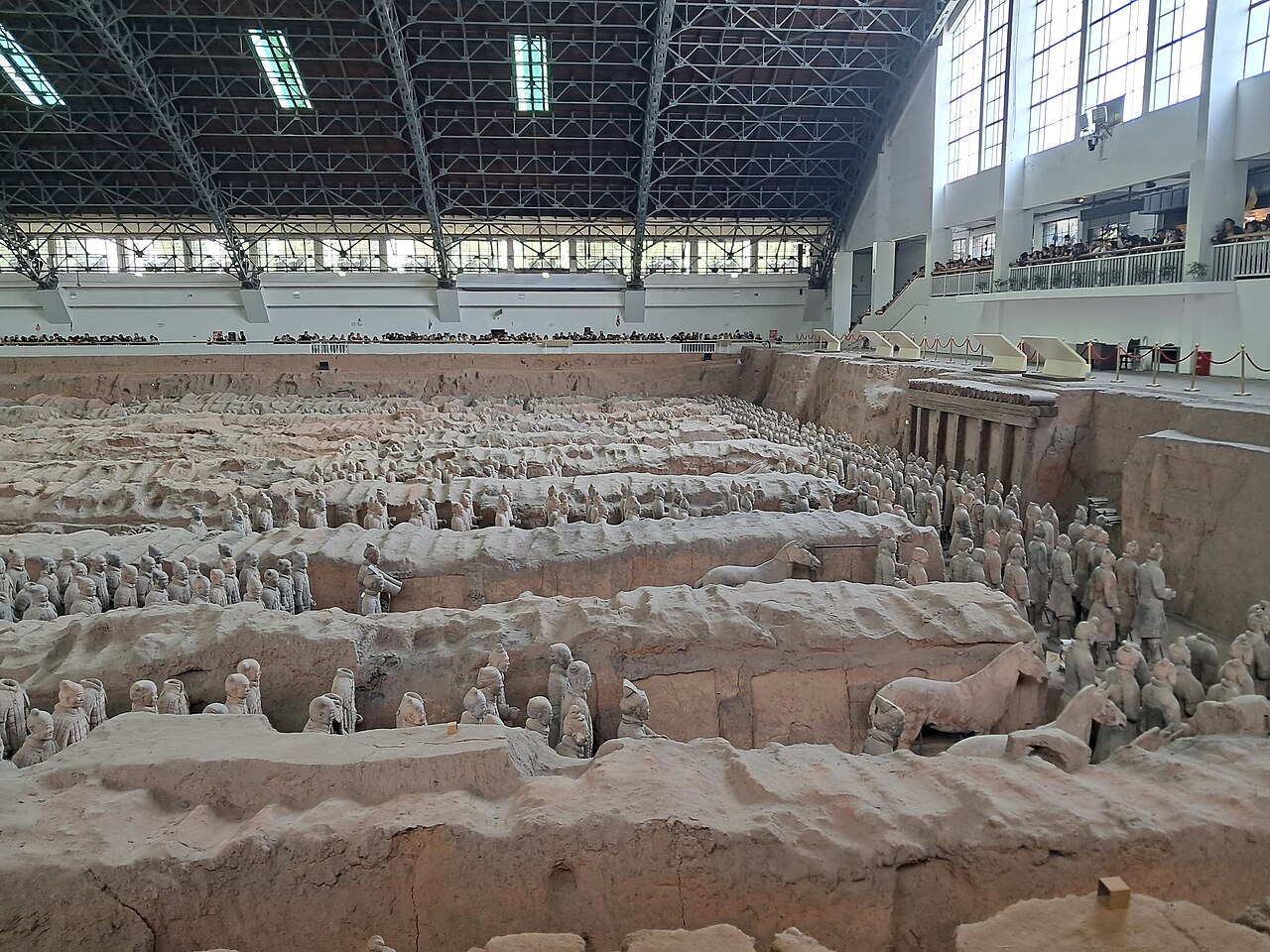
The Mausoleum of the First Qin Emperor was inscribed as a UNESCO World Heritage Site in 1987. Qin Shi Huang (259–210 BCE), who unified China in 221 BCE after a military campaign of ten years, ordered construction of his funerary complex at the age of thirteen, when he became ruler of the Qin state; construction continued for 38 years and employed a workforce estimated at 700,000 by the Han historian Sima Qian. The mausoleum mound covers an area of 355,000 square metres; the burial chamber has never been excavated. Three pits containing life-size terracotta figures were discovered by farmers drilling a well in March 1974 and contain approximately 8,000 warriors, 130 chariots and 670 horses. Han-dynasty historian Sima Qian recorded that the burial chamber contained mercury rivers reproducing the geography of China’s waterways, mechanically propelled; soil samples from the mound have confirmed anomalously high mercury concentrations consistent with his account.
Xi’an city and immediate surroundings: three inscriptions within 30 kilometres 0–30 km, 30 minutes by metro or bus
The mausoleum site is 30 kilometres east of Xi’an city centre, reachable by Metro Line 9 from Weiyang Lake station to Huaqing Pool stop (approximately 45 minutes) and then bus or taxi 10 minutes further east, or by direct tourist bus 306 from Xi’an Railway Station. The city of Xi’an itself contains several elements of the UNESCO World Heritage inscription and its associated cultural geography. The Ancient City of Chang’an, which served as the capital of 13 dynasties over 1,100 years, is directly referenced in the Silk Roads UNESCO inscription (the Routes Network of Chang’an-Tianshan Corridor, inscribed 2014), which lists Xi’an as the eastern starting point of the Central Asian Silk Road. The Xi’an City Wall, the most complete surviving Ming-period city wall in China, forms an 11.5-kilometre rectangle enclosing the old city centre and was built between 1370 and 1378 CE on the foundations of the Tang imperial city. The wall is 12 metres high and 15–18 metres wide at the base; a paved walkway along the top is usable on foot or by bicycle rental. The four main gates preserve original gate towers, barbican enclosures and drawbridge mechanisms; the South Gate (Yongning Gate) is the most monumental and is frequently used for public ceremonies. Xi’an Wall is not independently inscribed as UNESCO but forms the physical setting for the Chang’an Silk Road component and warrants a half-day visit.
The Big Wild Goose Pagoda (Da Yan Ta) in the Ci’en Temple complex, 4 kilometres south of the city wall in Xi’an’s southern urban district, is one of the component sites of the Silk Roads: Chang’an-Tianshan Corridor inscription. The pagoda was built in 652 CE under the Tang Emperor Gaozong to house the Buddhist scriptures and relics that the monk Xuanzang brought back from India after a 17-year overland journey (629–645 CE). Xuanzang’s journey, covering approximately 25,000 kilometres through Central Asia and India, was one of the most significant acts of knowledge transfer in the pre-modern world; the 657 Sanskrit texts he returned with were translated into Chinese over the following years, establishing the foundation texts for several schools of Chinese Buddhism. The pagoda is seven storeys and 64 metres tall in its current form, having been reduced from the original ten storeys by an earthquake; the original Tang structure was built from fired brick without mortar, relying on interlocking compression for stability. A smaller pagoda (Ci’en Monastery Pagoda) at the same complex dates to the Tang period and can be entered separately. The Dayan Pagoda North Square is the largest musical fountain plaza in Asia by some accounts, operating evening shows; this is an adjacent modern development and not part of the UNESCO inscription. From the Terracotta Army site, Dayan Pagoda is reachable by bus 306 to Xi’an Railway Station and then metro Line 3 south (total 90 minutes from the museum entrance).
The Small Wild Goose Pagoda (Xiao Yan Ta), 1 kilometre south of the city wall at Jianfu Temple, is also a Chang’an Silk Road component and is 15 storeys at 43 metres; it was damaged in a 1487 earthquake that split the main body vertically, but the crack closed partially in a subsequent earthquake in 1521. The temple that surrounds it is one of Xi’an’s most intact Tang-period monastic enclosures; the Jianfu Temple Bell, cast in 1192 CE and striking 13 times each morning, is one of the famous sounds of historical Xi’an. The pagoda and the Big Wild Goose Pagoda can be visited in a single afternoon from the city centre. Together with the city wall and the Silk Roads inscription context, they constitute the core of a Xi’an UNESCO day before or after the Terracotta Army.
Regional extensions by high-speed rail: two inscriptions 350–700 kilometres east 350–700 km, 2–4 hours by high-speed rail
The Longmen Grottoes in Luoyang, Henan Province, were inscribed in 2000 and lie approximately 380 kilometres east of Xi’an, reachable in 1.5–2 hours by high-speed rail from Xi’an North station to Luoyang Longmen station (which is 3 kilometres from the grottoes themselves, connected by taxi or bus). The site comprises 2,345 carved niches containing more than 110,000 Buddhist figures cut into two facing limestone cliff faces on either side of the Yi River, with construction spanning from the Northern Wei dynasty (493 CE) to the Tang period. The most impressive single work is the Fengxian Temple complex (completed 676 CE under Empress Wu Zetian): a large open-air alcove with a central seated Vairocana Buddha 17.14 metres high, flanked by disciples, bodhisattvas, heavenly kings and guardian warriors in a compositional arrangement that reads as a single unified sculptural programme rather than individual figures. The face of the central Buddha is one of the most reproduced images in Tang art; Empress Wu Zetian donated 20,000 guan from her cosmetic allowance, according to Tang records, to fund the Fengxian Temple completion, and the Buddha is sometimes interpreted as bearing her features, though this identification is contested. The site stretches for approximately 1 kilometre along the river; the east and west cliff faces require separate admissions, with the west cliff (Xishan) containing the major works including Fengxian Temple. A full visit takes 3–4 hours. Luoyang was the capital of the Eastern Han, Cao Wei, Western Jin and later Northern Wei dynasties; the Luoyang Museum in the city centre provides material culture context for the transition between the Northern Wei Buddhist art at Longmen and the earlier Han period represented by the Terracotta Army.
The Ancient Building Complex in the Wudang Mountains (Wudangshan), inscribed in 1994, lies approximately 600 kilometres east of Xi’an in Hubei Province, reachable in 3.5 hours by high-speed rail from Xi’an North station to Danjiangkou station (for Wudang) or nearby Shiyan station. The Wudang complex was built primarily during the Ming Yongle reign (1412–1423) as a Taoist sacred mountain; the emperor ordered construction of a palace complex on the summit using 300,000 labourers and artisans. The ensemble includes 8 palaces, 2 Taoist temples, 36 nunneries and 72 cliff temples distributed across the mountain range, connected by an ancient stone path system. The Jinding (Golden Summit) copper temple at 1,612 metres is the highest point; the Purple Cloud Palace (Zixiao Gong) at mid-mountain is the largest surviving Ming complex on the site. Wudang is regarded as the origin point of Taoist martial arts, particularly taijiquan; while the historical evidence for this attribution is disputed by scholars, the association has made the mountain a centre for martial arts training programs that run continuously through the year and are open to foreign participants. The combination of Wudang with the Terracotta Army and Longmen Grottoes forms a coherent central China itinerary across three dynasties (Qin, Tang, Ming) and three UNESCO inscriptions within a high-speed rail corridor of approximately 700 kilometres.
The Shaolin Temple at Mount Song (Songshan) in Dengfeng, Henan, is 350 kilometres east of Xi’an and 2 hours by high-speed rail plus 1 hour by bus. The Historic Monuments of Dengfeng, which includes the Shaolin Temple complex and Zhongyue Temple among 11 component sites, was inscribed in 2010. The Shaolin Temple was founded in 495 CE by the Northern Wei emperor for the Indian monk Buddhabhadra; Bodhidharma, the semi-legendary founder of Chan (Zen) Buddhism, is traditionally associated with the temple, though historical documentation for his biography is limited. The forest of 248 brick and stone funeral stupas (Pagoda Forest) east of the main temple is the largest such ensemble in China; the towers date from the Tang to the Qing period and are inscribed in the Dengfeng UNESCO property. Dengfeng is also the site of the Central Plains Observatory (Guanxingtai), built in 1279 CE for astronomical observations under Kublai Khan, and the Song Academy (Songyang Academy), one of the four great academies of Song-dynasty education. The Dengfeng inscription can be combined with Luoyang (60 kilometres northwest) in a single Henan day trip from Xi’an.
Practical information
Xi’an is served by Xi’an North station on the national high-speed rail network (Beijing 4.5 hours, Shanghai 5.5 hours, Chengdu 2 hours, Luoyang 1.5 hours) and by Xi’an Xianyang International Airport (30 minutes by metro Line 14 to the city). The Terracotta Army site is 30 kilometres east of the city centre; the most efficient independent transport is Metro Line 9 to its current eastern terminus (Huaqing Pool station), then bus 915 or taxi to the Qinshihuang Mausoleum site (about 10 minutes). The tourist bus 306 from Xi’an Railway Station operates hourly and stops at both Huaqing Pool and the Terracotta Army, making it convenient for those not using metro.
Spring (March to May) and autumn (September to November) are the preferred seasons; summer (June to August) is hot, humid and extremely crowded, with queues for Pit 1 (the largest exhibition hall) reaching 30–60 minutes. Inside the pits, the figures closest to the rope barriers show extraordinary individuated facial detail; allow a minimum of two hours across all three pits. The mausoleum mound itself, visible from the approach road as a large earthen pyramid approximately 50 metres tall, is not open to the interior; a small archaeological museum near the base provides context on the mound’s construction and the evidence for the burial chamber’s contents. The Huaqing Hot Springs (Huaqing Chi), 10 kilometres west of the Terracotta Army site, is an associated historical site with Tang-period bathing pavilions and associations with Emperor Xuanzong and the consort Yang Guifei; it is not UNESCO-inscribed but is frequently combined with the Terracotta Army as a half-day extension.
Frequently Asked Questions
Why has the main burial chamber of the First Qin Emperor never been excavated?
The decision not to excavate the main mausoleum mound at Lintong is a deliberate conservation policy maintained by the Chinese government and endorsed by international heritage bodies including UNESCO and ICOMOS. The principal stated reasons are technical and reversibility-based. The experience of the 1956–1958 excavation of the Ming Tombs Dingling pit (near Beijing) is frequently cited: artifacts including silk textiles, lacquerwork and organic materials deteriorated rapidly on exposure to air because the preservation technology available at the time was inadequate to stabilise them, and the damage was irreversible. The terracotta warriors in Pit 1 at the Qin site presented a related problem: many were excavated in 1974–1976 with polychrome paint intact on the clay surface, but the paint, bound with an organic linseed-based medium, lifted and flaked within minutes of exposure to atmospheric humidity. Techniques for stabilising the pigment were not developed until the 1990s, meaning the early-excavated warriors are now the monochrome grey figures familiar from photographs, while current excavations recover painted fragments that can be stabilised in situ. The burial chamber, which Sima Qian described as containing mercury rivers, automated crossbow traps, astronomical ceiling maps inlaid with pearls and miniature reproductions of palaces, is assumed by archaeologists to be far more complex and fragile than the pit assemblages. Elevated mercury readings confirmed by soil-sample surveys from the 1980s onward are consistent with Sima Qian’s account; the concentrations are high enough to present a direct health risk to excavators. The government position is that the chamber should remain sealed until conservation methods are demonstrably adequate for the material, which current Chinese heritage officials suggest will not be within the next generation.
How long should I allow for the Terracotta Army and what does each pit contain?
Allow a minimum of two full hours on site for a thorough visit to all three pits plus the on-site museum building. Three hours is more comfortable. Pit 1, the largest, is a 230 × 62 metre vaulted hall containing approximately 6,000 warriors, chariots and horses in 11 parallel columns with wooden partition walls between them. The rows closest to the viewing balcony show the individuated facial modelling most clearly; none of the figures are identical, and the variation in facial features, hairstyles, armour type and hand position is the primary evidence that different workshops produced different units. Pit 2, smaller and L-shaped, contains cavalry, archers and mixed infantry units; parts of it remain unexcavated, with the earthen walls exposed for visitors to see the excavation state in progress. Pit 3, the smallest and the last discovered, contains 68 figures interpreted as the command unit: they face inward rather than outward and the arrangement is consistent with a military command post rather than a combat formation. An additional exhibition hall near the entrance displays two bronze chariots found in a separate pit in 1980; each is approximately half life-size, cast in bronze with silver and gold detail, and represents the most technically sophisticated bronze casting known from the Qin period. They were found broken into 3,500 pieces and required eight years of reconstruction; each carriage top was cast as a single shell, a feat not repeated in Chinese bronze-casting until modern industrial methods. Combined with the Huaqing Pool stop and travel time from central Xi’an, a full Terracotta Army day takes 8–9 hours from the city centre and back.
How do the Longmen Grottoes compare to the Terracotta Army as a half-day excursion from Xi’an?
The Longmen Grottoes are not a half-day excursion from Xi’an—the journey alone is 1.5–2 hours each way by high-speed rail, making a minimum five-hour day even with a short visit, and the site warrants 3–4 hours of walking. The realistic approach is to include Luoyang as an overnight stop on a Beijing–Xi’an or Xi’an–Beijing high-speed rail journey, rather than treating it as a day trip. Luoyang also has the Luoyang Museum (free, with important Northern Wei Buddhist sculpture and Han bronzes), the White Horse Temple (Baima Si, traditionally regarded as the first Buddhist temple in China, founded 68 CE), and the National Peony Garden (in April only, when peonies bloom). A two-night stay in Luoyang with a day trip to Dengfeng’s Shaolin Temple and Songshan (60 kilometres by bus) makes the combination efficient. In terms of the artistic comparison: the Terracotta Army is primarily archaeological, its power coming from the scale of a single repeated human form across a vast space; the Longmen Grottoes are primarily sculptural and iconographic, with the Fengxian Temple’s 17-metre Buddha representing the apex of Tang monumental Buddhist sculpture in China. Both sites require physical presence to convey their scale accurately; neither translates fully in photographs. Visiting both within a single China itinerary, connected by the Xi’an–Luoyang high-speed link, is the recommended approach rather than choosing one over the other.
Sources
- S1 — UNESCO World Heritage Centre — Mausoleum of the First Qin Emperor (Ref. 441) — https://web.archive.org/web/20230601000000/https://whc.unesco.org/en/list/441/
- S2 — Emperor Qinshihuang's Mausoleum Site Museum — https://whc.unesco.org/en/list/441/
- S3 — Kuhn, Dieter. <em>The Age of Confucian Rule: The Song Transformation of China</em>. Harvard University Press, 2009. ISBN: 978-0-674-03661-1.
Spotted an error? Write to editorial@culturalheritageonline.com and we correct it the same day.