Phong Nha-Ke Bang National Park in Quang Binh Province, central Vietnam, contains more than 300 cave grottoes carved through limestone that is 400 million years old — the oldest significant karst formation in Asia. Son Doong, the largest cave on earth by cross-section volume, sits inside the park; a single chamber reaches 200 metres wide and 150 metres tall, large enough for a Boeing 747 to fly through. The park’s UNESCO listing, granted in 2003 and extended in 2015, covers 123,326 hectares and lies 130 kilometres north of Hue by road.
Son Doong: the cave with its own clouds and internal jungle Inside Phong Nha-Ke Bang National Park
Local farmer Ho Khanh first found the entrance to Son Doong in 1990 but could not relocate it for nearly two decades. British Cave Research Association surveyors returned with him in 2009 and completed the first full survey of the main passage, measuring it at 9 kilometres long, up to 200 metres wide, and 150 metres tall at its highest point. These figures make it categorically the largest cave passage by cross-section volume anywhere on earth, surpassing the previous record holder, Deer Cave in Malaysia. The name translates as “mountain river cave,” and the description is accurate: an underground river runs through much of its length, fed by surface drainage from the surrounding karst.
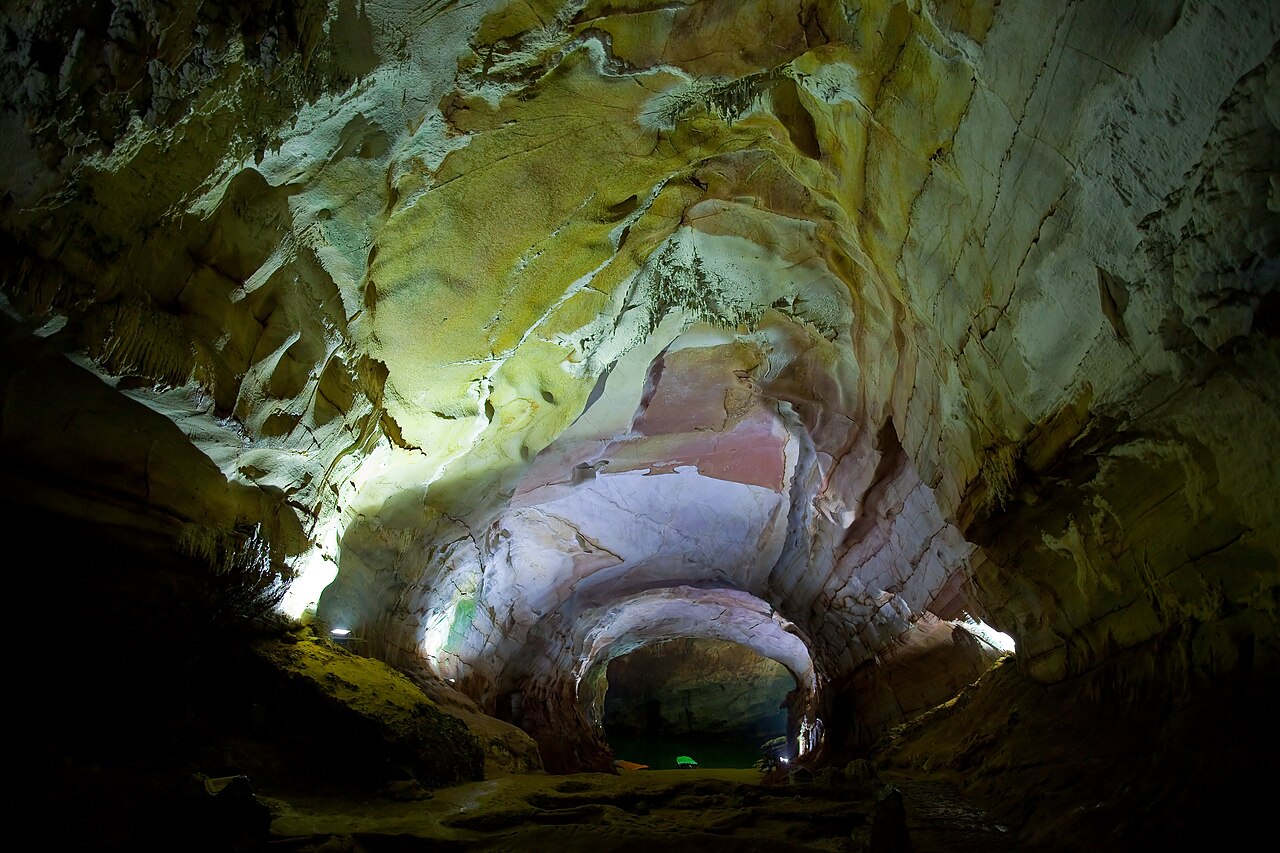
Two sections of the ceiling have collapsed over millennia, creating open shafts called dolines. Light pouring through these openings sustains two internal jungles — self-contained ecosystems of trees, ferns, and invertebrates that developed in isolation from the forest outside. The temperature differential between the cool cave air and the warmer world above generates its own weather: mist rises through the ceiling shafts and can be observed from outside the cave hovering over the canopy. This microclimate means Son Doong functions as a distinct biome within a biome, with plant species inside the cave showing measurable adaptation to reduced light levels.
Access is tightly controlled by Vietnamese law. Oxalis Adventure, the only operator licensed to run Son Doong expeditions, may take no more than 1,000 tourists per year into the cave. A four-day expedition costs approximately $3,000 per person and demands the physical fitness of a multi-day trekking trip: participants abseil 80 metres down the entrance shaft, wade through river sections in the dark, and sleep two nights inside the cave on sand banks. Permits sell out more than two years in advance. The cap exists because the internal jungles and cave fauna are acutely sensitive to increases in CO₂ from human breath, introduced bacteria, and physical disturbance to the cave floor. A 2014 proposal to install a cable car into Son Doong was rejected by the Vietnamese government after sustained scientific opposition.
Near the second doline stands a calcite barrier 90 metres high that researchers call the Great Wall of Vietnam, formed over tens of thousands of years as mineralised water deposited successive layers of calcium carbonate. Expedition participants climb it using fixed ropes. Beyond it, the cave continues for several kilometres before narrowing into flooded passages that require technical diving to explore. The full extent of the Son Doong system remains unmapped.
Phong Nha cave, karst geology, and the park’s rare fauna Son Trach village, 50 km west of Dong Hoi
The limestone that Son Doong and every other passage in Phong Nha-Ke Bang cuts through was deposited on the floor of a shallow tropical sea during the Cambrian and Devonian periods, between 400 and 500 million years ago. Tectonic uplift over successive geological epochs pushed the seabed skyward and exposed the rock to rainwater, which is weakly acidic and dissolves limestone along fracture lines. Underground rivers did the bulk of the carving: as water tables dropped over millions of years, rivers abandoned upper passages and moved deeper, leaving higher tunnels dry and filling them with stalactite and stalagmite formations. The result is a stacked cave system with active lower levels still carrying water and dry upper levels holding formations that took hundreds of thousands of years to grow.
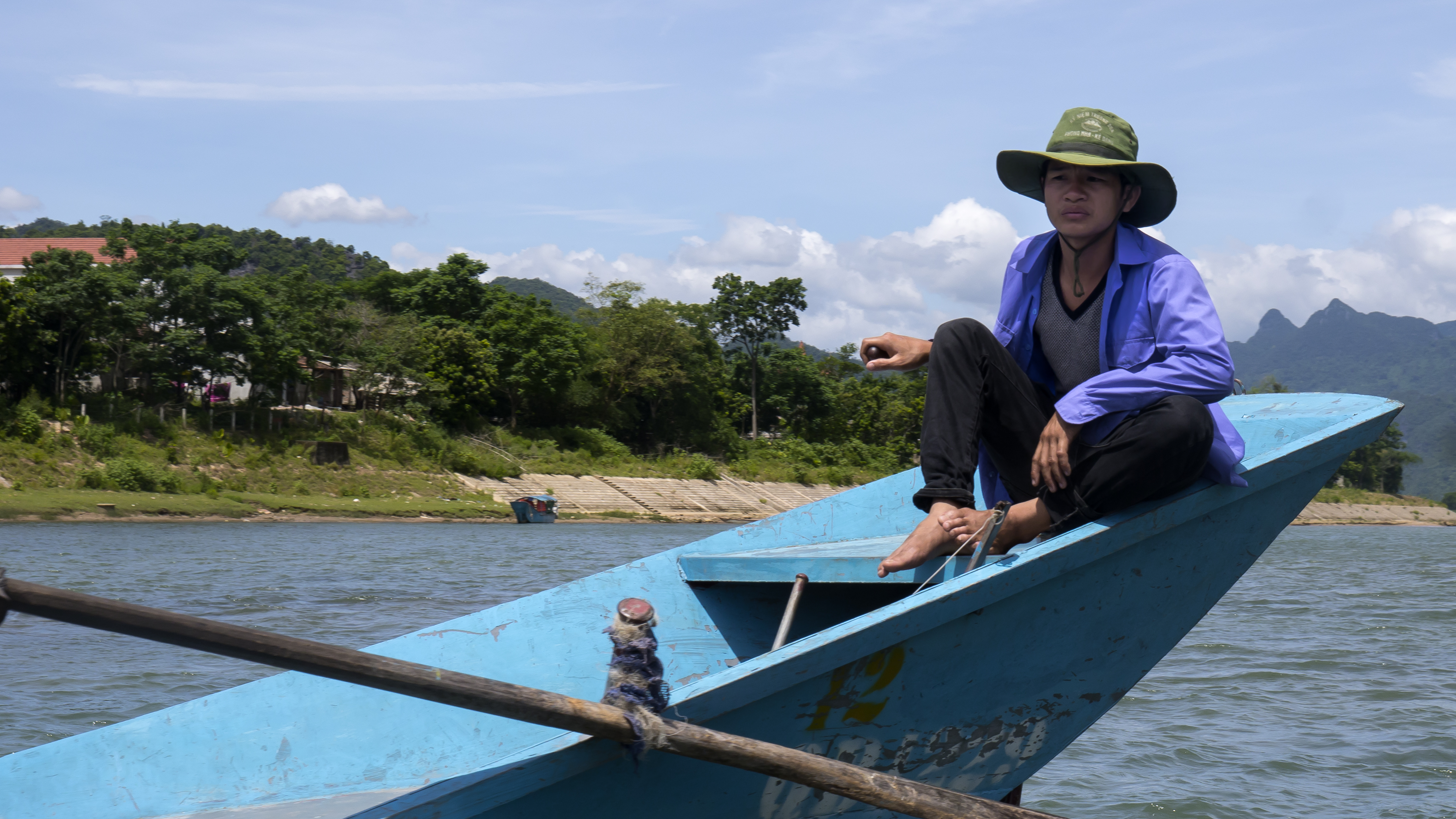
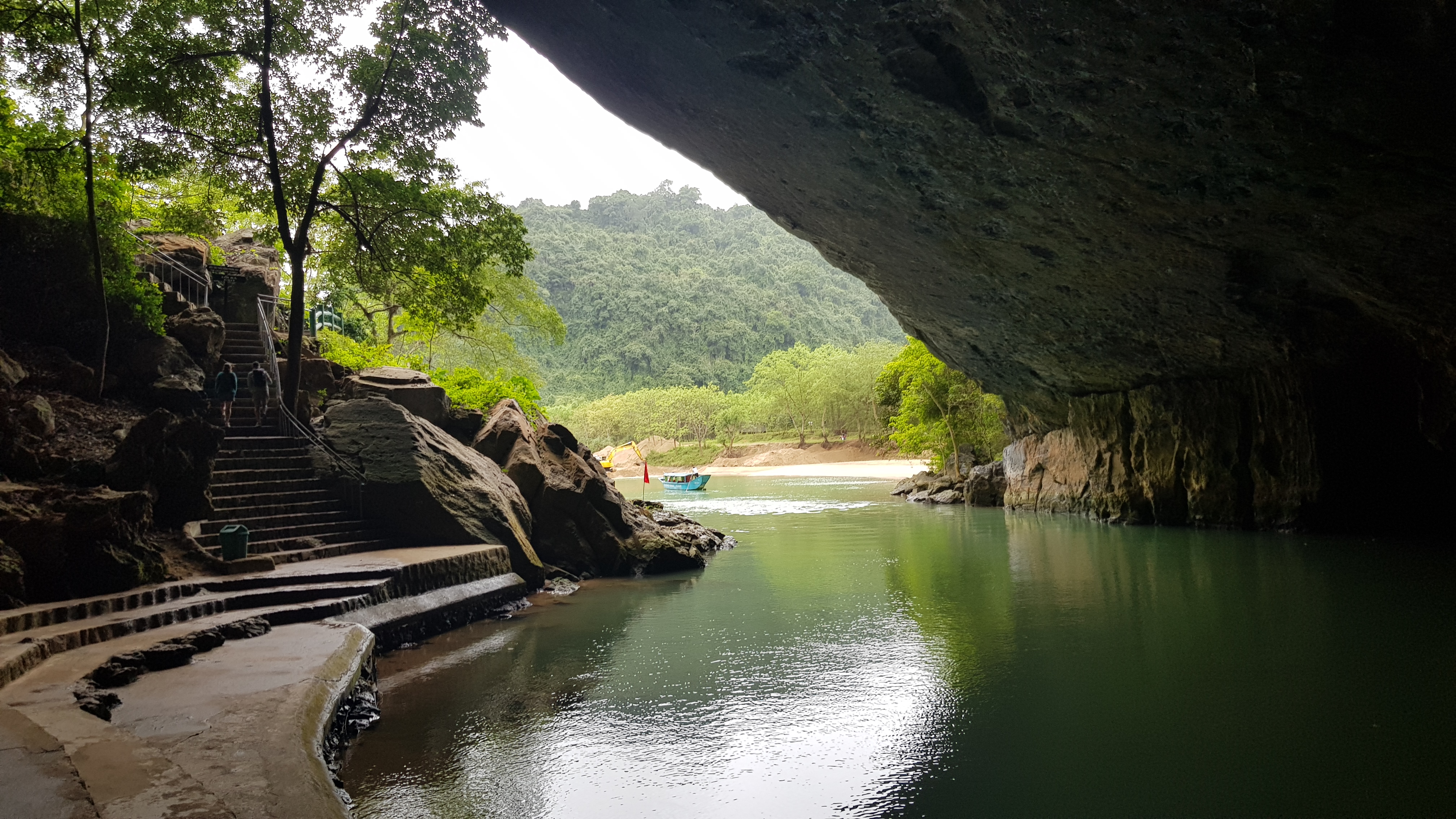
The Phong Nha cave has 83.2 kilometres of mapped passages — one of the longest surveyed cave systems in the world — but is most visited via the 14-kilometre underground river running through its accessible lower section. Motorboats depart from Son Trach village and carry visitors upriver to the cave mouth, continuing underground for approximately 1.5 kilometres before passengers disembark to walk through chambers with ceiling heights reaching 25 metres. The cave appears in Vietnamese written records from at least the 9th century CE: Sanskrit inscriptions on its walls document its use by Cham kings as a Hindu sanctuary, and a 10th-century Vietnamese chronicle records it as a royal ceremonial site.
The Ke Bang forest — the older, lower zone of the national park — supports 113 vertebrate species including 58 reptile species, many endemic to this karst habitat. The Vietnam pheasant (Lophura hatinhensis), widely considered functionally extinct by the 1980s, was rediscovered alive in the Ke Bang forest in 1996. The saola (Pseudoryx nghetinhensis), a bovine species scientists first documented in 1992 in the Annamite Mountains along the Vietnam-Laos border, is among the world’s most critically endangered mammals; it has been photographed in the wild fewer than a handful of times, and no captive individual has survived more than a few months in captivity. Camera trap images from 2013 constitute the most recent confirmed photographic evidence of a living specimen.
The Hue Imperial Citadel — Vietnam’s other significant UNESCO cultural site in the region — lies 130 kilometres south by road, a journey of roughly three hours along National Route 1A or the Ho Chi Minh Highway. Dong Hoi, provincial capital of Quang Binh, is the main transport hub: it has a domestic airport with regular connections to Hanoi and Ho Chi Minh City and sits on the north-south railway main line.
Practical information Gateway: Dong Hoi Airport (VDH), 50 km east
Dong Hoi Airport (VDH) is served by Vietnam Airlines, Vietjet Air, and Bamboo Airways from both Hanoi and Ho Chi Minh City; flight time from Hanoi is approximately one hour. From Dong Hoi, Son Trach village — the main visitor base for the park — is 50 kilometres west by road, roughly one hour by taxi or booked transfer. Son Trach offers accommodation from backpacker hostels to mid-range guesthouses; advance booking is strongly advised during peak periods (July–August and December–January).
Phong Nha cave and Paradise Cave (a separate system with 31 kilometres of passages and a boardwalk-accessible main gallery) are open to independent day visitors; tickets are available at the park entrance. Son Doong expeditions require advance booking through Oxalis Adventure and operate only between January and August — the cave entrance floods completely between September and November. Dark Cave, which combines a zip line over the river with cave swimming, is accessible year-round. The Tu Lan cave system, explored via a two-day camping trip with river swimming, is also offered by Oxalis and several other licensed operators at a fraction of the Son Doong cost.
The dry season runs January to August; the wet season from September to November brings flash flood risk in cave passages. Average valley temperatures range from 18°C in January to 35°C in July.
Frequently Asked Questions
How do you get a permit for Son Doong Cave, and what does the expedition physically involve?
Permits are issued exclusively through Oxalis Adventure, the sole operator licensed by the Vietnamese Ministry of Natural Resources and Environment to run expeditions inside Son Doong. The company releases a fixed allocation of places each year; bookings consistently sell out more than two years before the expedition date. The price in 2024 was approximately $3,000 per person for the four-day, three-night trip. Participants are required to demonstrate fitness comparable to a multi-day mountain trek: the itinerary includes an 80-metre abseil into the cave entrance on day one, river crossings in chest-deep water, and two nights sleeping on sand banks inside the cave. Experienced BCRA-trained caving guides accompany each group and monitor passage conditions throughout. The expedition runs only between January and August; during the rainy season from September to November, the entrance passage fills with floodwater and becomes impassable. Participants must be at least 16 years old. The 1,000-person annual cap is maintained deliberately: larger numbers would raise CO₂ concentrations from accumulated breath to levels damaging to the cave’s biological communities, and physical disturbance to the cave floor compacts the sand and disrupts the invertebrate fauna that sustains the internal jungle ecosystems. A 2014 cable car proposal was rejected after a coordinated scientific response to the Vietnamese government, and the cap has not been raised since.
What is the geological significance of the 400-million-year-old karst at Phong Nha-Ke Bang?
The limestone massif underlying Phong Nha-Ke Bang was originally deposited as marine sediment during the Cambrian and Devonian geological periods, roughly 400 to 500 million years ago. This makes it substantially older than other major karst landscapes in Southeast Asia: the limestone of Ha Long Bay in northern Vietnam is approximately 340 million years old, while the karst of Guilin in southern China formed between 300 and 350 million years ago. Radiometric dating of the Phong Nha-Ke Bang rock matrix confirmed the age that places it among the oldest exposed carbonate karst on any continent. After its initial marine deposition, the limestone was subjected to tectonic compression during multiple orogenic episodes that folded and uplifted it, exposing the surface to chemical weathering. Underground rivers then carved the cave passages over tens of millions of years; the passages visible today represent only the most recent phase of carving, as the regional water table reached its present level. Some passages remain actively forming: the lowest cave levels still carry rivers through rock, and new speleothem growth continues at measurable rates wherever mineralised water drips from cave ceilings. The combination of extreme geological age, intact stratigraphy, and active cave-forming processes was central to the UNESCO Outstanding Universal Value assessment for both the 2003 listing and the 2015 extension.
What can visitors experience at Phong Nha-Ke Bang without booking the Son Doong expedition?
The overwhelming majority of visitors to Phong Nha-Ke Bang never enter Son Doong and still access some of the most significant cave landscapes in Asia. The Phong Nha cave — reached by motorboat from Son Trach pier — is open to independent visitors daily and requires no advance booking; the standard boat tour covers 1.5 kilometres inside the cave and includes the illuminated stalactite galleries that have been visited since the 1990s. Paradise Cave, a separate system reached by electric cart and a 1.2-kilometre wooden boardwalk, is considered by many cavers to be visually more dramatic than the tourist section of Phong Nha: its main gallery is up to 30 metres wide and reaches 72 metres in height at its tallest point, with dense concentrations of stalactite and stalagmite formations. Both caves sell tickets on the day at the park entrance. Tu Lan Cave is available as a two-day camping expedition involving river swimming through flooded passages and a night inside a dry upper gallery; Oxalis and several other operators run this route at a price several times lower than Son Doong. Dark Cave combines a zip line over the Song Chay River with a swim through a dark passage and is accessible to casual visitors year-round without advance reservation. The park supports two to three days of varied cave access without any technical commitment or expedition-level cost.
Sources
- S1 — UNESCO World Heritage Centre — Phong Nha-Ke Bang National Park and Hin Nam No National Park (Ref. 951) — https://whc.unesco.org/en/list/951/
- S2 — Sito ufficiale — http://www.phongnhakebang.vn
All addresses were reachable on 20 October 2026.
Spotted an error? Write to editorial@culturalheritageonline.com and we correct it the same day.