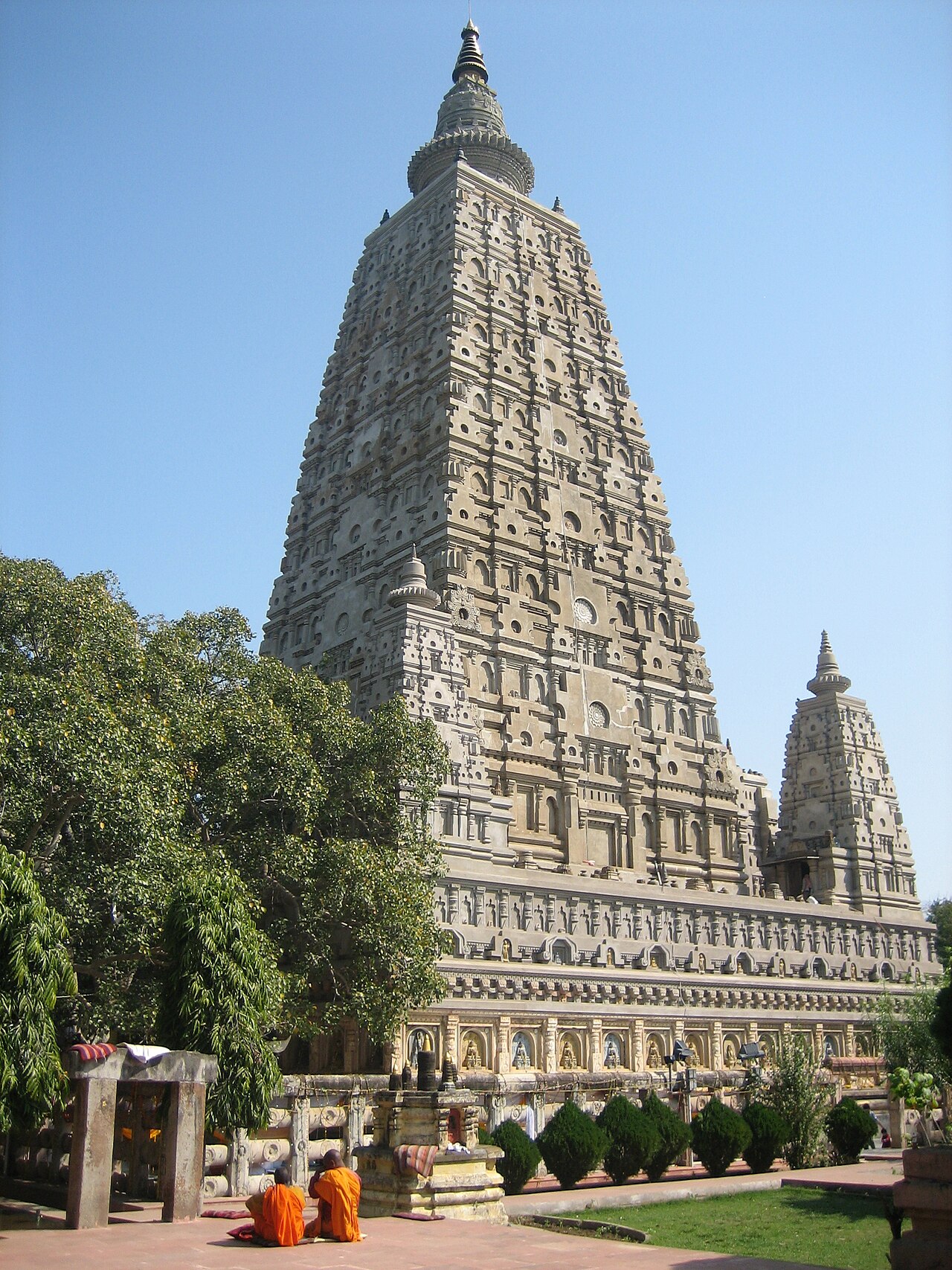
The Mahabodhi Temple Complex at Bodh Gaya (महाबोधि मंदिर, Bodh Gayā), inscribed by UNESCO in 2002, is the temple complex marking the site of the Buddha Shakyamuni’s enlightenment (bodhi) under the sacred pipal tree (the Bodhi Tree, Ficus religiosa) approximately 528 BCE — the most sacred site in Theravada and Mahayana Buddhism, and the site where according to Buddhist tradition the young prince Siddhartha Gautama (approximately 563–483 BCE) sat in meditation under the fig tree for 49 days and attained the transcendent insight (prajna) that made him the Buddha (“the Awakened One”). The Mahabodhi Temple (the main temple building, approximately 55 m in height, a fluted pyramid tower in a style that blends early Indian stupa and tower traditions with what is now described as the “Bodhgaya style” of temple architecture — a distinctive pyramidal form with a flat-topped shikhara and four corner towers that had wide influence on Buddhist architecture in Myanmar, Thailand, and Sri Lanka) is the most visited Buddhist pilgrimage site on earth, receiving approximately 3–5 million pilgrims annually from across Asia, with the largest numbers from Sri Lanka, Thailand, Myanmar, Japan, Korea, Taiwan, China, and Tibet, in addition to Indian Buddhists (particularly Ambedkarite Buddhists of the Dalit communities who converted to Buddhism following the lead of B.R. Ambedkar in 1956 CE) and Western Buddhist practitioners. The UNESCO inscription encompasses the main Mahabodhi Temple, the Bodhi Tree (the current tree, grown from a cutting of the tree under which the Buddha meditated), the Vajrasana (“Diamond Throne”, the seat of the Buddha’s enlightenment — a sandstone slab placed under the Bodhi Tree by Emperor Ashoka, approximately 250 BCE), and the seven sacred spots within the temple complex where the Buddha spent the seven weeks after his enlightenment in meditation and gratitude.
Bodh Gaya and the Bihar Buddhist heritage triangle Mahabodhi Temple · Bodhi Tree · Vajrasana · Nalanda · Rajgir — 0 to 120 km
The Mahabodhi Temple complex (approximately 4.8 hectares, enclosed within a boundary wall that separates the religious precinct from the surrounding town of Bodh Gaya — a busy pilgrimage town of approximately 40,000 residents surrounded by Buddhist monasteries built by various national Buddhist communities since the 20th century, creating one of the most architecturally diverse religious townscapes in South Asia) is organised around the main temple and the Bodhi Tree in a sequence of sacred spaces corresponding to the seven weeks of the Buddha’s post-enlightenment meditation. The main temple (originally built by Emperor Ashoka approximately 250 BCE in a form that no longer survives; the current structure represents Gupta-period rebuilding approximately 5th–7th century CE, with further Burmese restoration in the 1880s CE under King Mindon and British restoration by Alexander Cunningham and J.D. Beglar of the Archaeological Survey of India in the 1880s — the Beglar restoration’s accuracy has been criticised by some scholars as introducing non-original elements) stands on a high plinth approximately 6 m above the surrounding court, with its interior principal shrine containing a 1.5-metre gilded image of the Buddha in the “earth-touching” pose (bhumisparsha mudra, the gesture in which the right hand touches the earth, calling the Earth as witness to the Buddha’s enlightenment and his merit accumulated over countless lifetimes). The Bodhi Tree (the direct descendant of the original pipal tree under which the Buddha attained enlightenment — the tradition that this specific tree is a lineage descendant of the original is documented from at least the 3rd century BCE, when Emperor Ashoka sent a cutting to Sri Lanka with his daughter Sanghamitta, and the Bodh Gaya tree and the Sri Lankan tree at Anuradhapura have both been maintained as the sacred continuations of the original tree since that time) is approximately 30 m in height, with its multiple trunks and aerial roots draped with prayer flags and encircled by a low stone fence where pilgrims sit in meditation and lay offerings. The Vajrasana (the sandstone “Diamond Throne” slab beneath the Bodhi Tree, approximately 2 m × 1.2 m, the most sacred spot in the complex for Buddhist pilgrims, placed by Ashoka and therefore the oldest datable object at Bodh Gaya) is generally crowded with meditating pilgrims — the experience of sitting in meditation at or near the Vajrasana on a full-moon night, when thousands of pilgrims from across Asia are also present in the complex and the main temple is lit by butter lamps, is widely described as one of the most spiritually intense experiences available anywhere in the world, regardless of the visitor’s personal religious orientation.
Nalanda (UNESCO 2016, approximately 88 km northeast of Bodh Gaya by road via Rajgir) is the most historically important complementary UNESCO site — the Nalanda Mahavihara was the greatest Buddhist university in the ancient world, operating from approximately 5th century CE to 1193 CE when it was destroyed by the forces of the Khilji general Bakhtiyar Khilji. Rajgir (approximately 75 km north of Bodh Gaya, midway between Bodh Gaya and Nalanda, accessible by road) is the site of many events in the Buddha’s ministry and in the First Buddhist Council (held in the Saptaparni Cave approximately 486 BCE, the year after the Buddha’s death, where the Buddha’s discourses were orally compiled and standardised) — an important pilgrimage site for both Buddhist and Jain pilgrims (the Jain Tirthankar Mahavira, the contemporary of the Buddha, also spent time in Rajgir). Sarnath (approximately 250 km northwest of Bodh Gaya in Uttar Pradesh, near Varanasi, accessible by train from Gaya station to Varanasi junction then by road) is the site of the Buddha’s first sermon after his enlightenment at Bodh Gaya — the Deer Park (Isipatana/Mrigadava) where the first five disciples received the first teaching of the Four Noble Truths and the Eightfold Path, with the Dhamek Stupa (approximately 500 CE, Gupta period) marking the exact spot of the sermon, approximately 35 m in height in an excellent state of preservation with carved stone ornament. The Bodh Gaya–Nalanda–Sarnath circuit is the “Buddhist India” standard itinerary of international pilgrims.
Practical information
Bodh Gaya is in Gaya district, Bihar, approximately 14 km south of Gaya city. The nearest major railway junction is Gaya Junction (Gaya, approximately 14 km north of Bodh Gaya by road — 20 minutes by auto-rickshaw or taxi). Gaya Junction is on the main Delhi–Kolkata railway line with multiple daily trains from both directions (approximately 6–8 hours from Delhi, approximately 5–6 hours from Kolkata). Patna (the state capital of Bihar, approximately 120 km north of Gaya, approximately 2 hours by road) has a domestic airport (Patna Airport, PAT) with connections to Delhi, Kolkata, and Mumbai. The Mahabodhi Temple is open daily 05:00–21:00 (the temple itself has specific timing for access to the inner shrine — check on arrival). Admission is free but shoes must be removed at the entrance gate. Photography is permitted in the outer temple area but restricted or prohibited in the inner shrine (regulations change; verify on arrival). The experience of the temple varies enormously by time of day and season: full-moon days (especially the Vaisakha Purnima, the full moon of the Buddha’s birth-death-enlightenment month, typically in May) draw the largest crowds of thousands of international pilgrims; early morning (05:00–07:00) and late evening (after 17:00) provide the most contemplative atmosphere. Best visiting season: November–February (temperatures 15–28°C, dry and pleasant; the main pilgrimage season for international Buddhists who cannot travel in India’s summer heat). The monsoon (July–September) brings flooding risk in the lower-lying areas of Bodh Gaya town and reduced pilgrimage numbers. Accommodation ranges from budget guesthouses in Bodh Gaya town to mid-range hotels and several national Buddhist organisation guesthouses (the Sri Lanka, Thailand, Myanmar, Japan, and several other countries’ Buddhist national organisations maintain pilgrimage guesthouses that are sometimes open to pilgrims of any nationality for a modest donation).
Frequently Asked Questions
What happened to Bodh Gaya after the decline of Buddhism in India and when was it restored to Buddhist control?
The decline of Buddhism in India (a process extending from approximately the 7th century CE, when Chinese pilgrim Xuanzang visited India and noted the decline of Buddhist monasticism in many regions, to the 13th century CE when the last major Buddhist institutions were destroyed in the Khilji military campaigns in Bihar) left Bodh Gaya in an ambiguous institutional situation — the most sacred site in Buddhism was located in a region where Buddhism had essentially disappeared as a living religion, and the Mahabodhi Temple fell under the management of a Hindu Shaivite monastery (the Shaiva Math established by the mahant of Gaya, the principal Hindu administrative centre of the region, who claimed the Mahabodhi Temple as a Hindu temple because it had been maintained by Hindu priests for several centuries in the absence of a Buddhist community to maintain it). The site’s return to international Buddhist awareness began with the visit of the Sri Lankan Buddhist reformer Anagarika Dharmapala (1864–1933 CE) in 1891 CE — Dharmapala, arriving at Bodh Gaya for the first time and finding the holiest site in Buddhism managed as a Hindu temple with the principal Buddhist imagery in the inner shrine surrounded by Hindu offerings and the Bodhi Tree not being properly maintained, initiated a decades-long campaign for Buddhist management of the Mahabodhi Temple that became one of the first pan-Asian Buddhist political mobilisations. The Mahabodhi Society of India (founded by Dharmapala in 1891 CE to reclaim Bodh Gaya for Buddhism) lobbied the British colonial government, organised international Buddhist support from Ceylon (Sri Lanka), Japan, China, and Thailand, and brought the Mahabodhi Temple issue to international attention at a time when the colonial power might have imposed a settlement. The legal and political contest between the Hindu mahant’s claims and the Buddhist community’s claims continued through the colonial period; the final resolution came in 1949 CE with the Bihar State Legislature’s Bodh Gaya Temple Act, which established a joint management committee of four Hindus and four Buddhists to manage the Mahabodhi Temple — a compromise that has been disputed by Buddhist organisations who argue that the holiest Buddhist site should be managed exclusively by Buddhists. The formal handover of primary management to the Buddhist community occurred gradually over the post-independence decades; the UNESCO inscription in 2002 brought international attention to the conservation requirements of the temple and accelerated the resolution of some management disputes.
What is the Bodhi Tree at Bodh Gaya and is it the original tree under which the Buddha meditated?
The Bodhi Tree (bo tree, pipal/sacred fig, Ficus religiosa) at Bodh Gaya is a pipal tree growing immediately to the west of the main Mahabodhi Temple, on a raised terrace enclosed by a stone railing where pilgrims sit in meditation, pray, and lay offerings of flowers and prayer flags. Whether it is the “original” tree under which the Buddha sat in 528 BCE cannot be verified in any biologically strict sense — pipal trees do not live 2,500 years (their natural lifespan is approximately 400–600 years). The claim that the current tree is “the original tree” rests on a tradition of lineage rather than literal biological continuity: the historical documentation of the Bodh Gaya tree begins with Emperor Ashoka’s visit (approximately 250 BCE), which is approximately 270 years after the Buddha’s enlightenment — already a generational gap that implies the tree Ashoka saw was not itself the one under which the Buddha sat but an early successor. The tradition of taking cuttings to propagate the line is documented from the 3rd century BCE, when Ashoka’s daughter Sanghamitta is said to have taken a branch of the Bodhi Tree to Sri Lanka, where the resulting tree at Anuradhapura (the Sri Maha Bodhi) is still living (2,300 years old, one of the oldest documented trees in the world) and is itself a sacred Buddhist pilgrimage site. The current tree at Bodh Gaya was the subject of documented damage and restoration: the Burmese king Anawrahta (r. 1044–1077 CE) sent craftsmen to restore it; it was deliberately destroyed by the Shaivite king Pushyamitra Shunga approximately 185 BCE (the destruction is mentioned in Buddhist texts though its extent is disputed); another destruction is attributed to the Bengal Sultanate in the 14th century CE; and the current tree was partly damaged by a storm in 1876 CE and subsequently regrown from its own cuttings. The tree that Anagarika Dharmapala found in 1891 CE when he first visited was the post-storm regrown tree, probably approximately 15–20 years old at that point. The current tree is the continuation of a lineage that has been consciously maintained at the Vajrasana site for approximately 2,300 years — the specific botanic individual is a descendant of a descendant, but the tradition of maintenance on the exact spot and the cultural continuity of the Bodhi Tree lineage are the significant historical facts rather than the identity of any specific individual tree.
EXCERPT: Mahabodhi Temple Complex at Bodh Gaya, UNESCO-inscribed in 2002, marks the site of the Buddha’s enlightenment (528 BCE) under the Bodhi Tree — the 55-metre Gupta-period pyramid temple, the Vajrasana “Diamond Throne” placed by Emperor Ashoka (250 BCE), and full-moon nights when thousands of Asian pilgrims gather at the world’s holiest Buddhist site, 88 km from Nalanda Mahavihara (UNESCO 2016).
META: UNESCO World Heritage Sites near Mahabodhi Temple Bodh Gaya India: Nalanda Mahavihara 88 km northeast (UNESCO 2016), Buddhist Monuments at Sanchi 500 km southwest (UNESCO 1989), Agra Fort and Taj Mahal 650 km northwest (UNESCO 1983) — Bihar Buddhist heritage trail from Bodh Gaya through Rajgir to Nalanda, the sacred geography of the Buddha’s ministry.
Sources
- S1 — UNESCO World Heritage Centre — Mahabodhi Temple Complex at Bodh Gaya (Ref. 1056) — https://web.archive.org/web/20230601000000/https://whc.unesco.org/en/list/1056/
- S2 — UNESCO World Heritage Centre — Statement of Outstanding Universal Value (Ref. 1056) — https://whc.unesco.org/en/list/1056/
Spotted an error? Write to editorial@culturalheritageonline.com and we correct it the same day.