Bhopal sits within reach of two of India’s most significant ancient sites — a first-century Buddhist hilltop complex and a prehistoric rock shelter landscape with paintings that predate every known civilisation. Neither requires an overnight stay. Both reward an early departure. From Cultural Heritage Online.
Buddhist Monuments at Sanchi 46 km · 1 hr by train
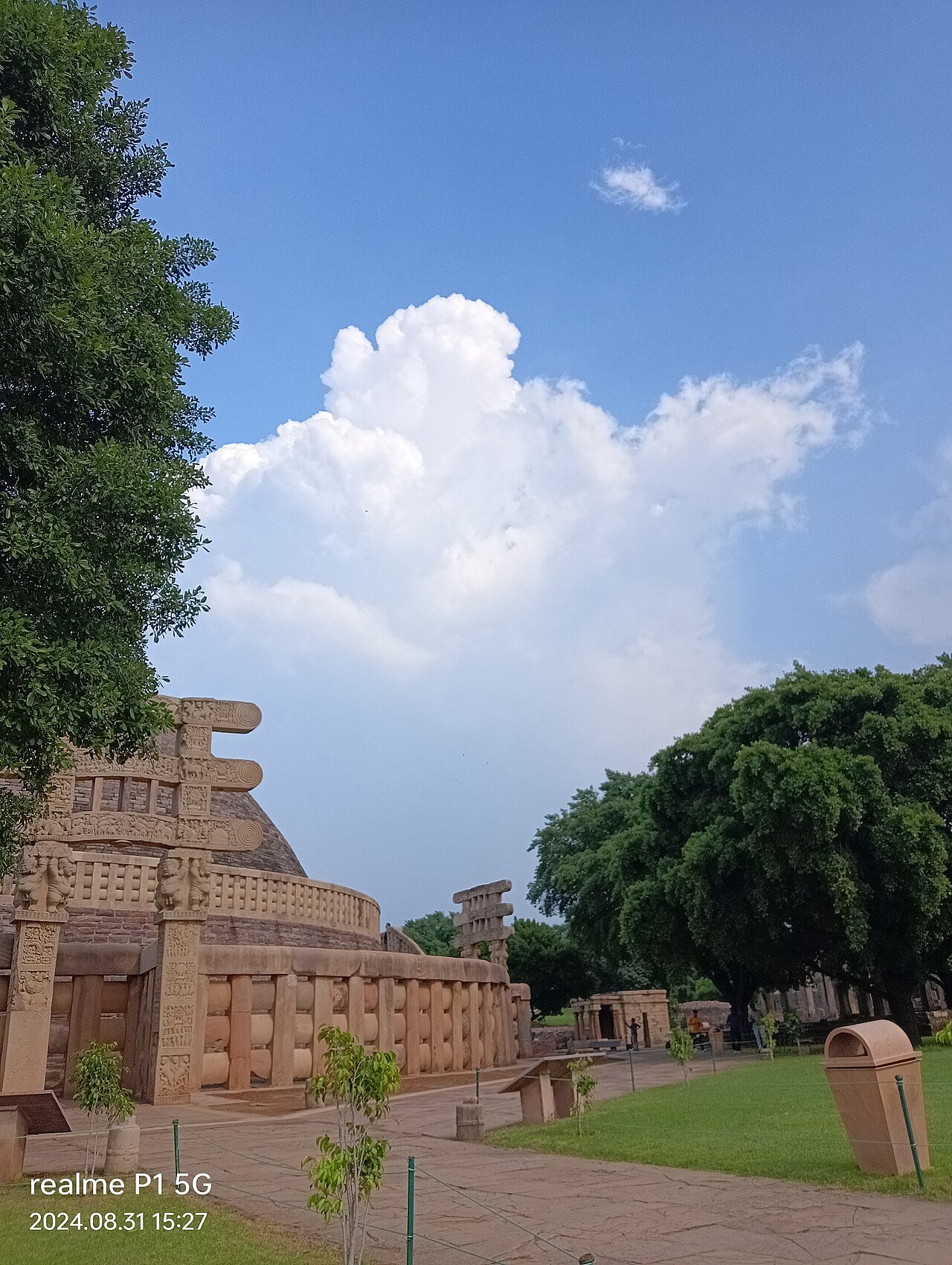
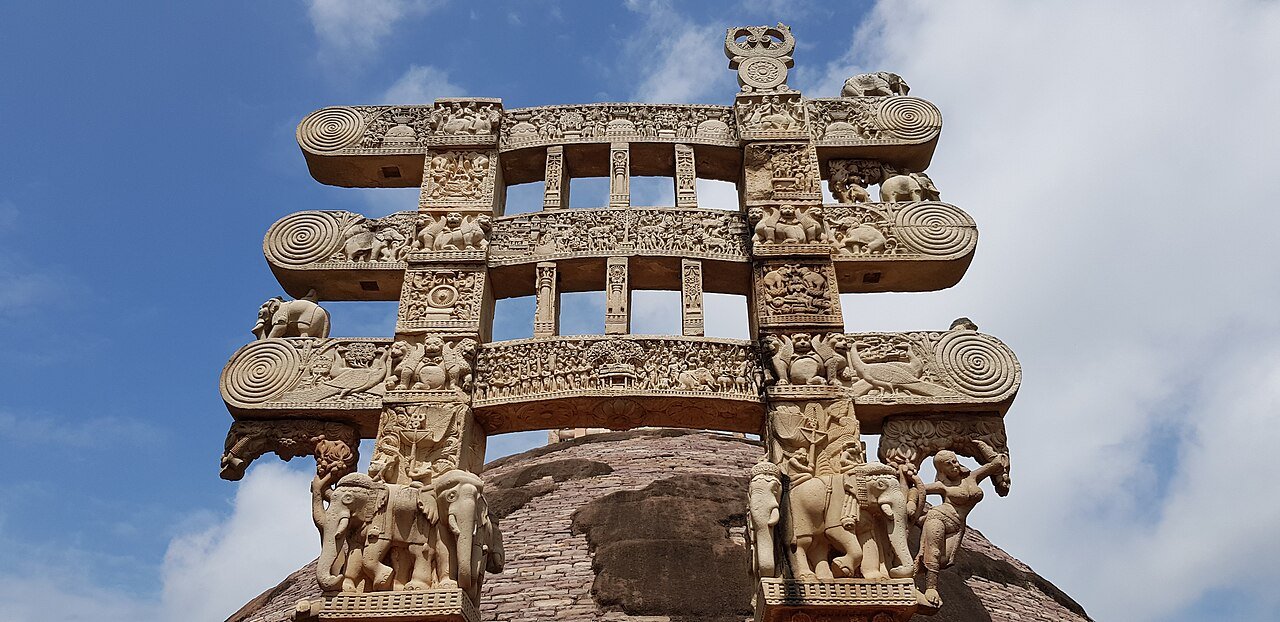
Inscribed as a UNESCO World Heritage Site in 1989, the Buddhist monuments at Sanchi form what many scholars regard as the best-preserved Buddhist complex in India. Emperor Ashoka of the Mauryan dynasty commissioned the Great Stupa in the 3rd century BCE as a reliquary mound housing sacred remains. The structure rises 16.46 metres and spans 36.6 metres in diameter — a calculated hemisphere of plain brick that communicates mass rather than ornament. The four carved stone gateways, the toranas, came later: the Satavahana dynasty added them between roughly 50 BCE and the early 1st century CE, covering them in narrative relief panels that trace episodes from the life of the Buddha in registers of extraordinary density. Deer, elephants, lotus flowers, and devotional figures crowd every surface. The hilltop site continued to grow across twelve centuries, accumulating temples, pillars, and smaller stupas that trace the full arc of Indian Buddhist architecture. Standing at the summit on a clear morning, the Madhya Pradesh plains extend in every direction, and the carved gateway figures seem to observe the same landscape they have faced for two thousand years.
Getting there: Sanchi is 46 km north-east of Bhopal. Local trains depart Bhopal Junction four to five times daily; the journey takes approximately one hour and deposits visitors at Sanchi station, a ten-minute walk from the hilltop entrance. Buses and taxis are also available from Bhopal but offer less reliable timing. Allow: 2–3 hours on site. Best for: Travellers who want to trace Indian Buddhist history from its earliest surviving monuments through the medieval period in a single, compact complex.
Rock Shelters of Bhimbetka 45 km · 1 hr by car
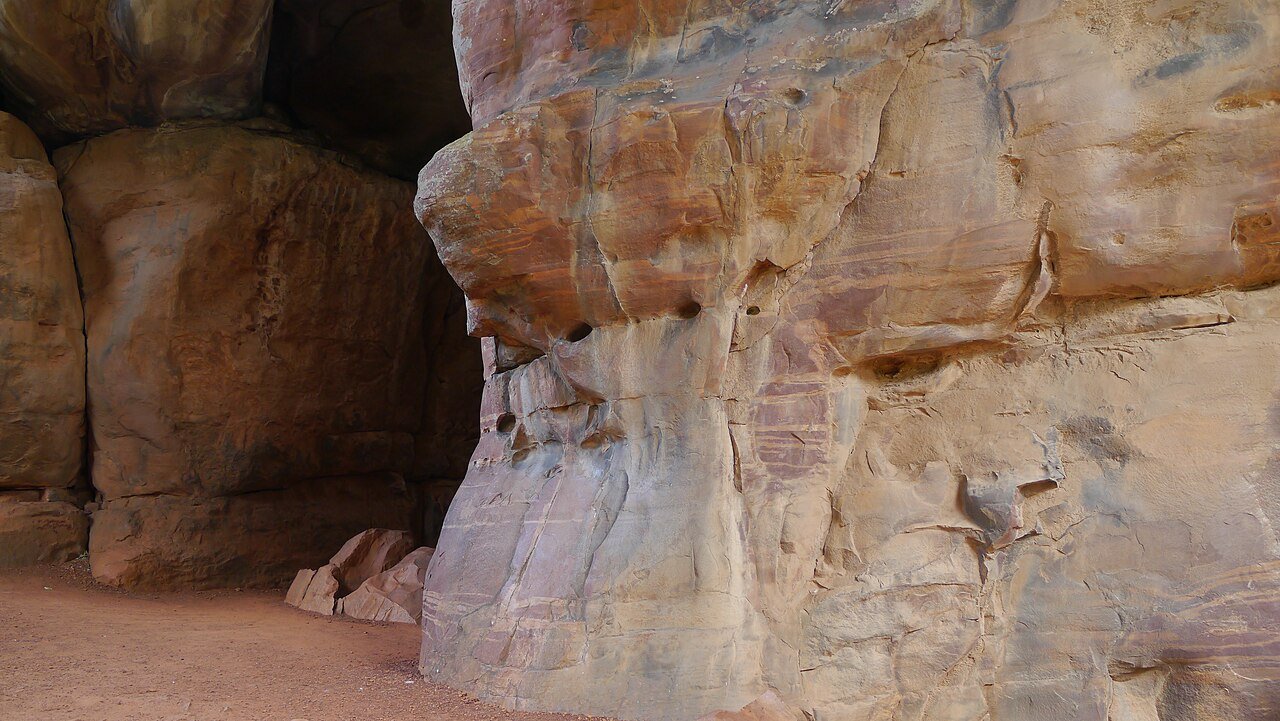
The Rock Shelters of Bhimbetka received UNESCO World Heritage designation in 2003, recognising a landscape of more than 750 rock shelters spread across seven quartzite hills covering an area of 1,893 hectares. Occupation at the site reaches back over 100,000 years, placing Bhimbetka among the oldest known sites of sustained human habitation on the Indian subcontinent. Archaeologist V. S. Wakankar first reported the shelters to the scholarly world in 1957; the full scale of the painted surfaces was not understood until the 1970s. Some 400 shelters contain paintings. The oldest images are dated to approximately 10,000 BCE — Mesolithic hunting scenes in red and white ochre that depict bison, deer, barasingha, and elephants alongside human figures with bows. Later layers add warriors on horseback and abstract geometric forms, producing a stratigraphic record of visual culture that spans from deep prehistory to the early historic period. Inside the largest shelters the ochre surfaces absorb the afternoon light in a way that makes the animals appear to move. It is a quality no photograph quite manages to capture.
Getting there: Bhimbetka lies 45 km south of Bhopal along National Highway 46. There is no direct public transport to the site entrance; shared auto-rickshaws run from Obaidullaganj town (the nearest rail stop), or visitors can hire a car or taxi from Bhopal for the approximately one-hour drive. Allow: 2–3 hours on site. Best for: Anyone drawn to prehistoric art, early human occupation, and the particular silence of a landscape that has sheltered people across geological timescales.
Frequently Asked Questions
How many UNESCO World Heritage Sites are near Bhopal?
Two UNESCO World Heritage Sites sit within 46 kilometres of Bhopal city centre: the Buddhist Monuments at Sanchi (inscribed 1989) to the north-east, and the Rock Shelters of Bhimbetka (inscribed 2003) to the south. Both can be visited as day trips from Bhopal, and their contrasting subjects — Buddhist monumental architecture and prehistoric rock art — make them a natural pairing for a two-day itinerary.
What is the closest UNESCO World Heritage Site to Bhopal?
The Rock Shelters of Bhimbetka are the closer site in straight-line distance at roughly 45 km south of Bhopal, though the absence of direct public transport means reaching them requires a car or taxi from the city or shared auto-rickshaws from the town of Obaidullaganj. Sanchi, at 46 km to the north-east, is in practice the more easily accessible site for independent travellers, served by regular trains from Bhopal Junction.
Do I need a visa to visit Bhimbetka and Sanchi, and what is the best season?
Most international visitors to India require an e-Visa, which can be applied for online before departure — check the Indian government’s official e-Visa portal for your nationality’s eligibility. The best season for visiting both sites is October through March, when temperatures across Madhya Pradesh are moderate and the skies are clear. April through June brings intense heat, and the July-to-September monsoon, while scenic, can make the hillside paths at Bhimbetka slippery.
What are the dress code and ticket arrangements at Sanchi and Bhimbetka?
Both sites are managed by the Archaeological Survey of India (ASI). Entry tickets can be purchased at the respective site gates; there is no advance online booking system as of 2025, so arriving early is advisable during peak season. No specific religious dress code applies at either site, though modest clothing and comfortable walking shoes are recommended given the uneven terrain, particularly on Sanchi Hill and across the rocky paths at Bhimbetka. Photography is permitted at both sites without an additional fee.
Sources
- S1 — Marshall, John, and Alfred Foucher. The Monuments of Sanchi. Swati Publications, 1982. ISBN 978-81-7002-005-9.
- S2 — Neumayer, Erwin. Lines on Stone: The Prehistoric Rock Art of India. Manohar Publishers, 1993. ISBN 978-81-7304-013-9.
Spotted an error? Write to editorial@culturalheritageonline.com and we correct it the same day.