Rila Monastery, Bulgaria’s most venerated religious site, sits at 1,147 metres in the Rila Mountains, 117 km south of Sofia. Founded in the 10th century by Saint John of Rila — Bulgaria’s patron saint — the complex holds 1,200 exterior frescoes, a cross that cost its maker his sight, and an unbroken role as custodian of Bulgarian culture across five centuries of Ottoman rule. UNESCO placed it on the World Heritage List in 1983.
A Mountain Refuge That Outlasted an Empire Rila Mountains, 117 km south of Sofia
Ivan Rilski — Saint John of Rila — withdrew from the world around 927 CE and settled in a cave in the Rila Mountains. Within his lifetime a small monastic community formed around him, and after his death in 946 the site became a pilgrimage destination. His cave, still accessible to visitors, lies roughly 2 km uphill from the present monastery. The distance is short, but the terrain makes the approach demanding enough to feel like the ascent it once was for medieval pilgrims crossing the Balkans on foot.
The monastery’s geographic position — deep in a river valley carved by the Rilska River, surrounded by peaks rising above 2,000 metres — gave it a degree of protection that lowland foundations lacked. When the Ottoman conquest of Bulgaria began in 1396, Rila Monastery did not disappear. It operated continuously, sometimes under difficult terms, sometimes with the explicit protection of Ottoman sultans who issued firmans recognising its status. Bulgarian nobles and later Bulgarian merchants funded its upkeep. The institution became something that a remote church could rarely sustain: a living archive of Bulgarian manuscripts, illuminated texts, ecclesiastical art, and the Bulgarian language itself at a time when that language had no official standing in a state that no longer existed.
By the 18th century the monastery was a focal point of the Bulgarian National Revival — a cultural and literary awakening that preceded independence by a century. Scholars copied manuscripts here, iconographers trained here, and abbots corresponded with communities across the diaspora. The UNESCO inscription in 1983 recognised not just the physical complex but this intellectual and cultural continuity, a record of institutional survival without parallel in the Bulgarian lands.
The Rila region itself belongs to the broader Rhodope-Rila highland arc that separates the upper Struma and Maritsa river valleys. The terrain shaped medieval trade routes connecting the Aegean coast to Sofia and on northward to the Danube. Rila Monastery controlled one of the few reliable high passes. Its network of metochions — subsidiary properties in towns as distant as Plovdiv and Bucharest — made it an economic institution as well as a spiritual one, a combination that explains both its wealth and its resilience.
Two other UNESCO World Heritage Sites lie within the greater Bulgarian cultural landscape, though neither is close. Boyana Church, 15 km north of Sofia, contains 13th-century frescoes painted in 1259 that art historians rank among the finest medieval paintings in Europe — remarkable for their naturalism at a moment when Byzantine convention still dominated religious art across the Orthodox world. The Thracian Tomb of Sveshtari, 490 km northeast near the Danube, dates to the 3rd century BCE and represents a different cultural layer entirely: the Getae, a Thracian people who produced carved female figures of extraordinary technical refinement. The Madara Rider rock relief, 430 km to the northeast, was carved into a vertical cliff face at a height of 23 metres sometime between the 8th and 9th centuries CE and depicts a proto-Bulgarian ruler in triumph. Each site represents a separate chapter of the long inhabitation of the Bulgarian lands.
The Church of 1,200 Frescoes and the Cross That Cost a Life’s Sight Monastery complex, open daily
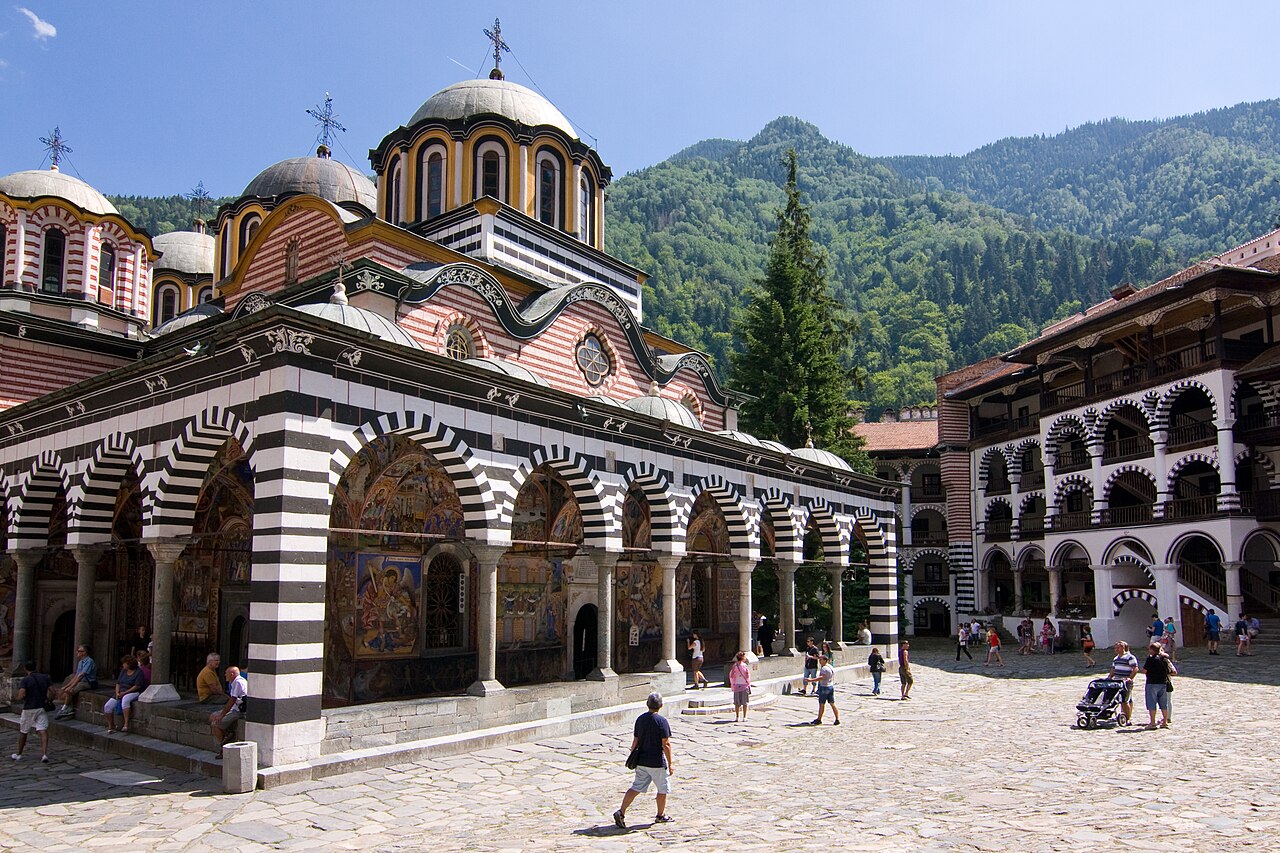
The monastery visible today is largely a product of the 19th century. A fire in 1833 destroyed most of the medieval structures, and the Bulgarian community — by then energised by National Revival sentiment — responded with an unprecedented rebuilding campaign. Between 1833 and 1837 craftsmen from across Bulgaria converged on Rila. The result is the great courtyard complex that survives today: four storeys of monks’ cells arranged around a central open space, arcaded in bold alternating bands of black and white stonework, with the Church of the Nativity of the Virgin occupying the centre.
The church, completed between 1834 and 1837, is the visual centrepiece of the complex. Its exterior portico carries approximately 1,200 frescoes covering every surface — vaults, columns, lunettes, and walls — in a programme that moves from scenes of the Last Judgement at the entrance to episodes from the life of the Virgin and the life of Christ as the visitor proceeds inward. The dominant painter was Zahari Zograf, one of the leading figures of Bulgarian National Revival art, who worked here alongside his brother Dimitar. The interior continues the scheme across 36 domes, the gilded iconostasis, and the bishop’s throne, creating an overwhelming accumulation of sacred imagery. The colours have been maintained and restored over the decades but retain the warm ochres and deep blues that characterise Zograf’s palette.
The monastery’s museum holds the most important collection of religious artefacts in Bulgaria, but one object draws particular attention: the Raphael Cross, a wooden crucifix carved by the monk Raphael over 12 years in the early 19th century. The cross measures 81 cm by 43 cm and contains 140 miniature scenes from the Bible, each with figures no larger than a grain of rice. The work involved carving with tools made from splinters of bone. Raphael worked without magnification. By the time he finished, the sustained close work had destroyed his sight. He went blind. The cross is now displayed in a glass case, and visitors with good eyesight and patience can make out the individual figures — the Annunciation, the Nativity, the Crucifixion — packed into panels smaller than a thumbnail.
The one medieval structure that survived the 1833 fire is the Hrelyo Tower, built in 1334-1335 under the boyar Hrelyo, a local nobleman who sought both spiritual merit and political protection in his patronage of the monastery. The tower stands 23 metres tall, square in plan, and now houses a small chapel at its upper level. It provides the single visible link to the pre-Ottoman medieval complex and stands in pointed contrast to the bright 19th-century architecture surrounding it.
Practical information
Rila Monastery is 117 km south of Sofia via the E79 highway toward Blagoevgrad, then east along a mountain road. Direct buses run from Sofia’s Ovcha Kupel bus station; the journey takes approximately 2 hours. Private transfers and organised day tours are widely available from Sofia hotels. There is no train service to the monastery itself.
The monastery is open to visitors every day of the year. The church is accessible without charge, though a small photography fee applies inside the nave. The museum (separate entrance) charges a modest admission fee. The monastery guesthouse offers rooms for those who want to spend a night in the complex — a worthwhile option that allows early-morning access before day-trip coaches arrive.
The cave of Saint John of Rila, 2 km uphill, involves a path through forest and some scrambling near the entrance. It is passable for fit visitors and takes about 45 minutes each way from the monastery. The cave itself is a narrow rock fissure; entering it is a traditional ritual of purification.
The best visiting months are May through October. Snow can close the mountain road in winter, and spring can bring heavy rain. July and August see the highest visitor numbers; September combines good weather with thinner crowds. Accommodation is available in the monastery guesthouse and in the nearby village of Rila, and more extensively in Blagoevgrad, 35 km away.
Frequently Asked Questions
What is the best way to visit Rila Monastery from Sofia as a day trip?
The standard day trip from Sofia to Rila Monastery takes approximately 2 to 2.5 hours each way by road. The most straightforward option is the direct bus from Sofia’s Ovcha Kupel bus terminal, which runs morning departures and allows about 4–5 hours at the monastery before the return service. Private taxis or transfers cost significantly more but allow flexibility, including stopping at the village of Rila or detouring to Boyana Church on the return. Organised day tours from Sofia hotels typically combine Rila Monastery with a brief stop at Boyana Church and include a guide — useful for visitors who want historical context without navigating independently. Driving gives the most control: the E79 south from Sofia to Blagoevgrad is a good road, and the turn east into the mountains is well-signed. The mountain section (roughly 20 km) involves tight bends but no unusual difficulty in dry conditions. Parking is available at the monastery entrance. Aim to arrive before 10:00 to get an hour in the complex before the peak of organised groups. If time allows, the 2 km walk to Saint John’s cave adds an hour to the visit and is strongly worth doing in good weather — the forest path is quiet and the cave itself is genuinely striking.
Is Rila Monastery still an active monastery?
Yes. Rila Monastery functions as an active Bulgarian Orthodox monastic community. A resident community of monks lives within the complex, observes the canonical hours, and maintains the liturgical life of the church. Visitors can attend services — the main daily liturgy is typically held in the early morning — but are expected to dress modestly (shoulders and knees covered; headscarves available at the entrance for women) and to observe silence during worship. The dual role of active monastery and major tourist site creates an atmosphere that can shift abruptly: a quiet morning liturgy with incense and chant can be followed by the arrival of several coaches within the hour. This rhythm is worth keeping in mind when planning arrival time. The monastic community manages both the museum and the guesthouse, and income from tourism directly supports the maintenance of the complex. The monks are not reclusive by Western monastic standards — the Bulgarian Orthodox tradition has always placed the monastery in relation to the lay community — but visitors should be mindful that the primary purpose of the space is religious practice, not heritage tourism.
How does Rila Monastery’s artwork compare to Boyana Church?
The two sites represent different eras and different artistic ambitions. Boyana Church, 15 km north of Sofia, contains frescoes painted in 1259 that are celebrated primarily for their departure from Byzantine convention: the faces are individualised, the figures have weight and presence, and the emotional range extends beyond the hieratic calm of Orthodox tradition. Art historians frequently describe the Boyana frescoes as anticipating the naturalism of early Italian Renaissance painting by several decades. The frescoes are fragile, and the church is now strictly limited to small visitor groups at timed intervals to protect the microclimate. Rila Monastery’s decoration, by contrast, was produced in the 1830s by Bulgarian National Revival painters working in a tradition that consciously blended Byzantine Orthodox iconography with Western European influences absorbed through prints and engravings. Zahari Zograf’s work at Rila is bold, colourful, and designed for impact at architectural scale — 1,200 exterior frescoes intended to instruct and overwhelm rather than to be examined individually at close range. The two sites are not in direct competition but represent distinct moments in Bulgarian religious art, separated by nearly six centuries.