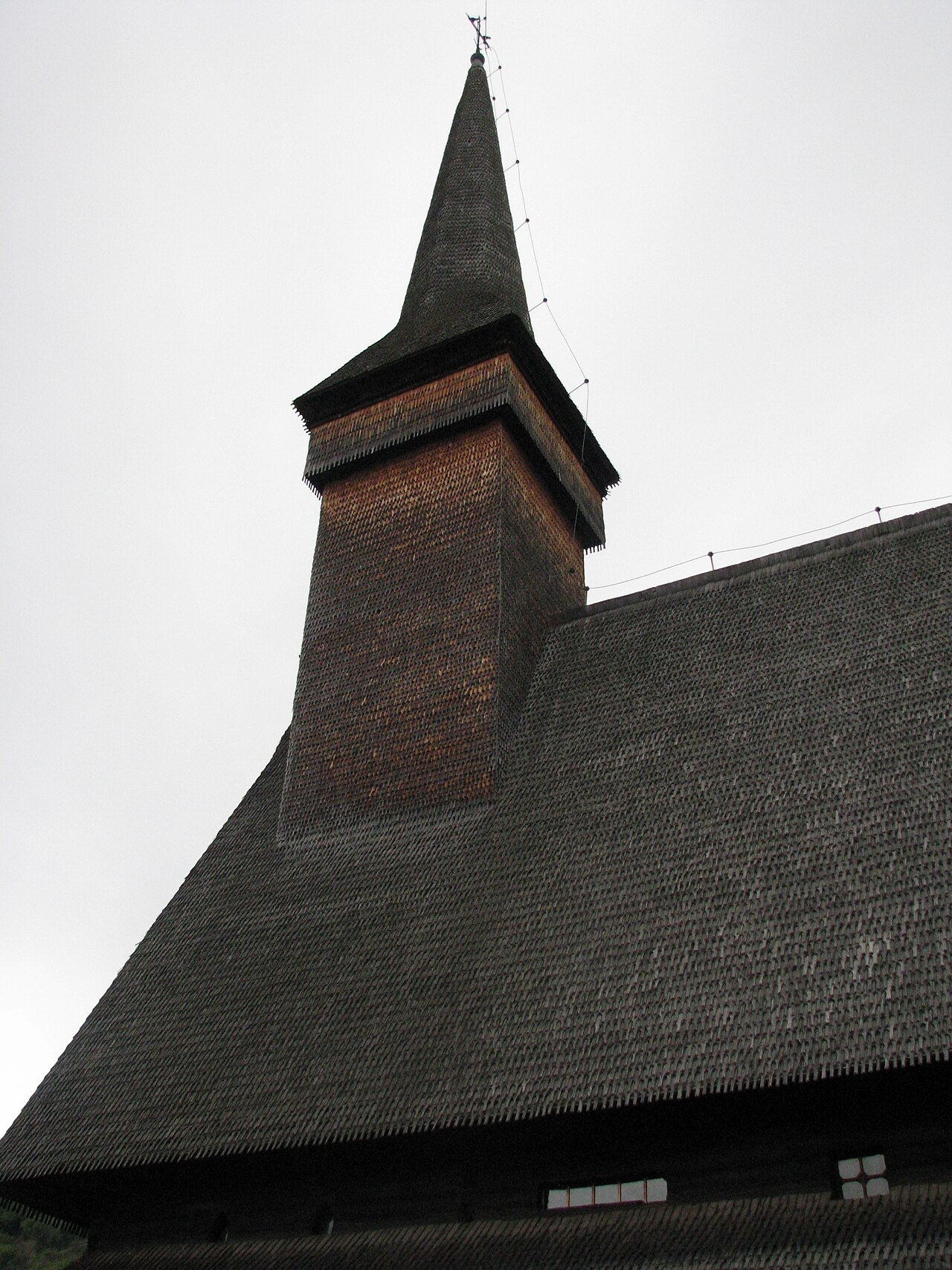
Eight Orthodox wooden churches in Maramureș County in northern Romania, inscribed on the UNESCO World Heritage List in 1999, represent one of the most distinctive achievements of vernacular religious architecture anywhere in Europe: blocky log-built naves topped with impossibly tall and slender Gothic spires that push upward through the timber-frame tradition of the Carpathian highlands. Built during the 17th and 18th centuries — with some foundations possibly reaching back to the 14th century — they were constructed without nails, relying entirely on traditional log-jointing techniques passed down within local carpenter communities. Šurdești’s tower reaches 54 metres; Ieud Deal may have the oldest foundations of the eight.
The Architecture: Log Walls, Gothic Spires and Byzantine Icons Northern Romania · Maramureș County
The Wooden Churches of Maramureș are a paradox in timber. The base of each church is a sturdy, low-set structure of horizontal oak logs fitted together without metal fixings, following a construction logic that emphasises horizontal compression, mass, and permanence. The walls are thick, the windows small, and the interior plan straightforward: a narthex, a nave, and a sanctuary separated by a painted iconostasis. Then, contradicting every visual expectation set by this horizontal solidity, a tower rises from the roof — narrow, vertically exaggerated, and pointed in a way that refers unmistakably to the Gothic spire tradition of Central European stone churches. The combination is not a compromise but a synthesis, and it was achieved by communities that had absorbed Gothic architectural influences from the Hungarian and Saxon traditions to the west while maintaining Byzantine Orthodox liturgical and iconographic practices inherited from the east.
The eight inscribed churches are distributed across villages in the valleys of the Iza, Mara, and Cosău rivers: Bârsana, Budești (two churches: Josani and Susani), Desești, Ieud (the Deal church), Plopiș, Poienile Izei, Rogoz, and Șurdești. Each has its own character. Șurdești, in the Cosău valley, is defined by its exceptional tower height of 54 metres, which makes it the tallest wooden church tower in Romania and one of the tallest wooden towers in the world. The tower’s proportions — extremely narrow relative to its height — create a sense of structural tension that is all the more striking given that the structure is built entirely of timber and has stood for three centuries without reinforcement. Ieud Deal, in the Iza valley, is the most historically significant: its foundations may date to the 14th century, and the church houses an iconostasis and interior frescoes of considerable quality. A 1391 manuscript known as the Ieud Codex — the oldest known text written in the Romanian language — was discovered here in the 19th century, though the document is now held in the Romanian Academy Library in Bucharest.
The interiors of these churches are their other great distinction. The wooden walls and ceilings were painted with fresco or tempera by local artists working within a vernacular adaptation of Byzantine iconographic conventions. The painting programmes include the standard Orthodox subjects — Christ Pantocrator in the dome, the Deesis, scenes from the life of the Virgin and the apostles — but executed in a visual language that is immediately recognisable as local rather than Byzantine metropolitan. Figures are elongated, gestures are expressive, and the colour palette tends toward strong contrasts of ochre, red, and blue-black. The quality varies considerably across the eight churches; Desești and Poienile Izei are generally considered to have the finest surviving interior painting.
The construction technique — horizontal log walls fitted at the corners using notched jointing, without metal nails or fasteners — is a pan-Carpathian tradition that also appears in secular buildings throughout Maramureș: farmhouses, granaries, and the famous carved wooden gates that mark the entrances of traditional properties. The UNESCO inscription was partly intended to recognise the continuity between the religious and secular dimensions of this building tradition, which remained locally active into the 20th century even as it disappeared almost everywhere else in Europe. The churches are not museum pieces: all eight remain active Orthodox parish churches, and several continue to hold regular services for their village communities.
Maramureș Folk Culture: the Merry Cemetery, Carved Gates and Living Traditions Maramureș · Iza and Cosău Valleys
Maramureș County is one of the few regions in Romania where traditional rural culture — architecture, craft, costume, ceremony, and music — has survived in sufficiently concentrated form to be experienced as something more than a tourism reconstruction. This survival is partly the result of the county’s geographic isolation: the Carpathian mountains to the south and the Ukrainian border to the north have historically limited the penetration of industrial and urban development that transformed other Romanian rural regions in the 19th and 20th centuries.
The village of Săpânța, near the border with Ukraine, is home to the Merry Cemetery (Cimitirul Vesel), which has no parallel in European folk art. Beginning in 1935, the local craftsman Stan Ioan Pătraș began carving and painting wooden grave markers in the form of tall crosses decorated with brightly coloured paintings and humorous verse epitaphs in the first person, written from the perspective of the deceased. The practice described the individual’s life, their personality, and sometimes the circumstances of their death with a directness and wit that is entirely at odds with the conventional gravity of funerary monuments. The tradition has been continued after Pătraș’s death in 1977 by his apprentice Dumitru Pop and subsequently by Pop’s successors, and the cemetery now contains several hundred of these markers, the older ones showing the effects of weather and age while new markers continue to be added. The Merry Cemetery is not UNESCO-inscribed, but it is among the most visited heritage attractions in Romania and is typically included in any Maramureș heritage circuit.
The carved wooden gates of Maramureș are another expression of the same carpentry tradition that produced the churches. The gates — tall, elaborately carved structures at the entrances to traditional farmyards — are decorated with geometric and solar motifs, rope patterns, and figurative elements that follow iconographic conventions specific to Maramureș. Their scale and the density of their carving make them major folk art achievements. The village of Budești, which contains two of the inscribed wooden churches, is also well known for its traditional gate architecture. Active workshops producing both new gates and restored panels exist in several villages, and it is possible to meet craftspeople working in the tradition.
The folk culture of Maramureș extends into costume, music, and ceremony. The Sunday market in Ocna Șugatag and the various village fairs held through the spring and summer months are occasions when traditional costumes — particularly the elaborately embroidered women’s blouses and the sheepskin coats worn by older men — are still worn by participants rather than performers. The horse-drawn cart remains a functional vehicle in parts of the county. This is not theatre; it is the result of an economy and social structure that changed more slowly here than elsewhere.
Across the border with Ukraine, the closely related Wooden Tserkvas of the Carpathian Region form a transnational UNESCO serial site inscribed jointly with Poland in 2013, covering wooden Greek Catholic and Orthodox churches in the Carpathian foothills. Several of these Ukrainian churches are close to the Romanian border and can be visited as part of a cross-border Carpathian heritage circuit, subject to current border crossing arrangements and travel advisories regarding the conflict in Ukraine.
Two hundred kilometres to the south, the Historic Centre of Sighișoara — a medieval Saxon citadel town in Transylvania — is the nearest Romanian UNESCO World Heritage Site to Maramureș, inscribed in 1999 in the same cycle as the wooden churches. The Painted Monasteries of northern Moldavia (Voroneț, Sucevița, Moldovița, and others), inscribed in 1993 and 2010 as two related serial properties, lie approximately 150–200 kilometres east and represent another extraordinary tradition of exterior religious painting, this time on 15th and 16th-century stone and brick Orthodox churches.
Practical information
Maramureș County is in the far north of Romania, bordering Ukraine. The county seat, Baia Mare, has an airport with domestic flights to Bucharest and some seasonal connections. Alternatively, Baia Mare and the county can be reached by train from Cluj-Napoca (approximately 2.5 hours) or by long-distance services from Bucharest (approximately 9–10 hours). The eight inscribed wooden churches are distributed across valleys that require a car to visit efficiently: no single bus route connects them all. Car hire from Baia Mare or Sighetu Marmației is the standard approach. The distances between churches are not large — most of the Iza valley churches are within 40–50 kilometres of each other — but the roads in the valleys are narrow and slow.
Most of the churches are kept locked outside of service times; each village typically has a key-holder (usually a local woman designated as caretaker) who can be found by asking at the nearest houses. A small donation is expected and appropriate. Services are held on Sundays and religious holidays. Visiting during a Sunday morning service is possible and welcomed in most villages, but requires respectful behaviour and appropriate dress. The best season for Maramureș is late spring (May–June) for the landscape and wildflower meadows, or early autumn (September) for harvest festivals and clearer light. Accommodation ranges from agro-tourism guesthouses in individual villages — the standard and recommended choice for experiencing local hospitality and food — to hotels in Sighetu Marmației and Baia Mare.
Frequently Asked Questions
How were the wooden churches built without nails?
The construction technique used in the Maramureș wooden churches is a form of log jointing that relies on precisely cut notches and slots at the corners and junctions of structural members, which lock the logs together through compressive and mechanical forces rather than metal fasteners. The most common method is a form of corner notching in which the logs are shaped at their ends so that they interlock at right angles; the weight of the structure above presses the joints together and prevents lateral movement. The technique is related to construction methods found throughout the Carpathian region and into Scandinavia, Russia, and North America wherever timber was the primary building material and blacksmithed nails were expensive or unavailable. In Maramureș, the specific forms of the notches and the proportioning of structural members were part of the tacit knowledge of local carpenter guilds passed from master to apprentice over generations. The towers, which are the most technically demanding element, were built using a system of internal timber framing that transfers loads from the upper spire sections down through the main structure to the ground. The Șurdești tower, which rises 54 metres, represents the outer limit of what this technique could achieve: the tower has required restoration and stabilisation work in recent decades because the accumulated movement and stress in the timber structure over three centuries has tested the joints near their engineering limits.
What is the Ieud Codex and why does it matter?
The Ieud Codex (Codicele de la Ieud) is a manuscript discovered in the loft of the wooden church at Ieud in Maramureș in 1921. Dating to around 1391–1392, it is the oldest known text written in the Romanian language. The codex is a collection of religious texts — including portions of a church calendar, texts related to liturgical practice, and other devotional material — translated from Church Slavonic into Romanian. Its importance lies not in its content, which is relatively straightforward religious writing, but in its linguistic evidence: it demonstrates that Romanian was already being used as a written language for religious and practical purposes by the late 14th century, earlier than had previously been documented. Transylvania and Maramureș appear to have been the region where the earliest shift from Church Slavonic to Romanian as a written religious language occurred, probably because the Orthodox communities there were in sustained contact with both Latin-script Hungarian culture and Cyrillic-script Orthodox tradition and found Romanian a pragmatic middle path. The codex is now held in the collections of the Romanian Academy Library in Bucharest; the church at Ieud has a reproduction on display. The discovery of the manuscript in this specific church reinforced the historical significance of Ieud Deal as a site of unusual cultural depth even within the already-significant Maramureș wooden church tradition.
Are any of the Maramureș wooden churches accessible to visitors with mobility limitations?
Access to the interiors and surroundings of the Maramureș wooden churches varies significantly and is not systematically adapted for visitors with mobility limitations. Most churches stand in traditional churchyards with uneven ground — grass, compacted earth, and stone path surfaces — that can be challenging for wheeled mobility aids or for visitors with significant walking difficulties. The church buildings themselves typically have one or two steps at the entrance threshold, and the interior floor is at the same level as the ground once the threshold is passed; the interior spaces are compact but not obstructed. None of the eight inscribed churches has installed ramps or systematic accessibility adaptations, and the conservation requirements of the structures make future modifications uncertain. The surrounding landscape — the valleys of the Iza, Mara, and Cosău rivers — is relatively flat and accessible by car along the valley roads, so the road-level view of the exterior of most churches is achievable without significant walking. The Merry Cemetery at Săpânța is also at ground level and accessible without significant walking for most visitors. Visitors with specific needs should contact local tourism offices in Sighetu Marmației or Baia Mare in advance for the most current information on access conditions at individual sites.