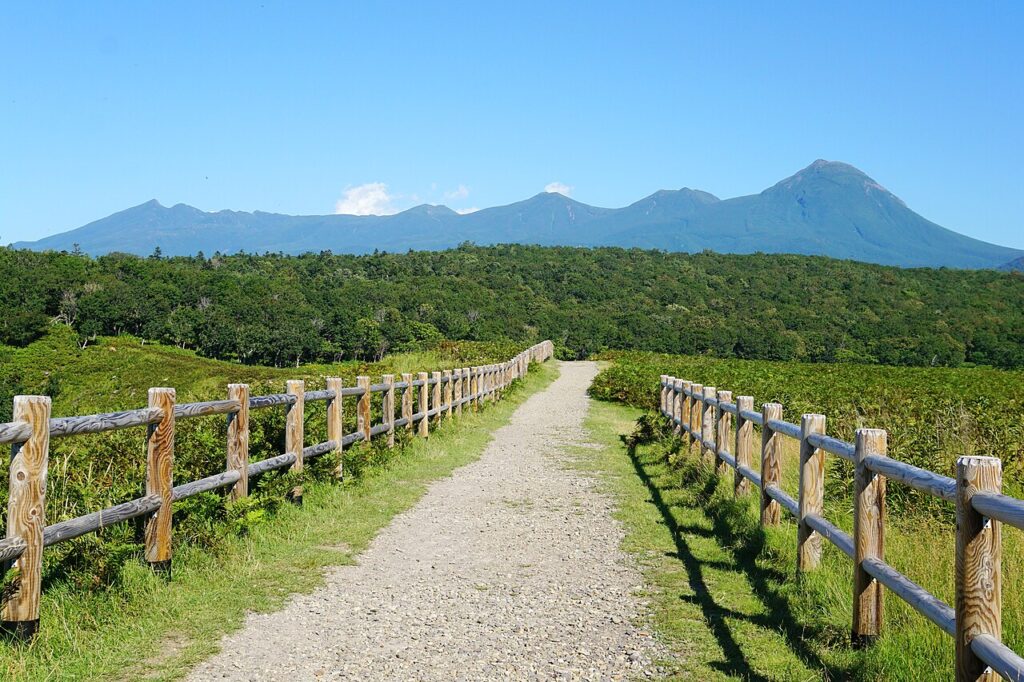
The World Heritage sites nearest to Shiretoko are the Jomon Prehistoric Sites in Northern Japan, 288 km away as the crow flies, followed by Shirakami-Sanchi at 557 km and the Sites of Japan’s Meiji Industrial Revolution at 583 km. Shiretoko itself is a natural property on the north-eastern peninsula of Hokkaido, inscribed in 2005 for the extraordinary interaction between its marine and terrestrial ecosystems.
The World Heritage sites within reach of Shiretoko
The distances below are straight lines between the reference points that UNESCO publishes for each property. They tell you what is close. They do not tell you how long the road takes, which depends on the season and the route.
| Site | Country | Distance | Inscribed | Type |
|---|---|---|---|---|
| Jomon Prehistoric Sites in Northern Japan | Japan | 288 km | 2021 | Cultural |
| Shirakami-Sanchi | Japan | 557 km | 1993 | Natural |
| Sites of Japan’s Meiji Industrial Revolution: Iron and Steel, Shipbuilding and Coal Mining | Japan | 583 km | 2015 | Cultural |
Read together, the three nearest sites frame two very different relationships between people and the Japanese archipelago. The Jomon Prehistoric Sites record a sedentary hunter-fisher-gatherer society that developed from about 13,000 BCE in the southern part of Hokkaido and northern Tohoku. Shiretoko, by contrast, is a landscape where a similar reliance on wild resources — salmon, marine mammals, forest plants — has continued into the present under modern protection. Shirakami-Sanchi preserves the last virgin beech forest of northern Honshu, another ecosystem sustained by cold northern conditions, while the Meiji Industrial Revolution sites mark the moment when Japan began to convert natural resources into heavy industry.
Sea ice at the lowest latitude in the northern hemisphere
Shiretoko is one of the richest integrated ecosystems in the world, according to UNESCO. The property encompasses a part of the peninsula that protrudes into the Sea of Okhotsk and the surrounding marine area. The key feature is seasonal sea ice that forms further south than anywhere else in the northern hemisphere, and appears earlier here than in other places where sea ice occurs. When that ice melts, it supplies the nutrients that trigger blooms of phytoplankton in early spring. Those blooms are the primary production that underpins the whole marine ecosystem, from krill and small fish up to salmon, seals and cetaceans.
The same chain crosses the shoreline. Salmonid species swim upstream to spawn and become food for terrestrial predators including the brown bear and Blakiston’s fish owl. UNESCO records that the brown bear population density on the peninsula is among the highest measured anywhere. The bear is the most visible symbol of Shiretoko’s food web, but the site also supports endangered and endemic species such as the plant Viola kitamiana and the Blakiston’s fish owl itself.
Criterion (x): threatened species and the southernmost Dolly Varden
Shiretoko was inscribed under criteria (ix) and (x). The second criterion reflects the property’s importance for a number of marine and terrestrial species. The watersheds on the peninsula are the furthest south place on Earth where the Dolly Varden still makes its run from the sea. The site also supports several Pacific salmonid species, including white spotted charr, masu salmon, chum salmon and pink salmon. In the surrounding waters there are seasonal populations of sea lions, spotted seals, killer whales, minke whales, sperm whales, Dall’s porpoise and the endangered fin whale.
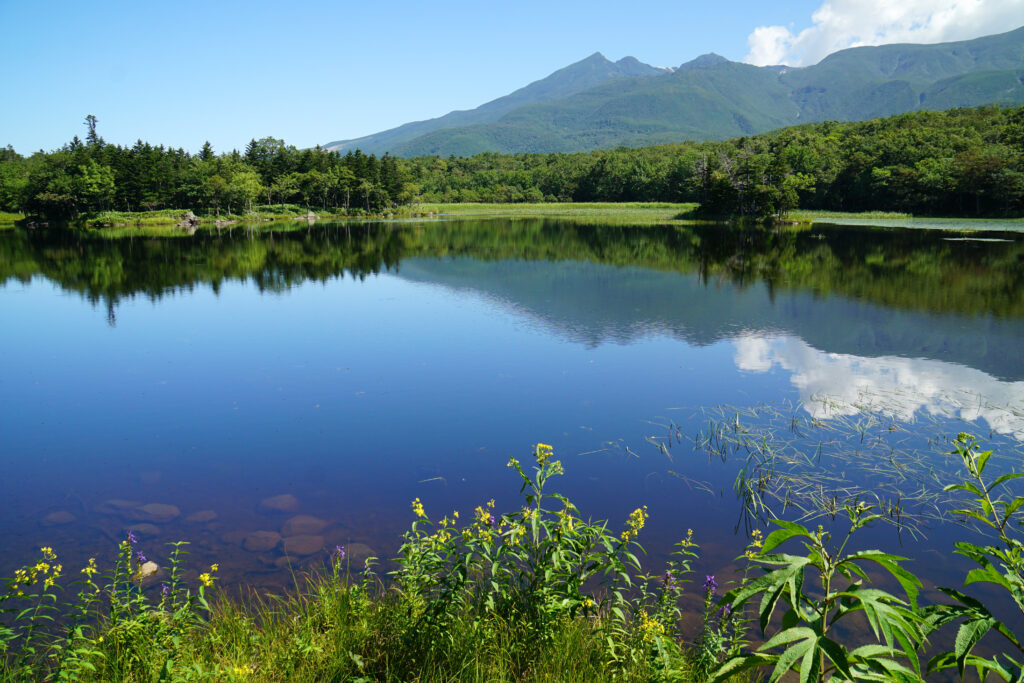
The terrestrial ecosystem combines northern species from the continent with southern species from Honshu. The result is a range of animal species that includes globally threatened seabirds and a globally important area for migratory birds. UNESCO notes that the property is significant as a habitat for these bird populations, and that the Steller’s sea eagle and white-tailed eagle are among the rare species legally protected as National Endangered Species of Wild Fauna and Flora.
Management, tourism and the Shiretoko Goko Lakes
The property is safeguarded by a layered system of Japanese legal instruments. Four national laws provide the backbone: one on nature conservation from 1972, one on natural parks from 1957, one on the administration and management of national forests from 1951, and one on the conservation of endangered wild fauna and flora from 1992. Most of the terrestrial area lies within the national forest owned and managed by the national government. Responsibility for the different protected zones is shared between the national environment ministry, the national forestry agency, the national cultural affairs agency and the Hokkaido prefectural government, all working under a single management plan written for the World Heritage site.
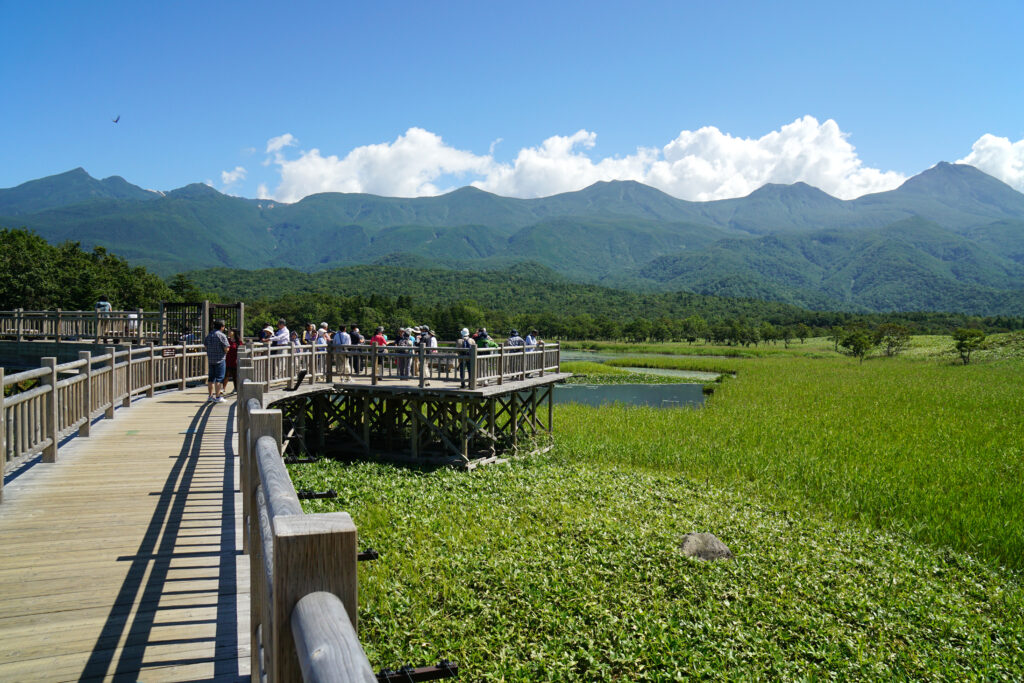
The Goko Lakes are a symbolic scenic spot within the property. The official site managed by the Ministry of the Environment describes five small lakes amid primeval forest backed by the Shiretoko mountain range, with an elevated wooden path and a ground pathway. Visitor access is one of the issues the management plan addresses. UNESCO notes that tourism is an increasingly important issue, with large numbers of visitors in summer and increasing numbers in winter to view the sea ice. A consolidated ecotourism strategy is required to balance those numbers against the protection of natural values.
Frequently Asked Questions
Which UNESCO World Heritage sites are near Shiretoko?
The nearest is the Jomon Prehistoric Sites in Northern Japan, 288 km away. Shirakami-Sanchi is 557 km away and the Sites of Japan’s Meiji Industrial Revolution are 583 km away. All distances are straight lines between UNESCO reference points.
When was Shiretoko inscribed as a World Heritage site?
Shiretoko was inscribed on the World Heritage List in 2005 as a natural property. It was listed under criteria (ix) and (x) for the interaction of marine and terrestrial ecosystems and for its importance to threatened and endemic species.
Why does sea ice matter to Shiretoko?
Seasonal sea ice forms further south than anywhere else in the northern hemisphere and its melting supplies nutrients that produce spring phytoplankton blooms. Those blooms form the base of a food web that extends from the ocean, through salmon runs, to brown bears and owls on land.
Can visitors see the Shiretoko Goko Lakes?
Yes. The Shiretoko Goko Lakes are accessed by an elevated wooden path and a ground pathway. The ground pathway has different visitation rules by season, while the elevated path provides free year-round access. The Ministry of the Environment manages both routes.
Sources
- UNESCO World Heritage Centre — Shiretoko (inscribed 2005). https://whc.unesco.org/en/list/1193/
- UNESCO World Heritage Centre — Jomon Prehistoric Sites in Northern Japan (inscribed 2021). https://whc.unesco.org/en/list/1632/
- UNESCO World Heritage Centre — Shirakami-Sanchi (inscribed 1993). https://whc.unesco.org/en/list/663/
- UNESCO World Heritage Centre — Sites of Japan’s Meiji Industrial Revolution: Iron and Steel, Shipbuilding and Coal Mining (inscribed 2015). https://whc.unesco.org/en/list/1484/
- Ministry of the Environment, Government of Japan — Shiretoko Goko Lakes. https://www.goko.go.jp/multilingual_eng/index.html
- World Natural Heritage in Japan — Shiretoko. https://world-natural-heritage.jp/en/shiretoko/
Spotted an error? Write to [email protected] and we correct it the same day.