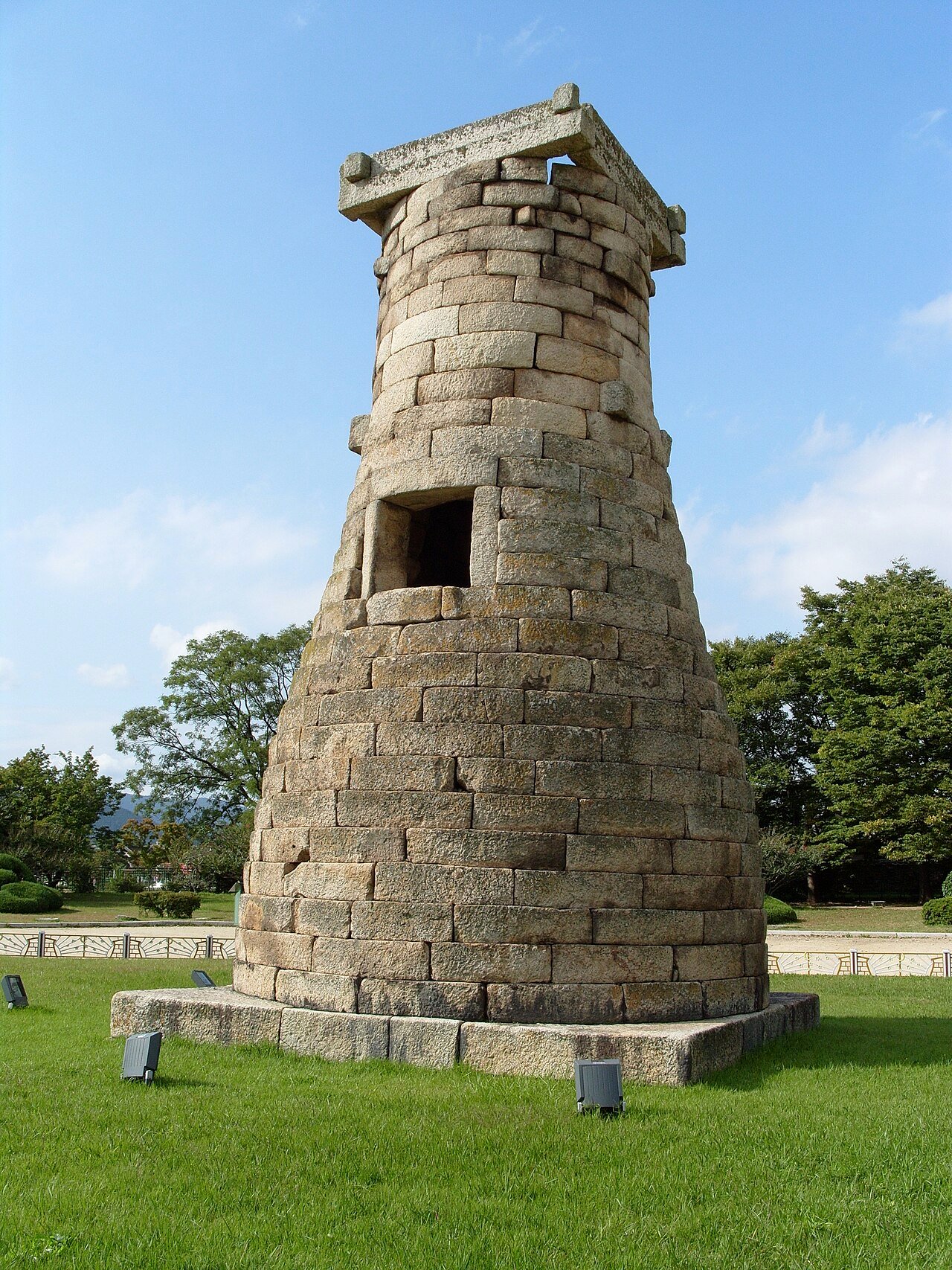
Gyeongju served as the royal capital of the Silla Kingdom for nearly a thousand years and remains one of the most archaeologically dense cities in Asia. The UNESCO inscription covers five separate protected districts spreading across the modern city and the sacred mountain to its south, earning the designation “museum without walls.” Tumuli, temple foundations, carved Buddhas and a bottle-shaped stone observatory built by a 7th-century queen all coexist within walking or short cycling distance of each other.
The Silla Kingdom and its capital city North Gyeongsang Province, southeastern Korea
The Silla Kingdom was founded, according to traditional accounts, in 57 BCE and endured until 935 CE — a span of nearly a millennium that makes it one of the longest-lasting dynasties in recorded history. For most of that period, Gyeongju (then known as Seorabeol) functioned as the political and ceremonial heart of the realm. In 668 CE, Silla forces, allied with Tang China, defeated the rival kingdoms of Koguryo and Baekje, unifying the Korean peninsula for the first time. The resulting Unified Silla period (668–935 CE) is regarded as the golden age of Korean Buddhist art and architecture: royal patronage funded temples, pagodas, bronze bells and illuminated manuscripts of extraordinary quality, many of which survive in Gyeongju’s museums and on its hillsides.
The UNESCO inscription, granted in 2000, identifies five districts. The Namsan District protects the sacred mountain south of the city, whose granite ravines and cliff faces bear over 150 rock-cut Buddhas, stupas and relief carvings — an open-air gallery accumulated over five centuries of Silla devotion. The Wolseong District encompasses the old palace quarter, including Anapji Pond (officially renamed Donggung Palace and Wolji Pond), a reconstructed royal garden with two pavilions and a stone retaining wall whose reflection in the dark water at dusk has become one of the iconic images of Korean heritage tourism. The Daereungwon District is the location of Tumuli Park, a 440,000 m² parkland containing 23 royal burial mounds. The largest, Hwangnamdaechong, rises to 22 metres and conceals two adjacent chambers, one of which yielded a gold crown of exceptional workmanship now displayed in the National Museum of Gyeongju.
The Hwangnyongsa District marks the former site of the great wooden temple complex founded in 553 CE by King Jinheung and expanded over a century. Its nine-storey wooden pagoda, completed in 645 CE, stood approximately 80 metres tall — the tallest wooden structure in East Asian history at the time — until the Mongol invasion of 1238 CE reduced it to ash. Only foundation stones remain, but archaeological excavations have recovered thousands of objects including bronze bells, gilt-bronze ornaments and ceramic roof tiles stamped with lotus patterns. The Sanseong District preserves Namsan Fortress, a mountain stronghold whose stone walls follow the natural ridgeline for several kilometres.
Throughout the modern city, the density of protected sites creates an experience unlike any other urban heritage destination in Korea. Burial mounds rise from residential neighbourhoods. The ruins of Wolseong Palace occupy a wooded hill near a busy road. This layering of the ancient and the contemporary is precisely what the “museum without walls” phrase captures — there is no perimeter fence, no single entry gate, no ticket booth separating the visitor from the Silla past.
Cheomseongdae, Bulguksa and Seokguram Within the city and 16 km to the east
Three structures in and around Gyeongju represent the peak of Silla scientific and artistic ambition. Cheomseongdae Observatory, built around 632 CE under the patronage of Queen Seondeok, is the oldest surviving astronomical observatory in East Asia. The structure is a bottle-shaped granite tower 9.4 metres tall, with a base diameter of 5.7 metres tapering to a square top platform. The body incorporates exactly 365 stones, corresponding to the days of the solar year, and the 12 layers of the foundation may represent the months. Silla astronomers observed celestial phenomena from this tower — not with optical instruments, which did not yet exist, but by naked-eye measurement of star positions and shadow lengths. The building survived because its proportions are perfectly self-buttressing: the rounded form distributes lateral stress outward and downward rather than concentrating it at the base.
Sixteen kilometres east of the city, on the wooded lower slopes of Tohamsan mountain, stands Bulguksa Temple. Founded in 528 CE and comprehensively rebuilt in 751 CE under the Buddhist court official Kim Daeseong, the temple complex is considered the finest surviving example of Unified Silla architecture. The approach is defined by two extraordinary stone staircases — the Cheongungyo and Baegungyo (Blue Cloud and White Cloud bridges) and the Yeonhwagyo and Chilbogyo (Lotus Flower and Seven Treasure bridges) — each representing the ascent from the secular world to the Pure Land of Buddhist paradise. These staircases are strictly decorative today; visitors climb by lateral paths. The central courtyard contains two stone pagodas that together form one of the most studied pairs in Korean art history: the Seokgatap (the pagoda of Sakyamuni Buddha), which is austere and geometric, and the Dabotap (the pagoda of the Treasure Buddha), which is exuberantly complex with its square base, octagonal middle section and round upper structure. A cache of artefacts found inside the Seokgatap in 1966 during restoration included the world’s oldest extant woodblock-printed document.
Four hundred metres above Bulguksa, the Seokguram Grotto was constructed simultaneously with the temple by the same architect Kim Daeseong. The grotto is a man-made granite cave containing a 3.5-metre seated Buddha of extraordinary geometric precision. The dome was constructed without mortar using carefully calculated stone courses, and the positioning of the main figure relative to the entrance, the surrounding bodhisattva reliefs and the opening at the rear creates specific lighting effects at sunrise on the spring equinox. Both Bulguksa and Seokguram received their own separate UNESCO inscription in 1995 (as part of a dual designation with the Gyeongju Historic Areas inscription of 2000), underlining the exceptional quality of these two structures within an already exceptional city.
Practical information
Gyeongju is 370 kilometres southeast of Seoul. The fastest connection is by KTX train from Seoul Station to Singyeongju Station, taking approximately two hours; a local bus or taxi then covers the 11 kilometres into the city centre. Alternatively, the KTX route via Dongdaegu and a transfer to a local train reaches Gyeongju Station (in the heart of the old city) in about two hours forty minutes. From Busan, Gyeongju is one hour by intercity bus or local train.
The best time to visit is spring (late March to early May, when cherry blossoms line the tumuli in Tumuli Park) or autumn (October to early November, when the foliage around Namsan and Bulguksa turns red and gold). Summer is warm and occasionally rainy; winter is cold but uncrowded. Cheomseongdae and the Tumuli Park mounds are outdoors and free to enter. Bulguksa and Seokguram charge modest entry fees (approximately 6,000 KRW and 5,000 KRW respectively as of recent years; confirm locally). The National Museum of Gyeongju, which houses the finest objects from the burial mounds, is free and an essential complement to any site visit. A bicycle is the ideal way to move between the dispersed districts within the city — rental shops are abundant near the station. Allow at least two full days to cover the main sites without rushing.
Frequently Asked Questions
What makes the Gyeongju Historic Areas different from other UNESCO sites in Korea?
Korea has a relatively small number of UNESCO World Heritage Sites, but Gyeongju is unusual even by international standards because the inscription covers an entire urban area rather than a single monument or bounded complex. Most heritage sites present the visitor with a discrete object — a palace, a temple, a fortress — that can be experienced in a single visit. Gyeongju instead distributes its significance across five geographically separate districts spread over the modern city and its surrounding hills. The Namsan District alone contains over 150 individual Buddhist carvings on cliff faces and boulders across a mountain that requires half a day to traverse properly. The burial mounds of the Daereungwon District sit in a suburban park surrounded by apartment buildings. Cheomseongdae stands in a field a short walk from a commercial street. This dispersal is not a disadvantage but a defining characteristic: it means that the history of the Silla Kingdom is woven into the fabric of a living city rather than preserved behind barriers in a dedicated heritage zone. The practical consequence for visitors is that exploring Gyeongju requires more planning and more physical movement than most other sites — but it also rewards that effort with a sense of genuine immersion in a city that has been continuously inhabited for over two thousand years.
Who was Queen Seondeok, and why did she commission the Cheomseongdae Observatory?
Queen Seondeok (reigned 632–647 CE) was the first woman to rule as sovereign of any of the Korean Three Kingdoms — a distinction that makes her commissioning of Cheomseongdae all the more significant. She came to power at a moment when Silla was under constant military pressure from Baekje and Koguryo, and she responded by pursuing a vigorous program of Buddhist patronage and cultural development intended to consolidate her legitimacy both domestically and in the eyes of the Tang Chinese court. Astronomical observation had both practical and ideological dimensions in 7th-century East Asia: it was used to fix the calendar (essential for agriculture and ritual), to generate astronomical almanacs that informed statecraft, and to interpret celestial omens that bore on the ruler’s mandate. Owning a permanent stone observatory was therefore a statement of royal seriousness. Seondeok is also credited with commissioning the nine-storey wooden pagoda at Hwangnyongsa Temple and with sending scholars to Tang China to study Buddhism and statecraft. She is revered in Korean historical memory as one of the great rulers of the Silla period, and a crater on Venus has been named in her honour by the International Astronomical Union.
Is it possible to see the interiors of the Silla royal burial mounds?
One burial mound in Tumuli Park — Cheonmachong (the “Heavenly Horse Tomb”) — has been opened to the public after excavation. Visitors can walk through the reconstructed burial chamber and examine replicas of the objects found inside, including a birch-bark painting of a galloping horse (the only surviving Silla painting) that gave the tomb its name. The originals are in the National Museum of Gyeongju. The other mounds in the park remain sealed. The largest, Hwangnamdaechong, was excavated by tunnel in the 1970s without opening the mound itself, recovering some 30,000 artefacts including the queen’s gold crown and a glass vessel imported from Sassanid Persia — evidence of Silla’s connections to the Silk Road trading network. The approach of tunnelling rather than opening the mounds reflects both conservation priorities and the practical difficulty of stabilising chamber walls once exposed to air. Archaeological understanding of the mounds continues to develop through non-invasive scanning and targeted small excavations. For visitors, the combination of Cheonmachong’s interior chamber, the museum’s collections and the parkland setting of the remaining mounds gives a comprehensive picture of Silla burial culture without requiring access to protected chambers.
Sources
- S1 — Lee, Ki-baik. A New History of Korea. Harvard University Press, 1984. ISBN 978-0-674-61576-2.
- S2 — Nelson, Sarah Milledge. The Archaeology of Korea. Cambridge University Press, 1993. ISBN 978-0-521-40783-0.
Spotted an error? Write to editorial@culturalheritageonline.com and we correct it the same day.