Göbekli Tepe, inscribed on the UNESCO World Heritage List in 2018, is a Neolithic sanctuary in southeastern Turkey that has fundamentally changed the way scholars understand the origins of human civilisation. Built around 9600 BCE by hunter-gatherers who had not yet developed pottery or farming, its massive carved limestone pillars predate Stonehenge by more than 6,000 years and stand as the oldest known monumental stone structures in the world. The site overturns the long-held assumption that organised religion and monumental architecture were products of settled agricultural societies — here, the ritual complex came first.
The Pillars and Their Symbols Şanlıurfa Province, southeastern Turkey, 760 m altitude
Göbekli Tepe sits on a bare limestone ridge in the Germuş mountain range, roughly 15 kilometres northeast of the city of Şanlıurfa. The name means “Potbelly Hill” in Turkish, a reference to the rounded summit that concealed one of the most consequential archaeological discoveries of the twentieth century. German archaeologist Klaus Schmidt, working with the German Archaeological Institute, recognised the site’s significance in 1994 and led excavations here every season until his death in 2014; the work continues today under Turkish and international teams.
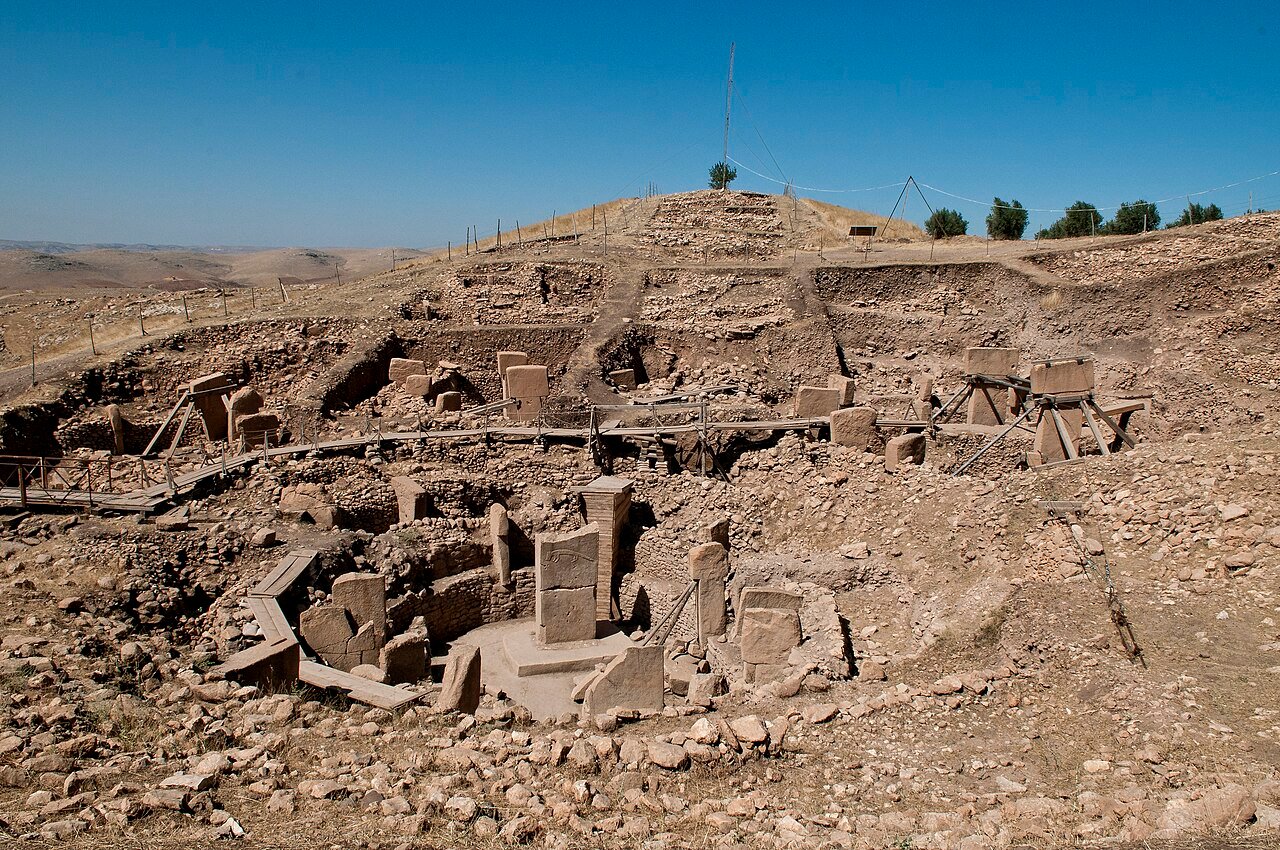
What Schmidt’s team found was a complex of circular enclosures — at least 20 mapped by geomagnetic survey, though only four (labelled Enclosures A, B, C and D) have been substantially excavated, representing approximately 5 percent of the total site. The enclosures range from 10 to 30 metres in diameter and are defined by dry-stone walls into which pairs of T-shaped limestone monoliths are set as central features. These pillars can reach 5.5 metres in height and weigh up to 20 tonnes. They are carved in shallow bas-relief with an extraordinary menagerie of animals: foxes, snakes, vultures, wild boars, aurochs, gazelles, cranes, ducks and scorpions appear across multiple enclosures. Many pillars also carry an H-shaped motif interpreted as an anthropomorphic figure — a being with arms, hands and a loincloth whose head and body merge into the abstract T-form of the pillar itself, suggesting a possible deity or ancestral spirit.
The logistical achievement represented by the site is remarkable. The limestone blocks were quarried from bedrock outcrops approximately 300 metres away and transported and raised without draft animals or metal tools of any kind. An unfinished pillar still attached to the bedrock in the quarry provides direct evidence of the technique: flint and obsidian tools were used to detach the monolith from the living rock. Experimental archaeology suggests that organised groups of several hundred people, working with timber sledges and plant-fibre ropes, could move and erect the largest pillars — implying regular assemblies of multiple bands from across a wide region, drawn together by the sacred significance of the hilltop.
Around 8000 BCE, each completed enclosure at Göbekli Tepe was deliberately filled in with a mixture of limestone rubble, flint flakes, animal bones and earth, and new, progressively smaller enclosures were built on top. This systematic burial was clearly intentional rather than the result of abandonment. The most widely accepted interpretation is ritual retirement: the enclosures were ceremonially decommissioned and sealed once their cultic function was complete. The burial paradoxically preserved the lower portions of the site in exceptional condition, which is why the pillars and their carved reliefs survive today.
When Ritual Preceded the Plough 15 km northeast of Şanlıurfa city
Before Göbekli Tepe, the dominant model of prehistory held that the sequence ran in one direction: agriculture first, then surplus, then the social complexity and leisure necessary to build temples and develop organised religion. Göbekli Tepe was built more than a thousand years before the earliest evidence of plant cultivation in the surrounding region. Its builders were unambiguously mobile hunter-gatherers. The discovery forced a reassessment: the desire to maintain a communal ritual site may itself have provided the incentive to cultivate wild grains in the vicinity, producing agriculture as an emergent consequence of sacred obligation to a place.
The Şanlıurfa region sits at the heart of the Fertile Crescent, the arc of land in which wheat, barley, lentils and several other foundational crops were first domesticated. Wild emmer wheat, einkorn and wild barley all grew naturally here. Genetic studies of modern domesticated wheat have traced its origin to a region very close to Göbekli Tepe, though whether the connection is causal or coincidental remains an open question. What is not in question is that the same populations who built and maintained this sanctuary were the same populations among whom the agricultural revolution first took hold.
The symbolic programme carved into the pillars also repays close attention. Vultures and scorpions appear in positions that some researchers connect to mortuary practices — the deliberate exposure of the dead to birds, documented in later cultures across the region. Pillar 43 in Enclosure D, sometimes called the “Vulture Stone,” carries a composition that has been interpreted (controversially) as a record of a celestial event. Whatever the specific meaning of individual carvings, the builders were encoding persistent cultural information — cosmological, ritual or calendrical — into permanent stone. This is culture operating in a fully modern register, millennia before the first cities.
The nearby Şanlıurfa Museum, substantially redesigned and expanded in 2015, is an essential complement to the site. Its most important exhibit is the “Urfa Man,” a life-size limestone statue dating to approximately 10,000 BCE, found in the old city of Şanlıurfa in 1993 and recognised as the oldest known life-size anthropomorphic sculpture in the world. The figure clasps its hands over its lower abdomen, has no carved ears or mouth, and bears eyes made of polished obsidian — which would have caught and reflected light with startling effect when the statue was new and in use.
Practical information
Göbekli Tepe is open daily from approximately 08:00 to 17:00 in winter and 08:00 to 19:00 in summer; confirm current hours via the Turkish Ministry of Culture website before visiting, as they are subject to seasonal adjustment. Entry is charged at the standard rate for Turkish archaeological sites. The site is 15 kilometres northeast of central Şanlıurfa and most easily reached by taxi or organised tour; regular minibus connections are limited. A purpose-built visitor centre at the hilltop provides multilingual exhibits, a scale model of the enclosures and a short documentary. The main excavation area is covered by a large protective canopy and walkways allow close viewing without entering the dig zones. The landscape is semi-arid and fully exposed: summer temperatures regularly exceed 40°C, making early morning arrival strongly advisable from June to September. Bring water, sun protection and walking shoes. The Şanlıurfa Museum in the city is best visited either before or after the site; plan two to three hours there. Şanlıurfa is served by direct flights from Istanbul and Ankara and is approximately two hours by road from Gaziantep, which has its own outstanding mosaic museum with Roman floors from Zeugma.
Frequently Asked Questions
Why is Göbekli Tepe considered the most important archaeological discovery of the past century?
Before Göbekli Tepe was excavated and dated, the prevailing model of human prehistory described a clear sequence: hunter-gatherers first adopted farming, which led to settled communities, social hierarchy, surplus food and eventually the organisation necessary to build monumental architecture and develop religion. Göbekli Tepe, dated firmly to around 9600 BCE through radiocarbon analysis of organic material found in the fill layers, dismantled that model. Its builders were definitively pre-agricultural — the site predates the earliest evidence of farming in the surrounding Fertile Crescent region by at least a thousand years. Yet they organised large-scale communal labour, transported and raised multi-tonne limestone monoliths, and encoded complex symbolic programmes into carved reliefs. The implication is that religion, ritual and the desire to maintain a sacred gathering place may themselves have driven the development of agriculture, rather than being its product. This reversal of the presumed causal sequence has reshaped academic discussions across archaeology, anthropology and the study of religion, and continues to generate active scholarly debate about the pace of cultural evolution and the cognitive capacities of Palaeolithic and Neolithic Homo sapiens.
Who built Göbekli Tepe, and how did they move 20-tonne stones without metal tools?
The builders were anatomically and cognitively modern Homo sapiens living as mobile hunter-gatherers in the Fertile Crescent during the Pre-Pottery Neolithic A period, roughly 10,000 to 8800 BCE. They had no domesticated animals, no metal tools and no wheeled vehicles. The limestone pillars were quarried from natural bedrock outcrops about 300 metres from the site using flint and obsidian implements to detach the monolith from the living rock — an unfinished pillar still embedded in the quarry bedrock demonstrates this method directly. Once detached, the pillars were transported downhill using timber sledges, plant-fibre ropes and organised human labour. Experimental reconstructions by archaeologists and structural engineers suggest that organised groups of around 500 people working in coordinated teams could move and erect the largest pillars using these methods. This implies that the site served as a regular regional assembly point, drawing hundreds of individuals from multiple hunter-gatherer bands across a wide area. The collective labour of building and maintaining the sanctuary appears to have functioned simultaneously as a social bond, a religious obligation and a seasonal gathering that enabled exchange of mates, resources and information across the region.
What is known about the meaning of the animal carvings on the pillars?
The animal reliefs at Göbekli Tepe are the subject of intense and ongoing scholarly debate. The same species — foxes, snakes, vultures, wild boars, aurochs and scorpions — appear repeatedly across multiple enclosures, suggesting these animals carried consistent symbolic meaning rather than being chosen arbitrarily. Some researchers interpret the vulture imagery, which appears in prominent positions on several pillars, as connected to mortuary practices: in many ancient cultures of the region, the dead were exposed on platforms to be consumed by birds before the bones were collected and buried, and vultures would have been intimately associated with the transition between life and death. Scorpions and snakes may have carried similar associations with danger, the underworld or transformation. The H-shaped carvings on several central pillars, which appear to show arms, hands and a loincloth emerging from the T-form, are most widely interpreted as anthropomorphic figures — deities, ancestors or supernatural guardians of the enclosures. An important caution applies to all these interpretations: the builders of Göbekli Tepe left no written records, and the gap of more than ten thousand years between their world and ours makes any reading of symbolic intent speculative, however well-grounded in comparative religious anthropology.
Sources
- S1 — Schmidt, Klaus. Sie bauten die ersten Tempel: Das rätselhafte Heiligtum der Steinzeitjäger. C.H. Beck, 2006. ISBN 978-3-406-53500-0.
- S2 — Mithen, Steven. After the Ice: A Global Human History, 20,000-5000 BC. Harvard University Press, 2004. ISBN 978-0-674-01570-8.
Spotted an error? Write to editorial@culturalheritageonline.com and we correct it the same day.