
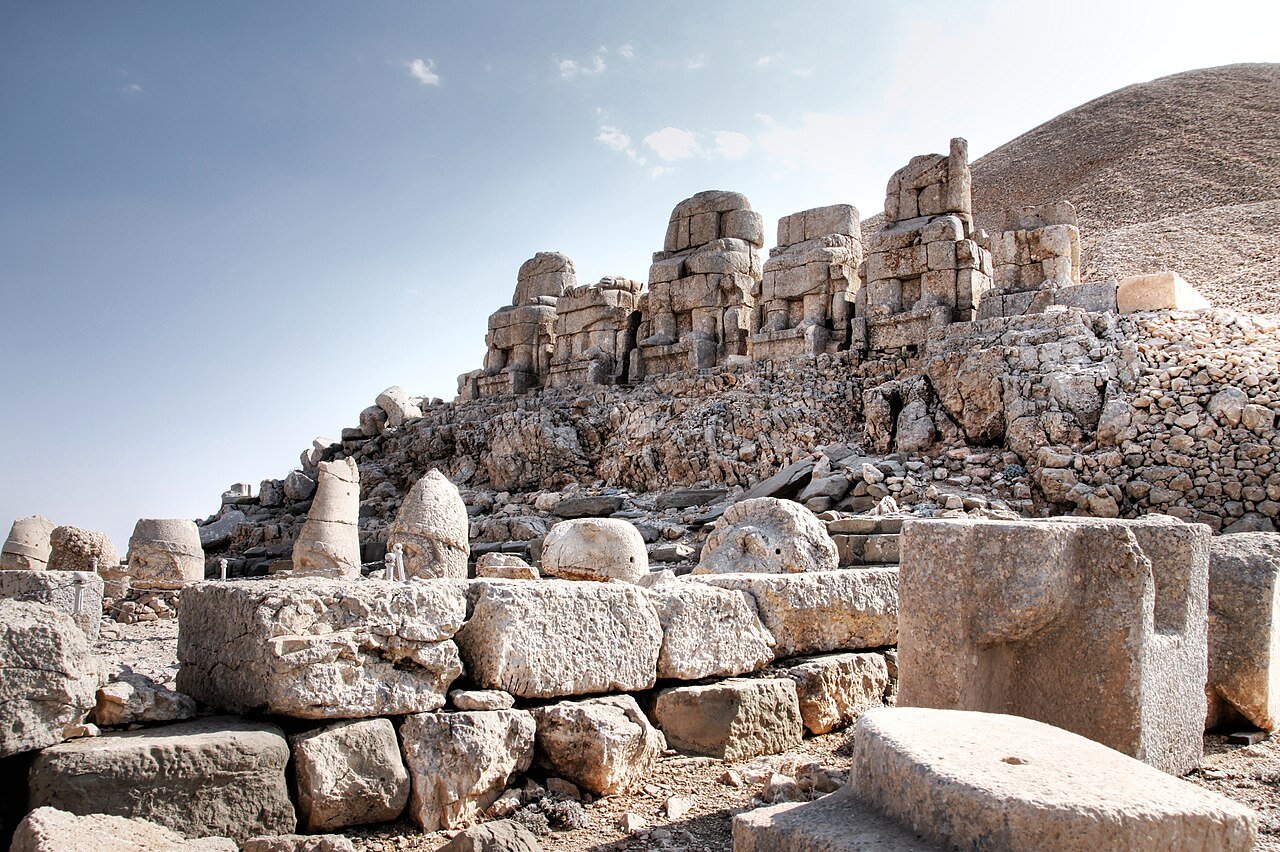
At 2,134 metres above sea level in southeastern Turkey, the summit of Mount Nemrut holds one of the strangest royal tombs ever built: a 50-metre artificial mound of crushed rock, flanked by two terraces where the colossal stone heads of gods and their royal companion have lain toppled since antiquity. King Antiochus I of Commagene erected the monument to himself in the first century BCE, blending Greek and Persian divine iconography into a theology that was entirely his own invention. UNESCO inscribed the site in 1987. The mountain is in Adıyaman Province, roughly 75 kilometres from Adıyaman city.
The Kingdom of Commagene and its extraordinary king Adıyaman Province · 75 km from Adıyaman city
Commagene occupied a strategic sliver of territory in the upper Euphrates region, bounded by the Taurus Mountains to the north and the Syrian lowlands to the south. It emerged as an independent kingdom around 163 BCE when the Seleucid Empire, heir to Alexander’s eastern conquests, began to fragment. The dynasty that ruled it was of mixed Macedonian-Persian origin — they claimed descent simultaneously from Alexander’s general Seleucus I and from the Persian Achaemenid royal line through Darius I. This double ancestry was not merely a dynastic boast; it shaped the unusual religious synthesis that Antiochus I (r. c. 69–36 BCE) made the ideological foundation of his reign.
Commagene was, in practical terms, a client kingdom balanced between two empires: Rome to the west and Parthia to the east. Antiochus I managed this position with considerable skill for more than three decades, and the construction of his funerary monument on the remote summit of Nemrut Dağ was one of the most ambitious assertions of royal prestige in the Hellenistic world. The location — an almost inaccessible peak — was presumably chosen because altitude implied proximity to the divine.
The monument consists of a conical tumulus of crushed rock, approximately 50 metres tall and 150 metres in diameter, created from stone quarried on site and broken into small pieces so that it could not be excavated easily. The burial chamber has never been found; despite several attempts using seismic surveying, archaeologists have not been able to locate a void within the mound. Whether Antiochus is actually buried there, or whether the chamber simply remains hidden by the density of the fill, is unknown.
On both the East and West Terraces that flank the tumulus, Antiochus arranged rows of colossal limestone statues — originally standing 8 to 9 metres tall — of himself seated among the gods he claimed as divine relatives. The syncretism on display is deliberate: Apollo is identified with Mithras (the Persian solar deity), Zeus with Oromasdes (the Zoroastrian supreme deity Ahura Mazda), and Heracles with Artagnes (the Armenian-Persian war god). Eagle and lion guardians stood at the ends of each row. The West Terrace also preserved a series of stone relief panels depicting the royal horoscope of Antiochus — a conjunction of Mars, Mercury, and Jupiter on 7 July 62 BCE, which may record his coronation date.
The fallen colossi and what remains today East Terrace best preserved · Accessible by minibus + final hike
Earthquakes, probably occurring over several centuries after the abandonment of the site, toppled all the statues. The bodies remain on their pedestals on the East Terrace — five torsos still standing in sequence, eroded but recognisable — while the heads have rolled forward and lie on the ground in front of them. This configuration, accidental as it is, has become one of the most recognisable archaeological images in the world: the row of enormous stone faces, some still wearing their elaborate headdresses (eagle-topped for the gods, tiara-shaped for Antiochus), staring up at visitors from ground level with an expression that reads, across two millennia, as a mixture of serenity and mild surprise at their own predicament.
The West Terrace is less well preserved but contains additional reliefs and inscriptions. The relief panels here include processional images of Antiochus shaking hands with each of the deities — a dexiosis scene that simultaneously expressed piety and claimed divine kinship. The long Greek inscriptions that accompany the monuments on both terraces are among the most extensive royal self-presentations from the Hellenistic period; Antiochus was clearly not a man who suffered from underconfidence. The texts describe the religious cult he established, the obligations of priests to maintain the sanctuary, and the theological basis for his identification of Greek and Persian gods.
The site was rediscovered by the German road engineer Karl Sester in 1881 while surveying routes through the Taurus region. The first systematic excavations were conducted by the German archaeologist Karl Humann and the Ottoman official Otto Puchstein in 1882–83. Modern archaeological work has continued intermittently since the 1950s, most extensively by the American Schools of Oriental Research.
The best time to visit Nemrut Dağ is at sunrise or sunset, when the low-angle light picks out the carved details of the stone heads and the summit mound glows amber against the sky. The experience at midday, with harsh overhead light and tourist groups arriving by the busload, is considerably less atmospheric. Many visitors drive to the carpark at about 2,000 metres and walk the final stretch to the summit on a well-maintained path.
Practical information
Nemrut Dağ is most conveniently approached from Adıyaman city, which has a domestic airport with connections to Istanbul and Ankara. From Adıyaman, minibuses run to Kahta (the closest town, 65 km from the summit), and from Kahta organised tours and taxis cover the final ascent road. The road is sealed to within a short walking distance of the summit carpark. Rental cars from Adıyaman or the larger city of Malatya (about 130 km away) allow the most flexibility.
The site is open year-round, but access to the summit road is subject to snow closure between roughly November and April. The best season is May through October. At 2,134 metres, the summit is significantly colder than the plains below; even in summer, bring a layer for sunrise visits. Entry to the national park requires a ticket, purchased at the gate on the ascent road.
The wider Nemrut Dağ National Park also includes the Karakuş tumulus (a smaller Commagenian royal burial with tall stone columns topped by eagles and bulls), the Roman bridge at Cendere (one of the best-preserved in the region, 2nd century CE), and the ancient city of Arsameia on the Nymphaios river, where large relief panels and inscriptions of the Commagenian royal family are carved into the cliff face alongside a cult tunnel descending into the bedrock.
Frequently Asked Questions
Who was Antiochus I of Commagene and why did he build this monument?
Antiochus I ruled the small kingdom of Commagene from approximately 69 to 36 BCE. The kingdom occupied a strategic position in the upper Euphrates valley, in what is now southeastern Turkey, and was politically balanced between the Roman Empire to the west and the Parthian Empire to the east. Antiochus claimed descent from both Alexander the Great’s general Seleucus I (on his father’s side) and from the Persian Achaemenid royal line through Darius I (on his mother’s side). He used this mixed ancestry as the foundation for a religious innovation: he identified Greek and Persian gods with each other and placed himself among them as a divine relative. The construction of his funerary monument on the summit of Nemrut Dağ — an 8–9 day journey from his capital Samosata on foot — was an assertion of prestige on a scale that far exceeded his kingdom’s actual size. The monument’s inscriptions make clear that Antiochus intended the site to serve as a permanent cult location, staffed by priests who would conduct regular ceremonies at the East and West Terraces. Whether this cult continued after his death is unknown; his successors maintained the dynasty until the Roman Emperor Vespasian dissolved Commagene as an independent kingdom in 72 CE.
Why are the heads of the statues on the ground?
The colossal statues at Nemrut Dağ were originally between 8 and 9 metres tall, placed on pedestals along the East and West Terraces. Earthquakes — the region sits in a seismically active zone — toppled the statues at some point after the site was abandoned, probably during the early medieval period. The heads, separated from the bodies by the fall, rolled forward off the pedestals and now lie on the terrace floors at ground level in front of the still-standing torsos. On the East Terrace, five torsos remain on their bases in relatively good condition; on the West Terrace the damage is more extensive. The heads retain considerable detail: the elaborate headdresses — eagle-topped for the divine figures, tiara-shaped for Antiochus — are still legible, and the facial features, despite centuries of exposure to Anatolian winters, are largely intact. The configuration is entirely accidental, but it has become the defining image of the site. The German engineer Karl Sester came upon this scene in 1881, reported it, and the first archaeological documentation followed in 1882–83 under Karl Humann and Otto Puchstein.
What is the syncretism on display at Nemrut Dağ?
The statues at Nemrut Dağ are not simply Greek gods or simply Persian gods: they are explicitly identified pairs, each combining a Greek deity with a Persian or Zoroastrian counterpart. The pairing inscribed on the monument identifies Apollo with Mithras (the Persian solar deity venerated across the Iranian world), Zeus with Oromasdes (the Zoroastrian supreme deity Ahura Mazda), and Heracles with Artagnes (an Armenian-Persian war god). Antiochus himself is seated among these paired deities as their equal and companion. This religious synthesis reflects the double cultural heritage Antiochus claimed: Macedonian-Greek through his Seleucid ancestry, and Persian through the Achaemenid line. The theological innovation went beyond simple equation of one god with another. Antiochus established a formal cult with calendrical festivals, priestly obligations, and a theology — laid out in the long Greek inscriptions on the terraces — in which he described himself as philhellene and philorhomaios (lover of the Greeks, lover of the Romans) while maintaining distinctly Persian royal ceremonial practices. The site is one of the clearest surviving examples of Hellenistic-period religious syncretism, and it predates the better-known Greek-Egyptian hybrid cults (Serapis, for instance) that became widespread across the Roman world.

.jpg)