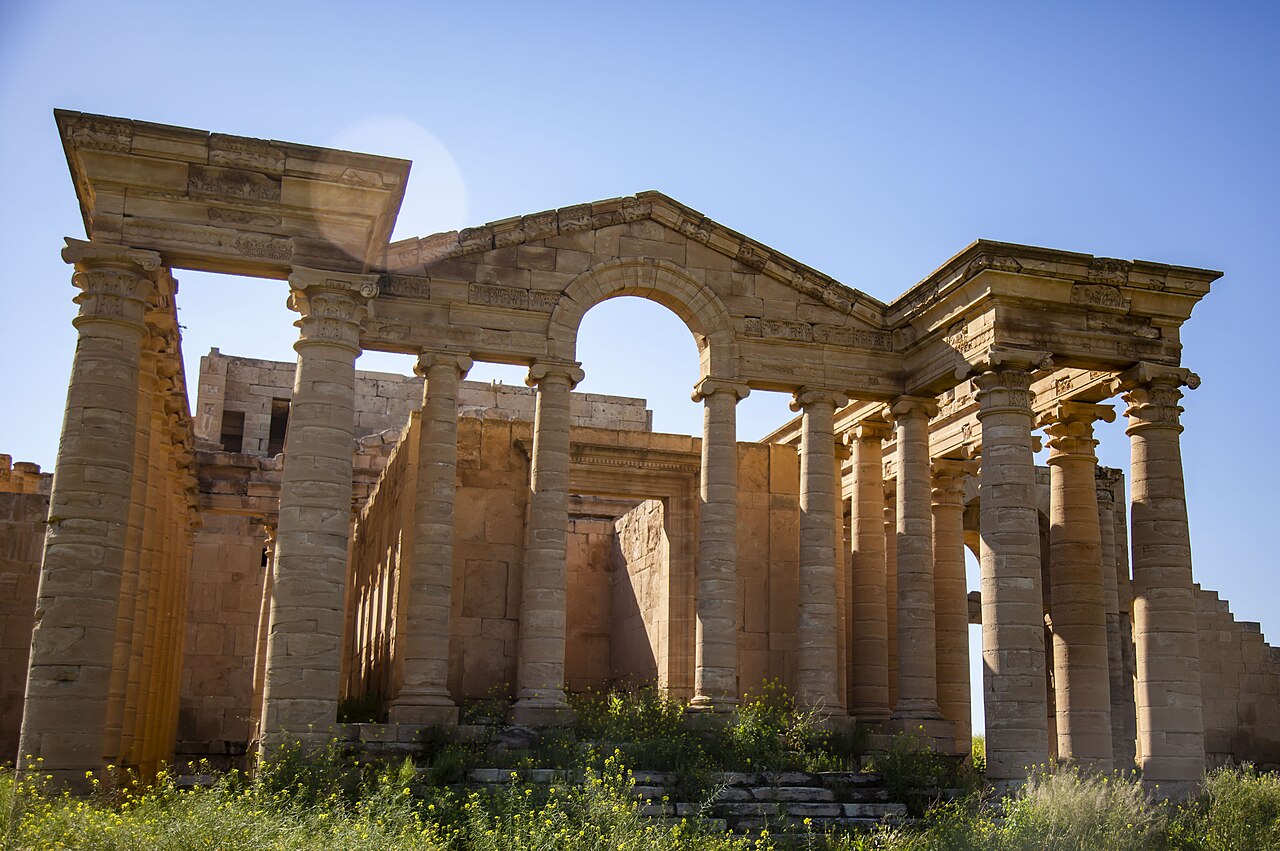
Hatra (Arabic: “الحضر”, “Al-Hadr” — the name’s origin is debated; one proposal derives it from the Aramaic “Hatran” meaning “the enclosure” or “the walled settlement”; another from an Old South Arabian deity name) inscribed by UNESCO in 1985, is a UNESCO World Heritage site recognising the ancient fortified city of Hatra in the northern Mesopotamian plain (approximately 290 km north of Baghdad and approximately 110 km southwest of Mosul in the Ninawa Governorate of Iraq) as the best-preserved example of a Parthian city (the Parthian Empire ruled the Iranian plateau and Mesopotamia approximately 247 BCE–224 CE) and as an outstanding example of the architectural and artistic synthesis unique to the cultural frontier zone between the Iranian (Parthian) world and the Greek-Roman world. Hatra flourished approximately 1st–3rd century CE as the capital of an autonomous Arab kingdom (the “Arabi” kings of Hatra — whose inscriptions in Aramaic and Greek identify them as ethnically Arab rulers who acknowledge the nominal suzerainty of the Parthian “King of Kings” while effectively governing independently) that controlled the desert caravan routes of the northern Syrian-Mesopotamian steppe. The city successfully defended itself against two Roman sieges (by the Emperor Trajan in approximately 116–117 CE and by the Emperor Septimius Severus in approximately 198–199 CE), demonstrating both the effectiveness of its circular fortification walls (approximately 2 km in diameter, with approximately 160 towers) and the political-military capacity of the Arab kingdom. The city fell approximately 241 CE to the Sassanid king Ardashir I (founder of the Sassanid dynasty, who considered the Parthian-affiliated kingdoms of northern Mesopotamia to be legitimate targets of his imperial consolidation) and was abandoned shortly after, allowing its remarkable buildings to survive relatively intact under the desert sands until modern archaeological excavation beginning in the 1950s CE. The site was severely damaged by the Islamic State (ISIS/ISIL) in approximately March 2015 CE, when IS fighters systematically destroyed many of the sculptures and reliefs and collapsed several of the great iwans — the most severe modern damage to a major UNESCO World Heritage site in the history of the World Heritage Convention.
Hatra’s syncretic architecture and the Parthian frontier art tradition Hatra Temple Precinct · Central Shrine · Circular Walls · Mosul 110 km · Baghdad 290 km
The architecture of Hatra is the outstanding expression of the syncretic artistic culture of the Parthian-era northern Mesopotamian frontier — a zone where the Greek-Roman cultural world (the Syrian cities of Palmyra, Dura-Europos, and Antioch to the west) met the Iranian Parthian world (with its own architectural tradition of the great barrel-vaulted iwan and its Iranian religious imagery) and the local Aramaic-speaking Semitic culture of northern Mesopotamia. The result at Hatra is a unique architectural vocabulary that combines: (1) the great iwan (the large vaulted hall open on one end — the central spatial element of Parthian Iranian architecture, whose origin is debated but whose use as the primary throne and temple hall in Parthian architecture predates its adoption in early Islamic architecture [the great iwans of the Abbasid palace at Ctesiphon / Taq Kasra and later the four-iwan courtyard plan of the Iranian mosque]; at Hatra, the central temple complex consists of four great iwans facing each other around a square temenos [sacred precinct], creating the characteristic Hatran plan); (2) Corinthian columns and Greek-style entablatures (decorative elements in the Greek architectural vocabulary applied as surface decoration to the Iranian spatial forms — a characteristic of the Parthian-era synthesis in which Greek decorative elements are used to embellish non-Greek spatial types); (3) Mesopotamian relief sculpture (the temples and iwan facades of Hatra were decorated with large-scale stone reliefs of Hatran deities [Shamash the sun god, Atargatis the Syrian mother goddess, and various warrior deities of the Hatran religious synthesis] in a style that combines Hellenistic frontal figural representation with Iranian and Aramaic iconographic elements — the specific style of Hatran sculpture is one of the most distinctive artistic products of the ancient world, instantly recognisable and without close parallel elsewhere); and (4) Aramaic inscriptions (the primary written language of Hatra is Aramaic — the Semitic lingua franca of the ancient Near East from approximately 800 BCE onwards, which remained in use throughout the Parthian period and gave birth to the Syrian script tradition still used by some Christian communities today). The most significant structure at Hatra is the central shrine complex (the “Temenos”) — a large walled sacred precinct approximately 440 m × 320 m in the centre of the city, with the four great iwans (the largest approximately 26 m span and approximately 36 m depth — among the largest unsupported brick vaults in the ancient world) facing each other across the central courtyard, with numerous subsidiary temples, shrines, and service buildings around the perimeter. The deity of the central iwan facing west (the largest and most elaborately decorated) appears to have been a solar deity (Shamash-Shamiyah — “Lord Shamash of Heaven”), while the other iwans were dedicated to other members of the Hatran religious pantheon including Atargatis, Allat (the pre-Islamic Arabian goddess whose cult was also present at Palmyra), and a military deity associated with the protection of the city.
Practical information
Hatra is approximately 290 km north of Baghdad and approximately 110 km southwest of Mosul — accessible by road from both cities. In the pre-2014 period, Hatra was regularly visited by tourists from Baghdad and Mosul; the site was heavily damaged by ISIS in 2015 CE but has been partially cleared and assessed since the liberation of the Mosul area in 2017 CE. As of 2023–2025 CE, the Iraqi State Board of Antiquities and Heritage has resumed conservation work at the site with international support, but the security situation and visitor infrastructure must be assessed before any planned visit. The site’s current accessibility should be verified through the Iraqi Ministry of Culture and Tourism or through established archaeological tour operators who specialize in Iraq heritage tourism (several reputable operators now offer guided cultural tours to the major Iraqi sites including Hatra, Babylon, Ctesiphon, and the Mesopotamian Marshlands). Best visiting months: October–April (the Ninawa summer is extremely hot; May–September temperatures regularly exceed 45°C).
Frequently Asked Questions
What was the Parthian Empire and how did it relate to both the Greek world and the later Sassanid Iranian Empire?
The Parthian Empire (also called the Arsacid Empire, from the name of its founding dynasty — the Arsacid clan of the Parni tribe, a nomadic people from the steppe zone northeast of the Caspian Sea who conquered the Seleucid satrapy of Parthia approximately 247 BCE under their leader Arsaces I) was the major Iranian imperial power between the Seleucid Greek Empire (the successor state of Alexander the Great in Asia, ruling approximately 312–63 BCE) and the Sassanid Iranian Empire (224–651 CE). The Parthian Empire at its maximum extent (approximately 1st century BCE–1st century CE) ruled a territory from the Euphrates River in the west (the Euphrates served as the de facto border with the Roman Empire for most of the Parthian period) to the Hindu Kush mountains in the east (modern Afghanistan), and from the Caspian Sea and the Aral Sea in the north to the Persian Gulf in the south — roughly equivalent to the modern territory of Iran, Iraq, and parts of Afghanistan and Pakistan. The Parthian political system was characterised by its decentralised structure (the Parthian king was “King of Kings” in title but exercised effective authority primarily through the network of client kings and tribal aristocracy, giving the empire a much more confederate character than the Achaemenid or Sassanid empires) and its relationship with the Greek-influenced culture inherited from the Seleucids: the Parthian kings initially used Greek as an official language alongside Parthian and maintained Greek administrative practices, but over time shifted towards a more explicitly Iranian cultural identity. The Parthian relationship with the Roman Empire was the defining geopolitical factor of the Mediterranean world for approximately 250 years (from approximately 92 BCE, when the first direct Parthian-Roman contact occurred at the Euphrates frontier, to approximately 224 CE, when the Sassanid overthrow of the Parthians transferred the burden of eastern confrontation to the new Iranian power). The Parthian-Roman conflict produced a major Roman military disaster at the Battle of Carrhae (53 BCE), in which the Roman general Marcus Licinius Crassus (the third member of the First Triumvirate with Julius Caesar and Pompey) was defeated and killed by the Parthian general Surena, whose cataphract cavalry and mobile horse-archer tactics destroyed the Roman legions — a defeat that shocked Rome and created a lasting fear of Parthian military power. The Parthian Empire fell to the Sassanid dynasty approximately 224 CE when the last Parthian king Artabanus IV was defeated by Ardashir I; unlike many conquered empires, the Parthian aristocracy was largely retained in the Sassanid state (the Parthian noble families [the “Seven Great Houses” of the Parthian tradition] remained a significant element of the Sassanid ruling class, maintaining their estates and titles under the new dynasty). The Sassanids presented themselves as the restorers of the “authentic” Iranian imperial tradition of the Achaemenids after the “foreign” Greek and the “degenerate” Parthian interludes — a characterisation that modern historians recognise as largely political ideology, as the Sassanids owed substantial debt to Parthian administrative and artistic traditions.
What was the damage done to Hatra by ISIS and what is the current state of conservation?
The damage to Hatra by the Islamic State (ISIS/ISIL) in approximately February–March 2015 CE is one of the most significant acts of deliberate cultural heritage destruction in the 21st century — comparable in scale and intentionality to the Taliban’s destruction of the Bamiyan Buddha statues in Afghanistan in March 2001 CE, and pre-dating the similar ISIS destruction at Nimrud, Nineveh (the ancient reliefs in the Mosul Museum), and the Arch of Triumph at Palmyra in Syria in the same period. The Islamic State’s stated justification for the destruction was religious — the destruction of pre-Islamic idols and places of worship, consistent with a specific ultraconservative Salafi-Wahhabi religious interpretation that regards figurative sculpture and pre-Islamic monuments as prohibited objects (“taghut” — false idols that must be destroyed). The actual destruction at Hatra was documented by ISIS-produced video footage released in approximately April 2015 CE, showing ISIS fighters using sledgehammers, pneumatic drills, and explosives to destroy the large sculptural reliefs of the Hatran deities in the central temple complex and to collapse several of the massive iwan arches. The specific damage documented includes: the destruction of the relief sculptural programme of the western iwan (the largest and most important iwan, with its deity reliefs and decorative stone panels); the collapse of several subsidiary iwan arches; the demolition of several free-standing statues of Hatran deities that had been excavated and left in situ; and the looting of smaller portable artifacts (coins, small bronzes, inscribed tablets) that were sold on the international antiquities market to fund ISIS operations. Since the liberation of the Ninawa Governorate from ISIS in 2017 CE, the Iraqi State Board of Antiquities and Heritage, with support from UNESCO (which established an emergency fund for Iraqi and Syrian heritage damaged by ISIS), ALIPH (the International Alliance for the Protection of Heritage in Conflict Areas), and various national archaeological missions (particularly the Italian mission under the coordination of the Sapienza University of Rome, which has worked at Hatra since the 1980s CE), has conducted: a comprehensive damage assessment survey; stabilisation of the remaining standing structures at immediate risk of collapse; and a long-term conservation plan for the site. As of approximately 2023–2024 CE, limited stabilisation work has been completed on several of the major iwan structures, and the site is considered safe for supervised archaeological work, though full restoration of the destroyed sculptural programme is not considered feasible (the destroyed stone reliefs were smashed into fragments and in most cases cannot be reconstituted). The ISIS destruction has increased international awareness of the site and generated significant new archaeological interest and conservation investment, partly paradoxically reversing the comparative obscurity of Hatra relative to better-known Mesopotamian sites like Babylon and Nineveh.
EXCERPT: Hatra, Iraq, UNESCO-inscribed 1985 — the capital of the first Arab kingdom: the Parthian frontier city that repelled Roman sieges by Trajan (117 CE) and Septimius Severus (199 CE), four great barrel-vaulted iwans around a sacred precinct, unique Hatran stone deity reliefs in a syncretic Parthian-Greek-Aramaic style — severely damaged by ISIS in 2015 CE, now under international conservation.
META: UNESCO World Heritage Sites near Hatra Iraq: Ashur (Qal’at Sherqat) Iraq 100 km north (UNESCO 2003), Nimrud Iraq archaeological site, Nineveh Iraq (Mosul), Babylon Iraq 300 km south (UNESCO 2019) — Hatra Al-Hadr Iraq UNESCO 1985, Parthian empire Arab kingdom first, iwan architecture Hellenistic synthesis, Roman sieges Trajan Septimius Severus, ISIS cultural heritage destruction 2015, Hatran sculpture Aramaic inscriptions.
Sources
- S1 — UNESCO World Heritage Centre — Hatra (Ref. 277) — https://web.archive.org/web/20230601000000/https://whc.unesco.org/en/list/277/
- S2 — UNESCO World Heritage Centre — Statement of Outstanding Universal Value (Ref. 277) — https://whc.unesco.org/en/list/277/
Spotted an error? Write to editorial@culturalheritageonline.com and we correct it the same day.