
Hattusa was the capital of the Hittite Empire, one of the defining Bronze Age powers of the ancient Near East, and today it stands as one of the most significant and least-visited archaeological sites in Turkey. Inscribed by UNESCO in 1986, the ruins in Çorum Province reveal a city that once housed 50,000 people behind 6–8 kilometres of double walls — and whose archives produced the oldest known peace treaty in history. The site is 210 kilometres east of Ankara, a long day-trip or an easy overnight from Çorum city.
Capital of the Hittite Empire Çorum Province · 210 km east of Ankara
The Hittites built Hattusa on a series of ridges and valleys in north-central Anatolia around 1650 BCE, when the Hittite king Hattusili I chose the site of an earlier Hattian settlement as his administrative seat. Over the next four centuries the city expanded dramatically, particularly under the New Kingdom rulers of the fourteenth and thirteenth centuries BCE — the period when Hittite power reached from the Aegean coast to the borders of Mesopotamia.
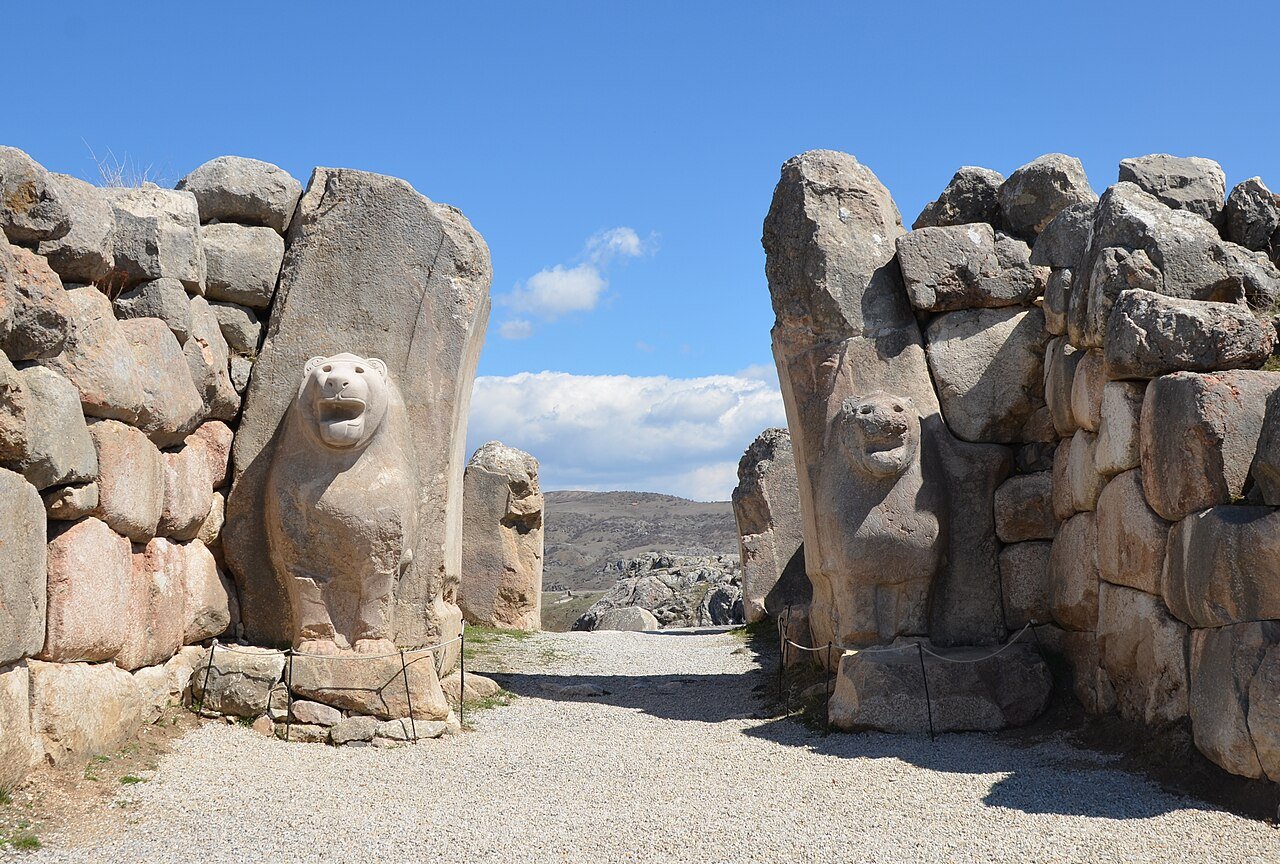
At its greatest extent, the city covered roughly 1.8 square kilometres and was enclosed by a double curtain wall of mud-brick on stone foundations, punctuated at intervals by towers and pierced by five major gates. The scale of this infrastructure was extraordinary for its time. Entering through the Lion Gate on the southwest side, visitors pass between two massive stone lion sculptures carved in the round from the living rock of the doorposts — the lions face outward, their mouths open, performing a protective function that was standard Hittite iconography for royal entrances. The King’s Gate on the east side bears a relief of a warrior figure that was for decades interpreted as a royal portrait but is now understood to represent a deity, possibly the war god Sharruma. The Sphinx Gate on the southern heights once displayed four large sphinx figures; two were taken to Istanbul and Berlin in the nineteenth and early twentieth centuries, and replicas now stand in their place. The originals were returned to Turkey in 2011.
The lower city holds the Great Temple of the Storm God, the largest Hittite religious structure known. Built in the late fourteenth or early thirteenth century BCE, the temple complex covers some 5,000 square metres and once contained the cult statue of the storm deity Teshub and his consort Hebat. Large stone water basins in the forecourt — used for ritual purification — are among the most intact elements still visible. The surrounding storerooms, which once held grain, oil, and other offerings, give a concrete sense of the temple’s role as an economic as well as spiritual centre of the city.
Hattusa was violently destroyed around 1200 BCE, almost certainly during the Bronze Age Collapse — a cascade of migrations, famines, and political disruptions that ended a dozen palace civilizations across the Eastern Mediterranean within a generation. The Hittite Empire did not survive it.
Yazılıkaya and the Treaty of Kadesh Rock sanctuary 1 km from main site · Archive in Istanbul Museum
One kilometre northeast of the main excavation area, the rock sanctuary of Yazılıkaya — the name means “inscribed rock” in Turkish — is one of the most remarkable open-air monuments in the ancient world. Two natural rock chambers, formed by geological faulting, were shaped by the Hittites into a sacred space during the thirteenth century BCE. The larger chamber features a processional frieze of 42 male gods on the left wall and 21 goddesses on the right, all depicted in the conventional Hittite profile view, marching toward a central scene where the storm god Teshub and his consort Hebat meet in divine procession. The figures stand roughly a metre tall and are carved in low relief directly into the limestone surface.
The smaller chamber served a funerary or memorial function and contains twelve identical warrior-god figures forming a guard of honour, along with a large relief of King Tudhaliya IV (c. 1237–1209 BCE) protected by the embrace of his tutelary deity Sharruma. The intimacy of the image — a king held in divine arms — is unusual in ancient Near Eastern art and gives Yazılıkaya a psychological weight that purely administrative monuments rarely achieve.
Back in the main city, the most consequential find was not architectural but textual. Excavations of the cuneiform archive beginning in 1906 uncovered thousands of clay tablets, including the text of the Treaty of Kadesh, agreed between the Hittite king Hattusili III and Pharaoh Ramesses II in 1259 BCE after the inconclusive Battle of Kadesh (1274 BCE). The treaty established a peace between the two superpowers, regulated the extradition of political refugees, and was sealed by the marriage of a Hittite princess to Ramesses. A copy of the treaty text, in Akkadian, is displayed at the United Nations headquarters in New York as a symbol of early diplomacy. The original silver tablets were not found; what survives are Hittite clay copies from the archive. Akkadian, the diplomatic lingua franca of the Bronze Age, was used rather than Hittite, which tells us something about the international prestige system of the period.
Practical information
Hattusa is located near the modern village of Boğazkale, about 210 kilometres east of Ankara and 82 kilometres from Çorum city. The most practical approach from Ankara is by bus or dolmuş to Sungurlu (2.5–3 hours), then a minibus or taxi to Boğazkale (30 minutes). Alternatively, rent a car from Ankara — the drive along the D785 is straightforward and allows you to cover both the main site and Yazılıkaya at your own pace, which is strongly recommended. Yazılıkaya is not directly accessible on foot from the main entrance without a significant uphill walk; a car or bicycle makes it far easier.
The site is open daily. Entry tickets for Hattusa and Yazılıkaya are purchased separately; the Boğazkale Archaeological Museum in the village is a third option and displays tablets and objects found on site. The museum of Anatolian Civilizations in Ankara holds a much larger collection of Hittite artefacts and is worth visiting either before or after the site.
Best season is spring (April–June) or early autumn (September–October). Summers in central Anatolia are hot and dry, and the site is almost entirely without shade. Comfortable walking shoes and water are essential; the circuit of the full walled area on foot covers 3–5 kilometres over uneven terrain. Allow a full day for the main site and Yazılıkaya combined.
Frequently Asked Questions
What is the Treaty of Kadesh and why does it matter?
The Treaty of Kadesh, agreed in 1259 BCE between Hattusili III of the Hittites and Ramesses II of Egypt, is the earliest surviving written peace agreement between two sovereign powers. It was negotiated following the Battle of Kadesh in 1274 BCE, fought in the region of modern Syria. Neither side could claim a decisive victory at Kadesh, and the subsequent decades of tension eventually pushed both empires toward a negotiated settlement. The treaty text, written in Akkadian cuneiform, covered not just the cessation of hostilities but mutual defence clauses, the extradition of political refugees and runaway subjects, and was secured by the marriage of a Hittite princess into the Egyptian royal household. Both Egyptian and Hittite copies of the text were produced; the Hittite version on clay tablets was found in the archive at Hattusa, and the Egyptian version was inscribed on temple walls at Karnak and the Ramesseum. A replica of the Hittite text is displayed in the United Nations headquarters in New York as a symbol of early international law. The original silver tablets mentioned in the text have never been found and may not have survived, or may remain unexcavated.
What destroyed Hattusa around 1200 BCE?
Hattusa was burned and abandoned around 1200 BCE, part of the wider Bronze Age Collapse that ended palace civilizations across the Eastern Mediterranean within a single generation. The causes of this collapse remain contested among archaeologists and historians. Evidence points to a combination of factors: large-scale migrations of peoples, possibly including the “Sea Peoples” mentioned in Egyptian records; prolonged droughts reconstructed from paleoclimate data; disruption of the long-distance trade networks that Bronze Age palace economies depended on for metals and luxury goods; and possibly internal political instability within the Hittite state. The Hittite texts from Hattusa include late letters that seem to describe food shortages and requests for grain from Egypt, suggesting the empire was under severe stress before the final collapse. The city shows signs of organized evacuation as well as fire, suggesting the end was not simply a sudden military defeat but a more complex process. The Hittite Empire did not recover, though small “Neo-Hittite” city-states survived in southeastern Anatolia and northern Syria for several more centuries.
What is at Yazılıkaya and how does it relate to Hattusa?
Yazılıkaya is a rock sanctuary approximately one kilometre from the northeast edge of Hattusa’s walled area. It consists of two natural rock chambers formed by faulting in the limestone, which the Hittites transformed into a sacred complex during the thirteenth century BCE, most intensively under King Tudhaliya IV (c. 1237–1209 BCE). The larger chamber features the most complete Hittite divine procession known: 42 gods march in from the left, 21 goddesses from the right, all depicted in standard Hittite relief style with their names inscribed in cuneiform above each figure. They converge on a central scene showing the storm god Teshub and the sun goddess Hebat in divine union — the two most important deities in the Hittite pantheon. The smaller chamber is more intimate: it holds a relief of Tudhaliya IV being embraced by the god Sharruma, twelve identical warrior-god figures, and a sword whose blade emerges from the ground as if planted there by a divine hand. The sanctuary was probably used for the annual New Year festival (purulli), a celebration of cosmic order being renewed through the divine marriage of Teshub and Hebat. After the fall of Hattusa, the site fell into disuse and was gradually covered by soil until its rediscovery in the nineteenth century.
Sources
- S1 — Seeher, Jürgen. Hattusha Guide: A Day in the Hittite Capital. Ege Yayınları, 2006. ISBN 978-975-807-145-6.
- S2 — Bryce, Trevor. The Kingdom of the Hittites. Oxford University Press, 2005. ISBN 978-0-19-928132-9.
Spotted an error? Write to editorial@culturalheritageonline.com and we correct it the same day.

.jpg)