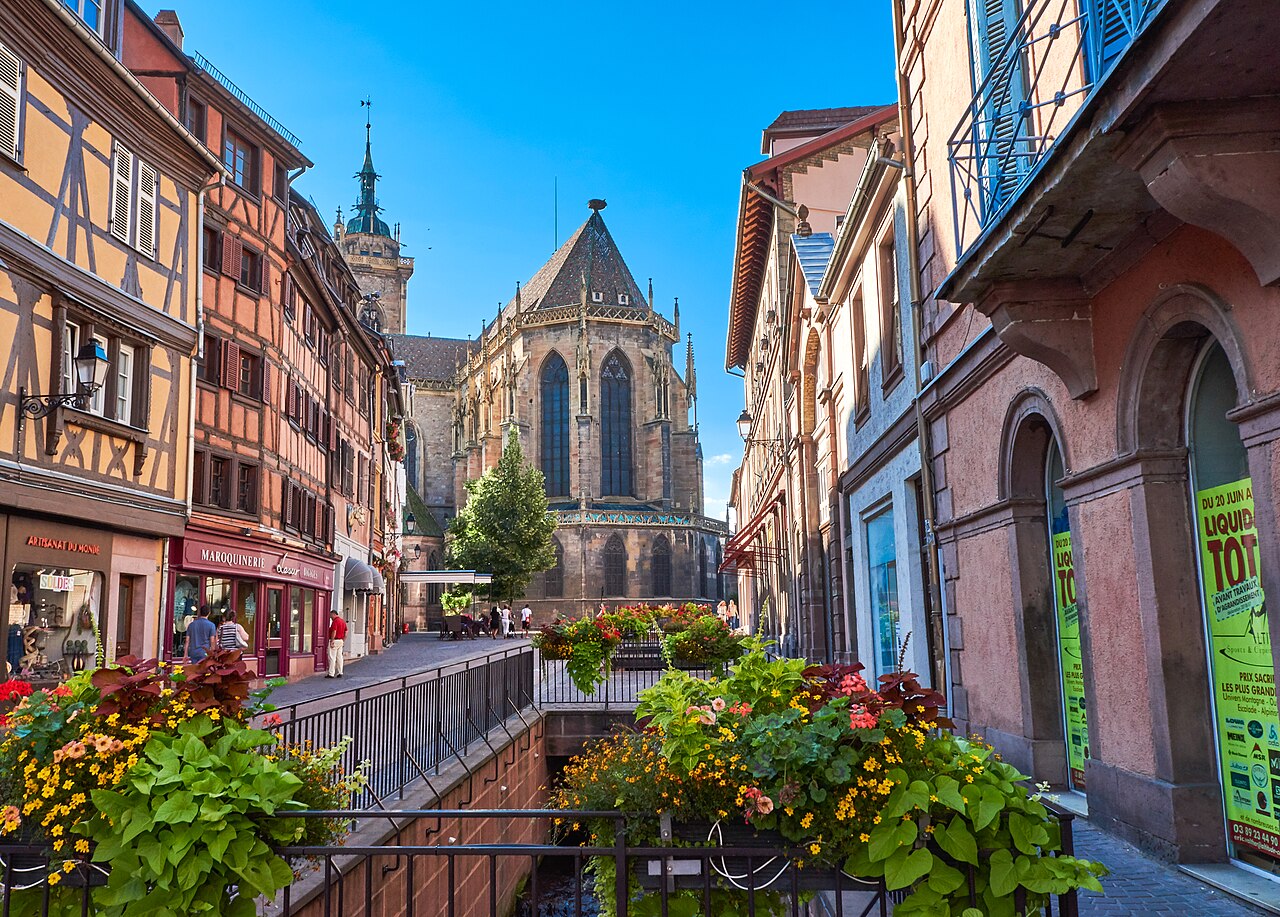
Colmar is the capital of Alsatian wine and the gateway to one of the most densely heritage-rich regions of France — a medieval trading city on the Rhine plain whose canals, half-timbered houses, and Unterlinden Museum (home to the Isenheim Altarpiece, the greatest Northern Renaissance painted altarpiece) sit at the centre of the Alsace Wine Route. Strasbourg’s Grande Île, inscribed in 1988, is 70 km north, and Mont Sainte-Odile’s Pagan Wall extends the heritage itinerary into the Vosges mountains.
Colmar: Medieval City on the Wine Route Alsace, Upper Rhine, France
Colmar is not itself UNESCO-inscribed, but it is the most completely preserved medieval Alsatian city on the Rhine plain and the pivot of the Alsace Wine Route (Route des Vins d’Alsace) — 170 km of wine-growing villages from Marlenheim in the north to Thann in the south. The Unterlinden Museum, founded 1853 in a thirteenth-century Dominican convent, holds the most important collection of Alsatian and Upper Rhenish medieval art in the world, centred on the Isenheim Altarpiece (c. 1512–1516) by Matthias Grünewald (Mathis Gothart Nithart, c. 1480–1528) — an 11-panel painted altarpiece made for the chapel of the Monastery of St. Anthony at Isenheim, where patients with St. Anthony’s Fire (ergotism, caused by the ergot fungus in infected rye) were treated. Grünewald’s Crucifixion panel — in which the body of Christ is covered with the suppurating sores and twisted limbs of an ergotism patient — was intended to show the suffering patients that Christ had shared their affliction; it is the most medically realistic depiction of bodily suffering in all of Christian art, and the most emotionally intense panel in Northern Renaissance painting. The museum’s other collections include Alsatian Romanesque sculpture, Renaissance goldsmithing, and a modern art collection (Picasso, Léger, Monet).
Strasbourg Grande Île: UNESCO Rhine Gothic City 🚌 ~35 mins by TER train north
The Grande Île of Strasbourg (inscribed 1988, extended 2017 to include the Neustadt) is the most completely preserved medieval Rhine port city in France — the historic island core of Strasbourg, bounded on two sides by the Ill River, whose Gothic Cathedral of Notre-Dame (begun 1015, the tallest building in the world from 1647 to 1874 at 142 metres), the medieval Petite France quarter (the former tanners’ and millers’ district on the river), the four covered bridges (Ponts Couverts, fourteenth century), and the Maison Kammerzell (1589, the finest secular Gothic building in Alsace) constitute one of the most concentrated medieval heritage ensembles in France. The 2017 extension added the Neustadt (New Town, built under German occupation 1871–1919), a monumental Wilhelmine urban quarter of Neo-Renaissance and Art Nouveau public buildings around the Place de la République that documents the most ambitious German urban planning programme in France — and one of the most complete examples of late nineteenth-century European city planning, comparable to the Ringstrasse in Vienna. Strasbourg is the seat of the European Parliament and Council of Europe; the city’s position on the Franco-German border, its dual cultural heritage, and its role as a European institutional capital make it a unique symbol of European post-war reconciliation.
Isenheim Altarpiece: The Crucifixion as Medical Art Unterlinden Museum, 1 rue Unterlinden, Colmar
The Isenheim Altarpiece (Retable d’Issenheim, c. 1512–1516) by Matthias Grünewald is the most important Northern European altarpiece and one of the most psychologically powerful works of art in the Christian tradition. Made for the chapel of the monastery of the Antonites (the Order of Saint Anthony) at Isenheim (25 km south of Colmar), it functioned as a devotional aid for patients with ergotism (St. Anthony’s Fire), a disease caused by a fungal toxin in infected rye flour that produced hallucinogenic convulsions, burning sensations in the limbs, and progressive gangrene — an affliction of epidemic proportions in northern Europe in the late medieval period. Grünewald’s altarpiece has two sets of folding wings (it can be opened to reveal three different configurations): the outermost configuration shows the Crucifixion in Grünewald’s most extreme naturalistic style — the body of Christ covered with hundreds of individual suppurating sores in precise medical detail, his fingers curling in the rigidity of death; the second opening shows the Annunciation and Resurrection; the innermost carved panels (by Nikolaus Hagenauer, c. 1505) show Saints Anthony and Sebastian. The altarpiece remained at Isenheim until the French Revolution, when it was moved to Colmar; it has been in the Unterlinden Museum since 1853. Its transfer to the museum saved it from the damage of the First and Second World Wars (it was evacuated from Colmar during both conflicts).
Practical information
Colmar is 70 km south of Strasbourg by train (35 minutes by TER regional express) and 450 km from Paris (2 hours by TGV to Strasbourg + regional train). Colmar’s historic centre (Petite Venise quarter, old customs house Koifhus, Dominican church with its Notre-Dame des Roses altarpiece) is walkable from the railway station. The Unterlinden Museum is open Tuesday–Sunday 9 a.m.–6 p.m. (Thursday until 8 p.m.); entry approximately EUR 15 (2024). Strasbourg Cathedral is open daily 7 a.m.–7 p.m.; free entry to the nave, paid entry to the astronomical clock show (12:30 p.m. daily, book in advance). The Alsace Wine Route runs south from Colmar; the villages of Riquewihr (13 km north, the most photographed Alsatian village) and Kaysersberg (10 km northwest, birthplace of Albert Schweitzer) are the most visited stops on the route. The Christmas market of Colmar (November–January) and Strasbourg (the oldest in France, since 1570) attract millions of visitors; accommodation in December is scarce and expensive. The best season without crowds is March–May and September–October (grape harvest).
Frequently Asked Questions
Is Strasbourg a UNESCO World Heritage Site?
Yes. Strasbourg — Grande Île and Neustadt was inscribed in 1988 (Grande Île) and extended in 2017 to include the Wilhelmine Neustadt. The inscription covers the medieval island core of the city (cathedral, Petite France, Ponts Couverts, Maison Kammerzell) and the monumental late nineteenth-century urban extension built during the German occupation of 1871–1919. It is notable as one of the few sites to include both medieval and modern (late 19th century) urban fabric under a single inscription, and as a document of Franco-German architectural exchange.
Why is the Isenheim Altarpiece displayed in three configurations?
The Isenheim Altarpiece was designed as a liturgical object to be opened and revealed progressively according to the feast days of the Christian calendar. On ordinary weekdays (the first configuration, visible from the nave), the outer panels showed the Crucifixion, the Lamentation, and Saints Sebastian and Anthony — the medicinal saints of the Antonite monastery whose chapel it served. On Sundays and feast days (the second configuration, opened to the middle panels), it revealed the Annunciation, the Concert of Angels, and the Resurrection — joyful scenes for the communal liturgy. On the feast of Saint Anthony and high feast days (the third configuration, fully opened to the innermost carved wooden panels), it revealed the carved polychrome figures of Saints Anthony and Sebastian by Hagenauer, with Grünewald’s Meeting of Saints Anthony and Paul painted on the wings. In the museum context today, the altarpiece is displayed in all three configurations simultaneously, which was architecturally impossible in its original chapel setting.
What is the Alsace Wine Route and what makes it distinctive?
The Route des Vins d’Alsace (Alsace Wine Route) is a 170 km signposted route through the Alsatian wine villages between the Vosges foothills and the Rhine plain, passing through approximately 70 wine-producing villages from Marlenheim to Thann. Alsace is distinctive among French wine regions in labelling its wines by grape variety (Riesling, Gewürztraminer, Pinot Gris, Muscat, Sylvaner, Pinot Blanc, Pinot Noir) rather than by appellation — a German influence on the labelling convention that dates from the German occupation of 1871–1919. The region produces the only French Riesling (considered the finest in the world by many critics, different in style from German Riesling) and the most distinctive Gewürztraminer of any French wine region. The Grand Cru system (51 officially designated grand cru vineyard sites) was established in 1983 and selects the hillside sites with the most complex geological substrates.
Sources
- S1 — Mellinkoff, Ruth. The Devil at Isenheim: Reflections of Popular Culture in Grünewald's Altarpiece. University of California Press, 1988. ISBN 978-0-520-06204-7.
- S2 — Jordan, William Chester. Europe in the High Middle Ages. Penguin Books, 2001. ISBN 978-0-14-016664-4.
Spotted an error? Write to editorial@culturalheritageonline.com and we correct it the same day.