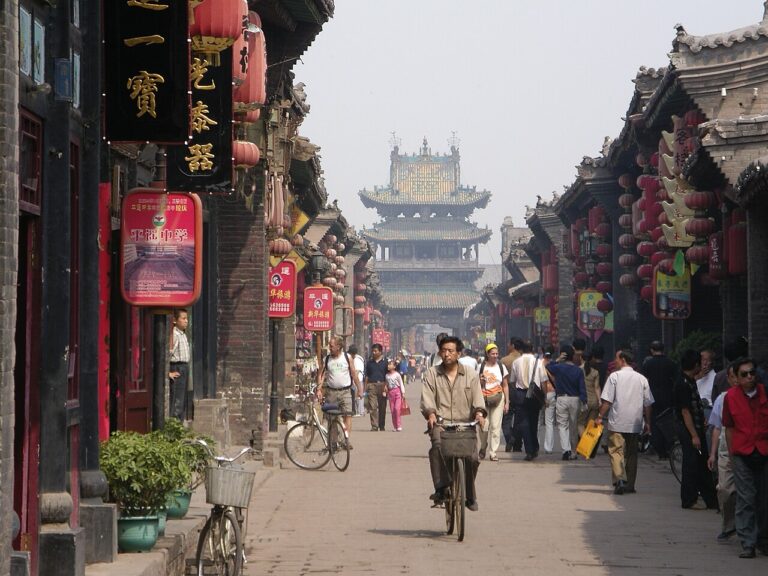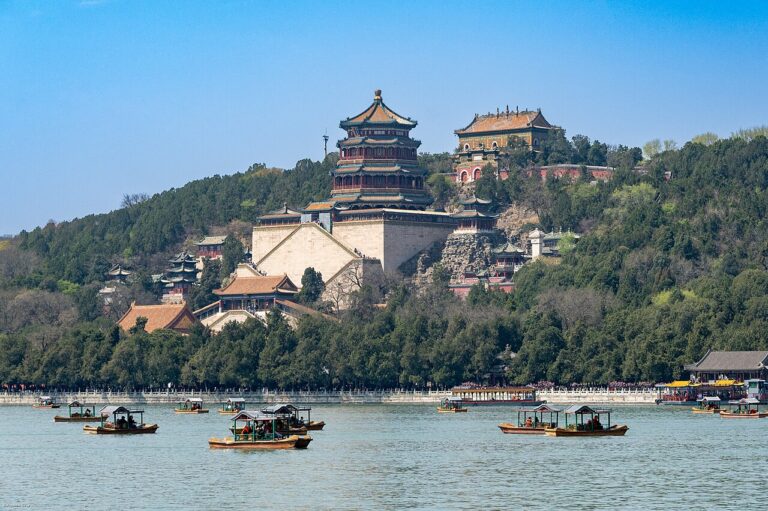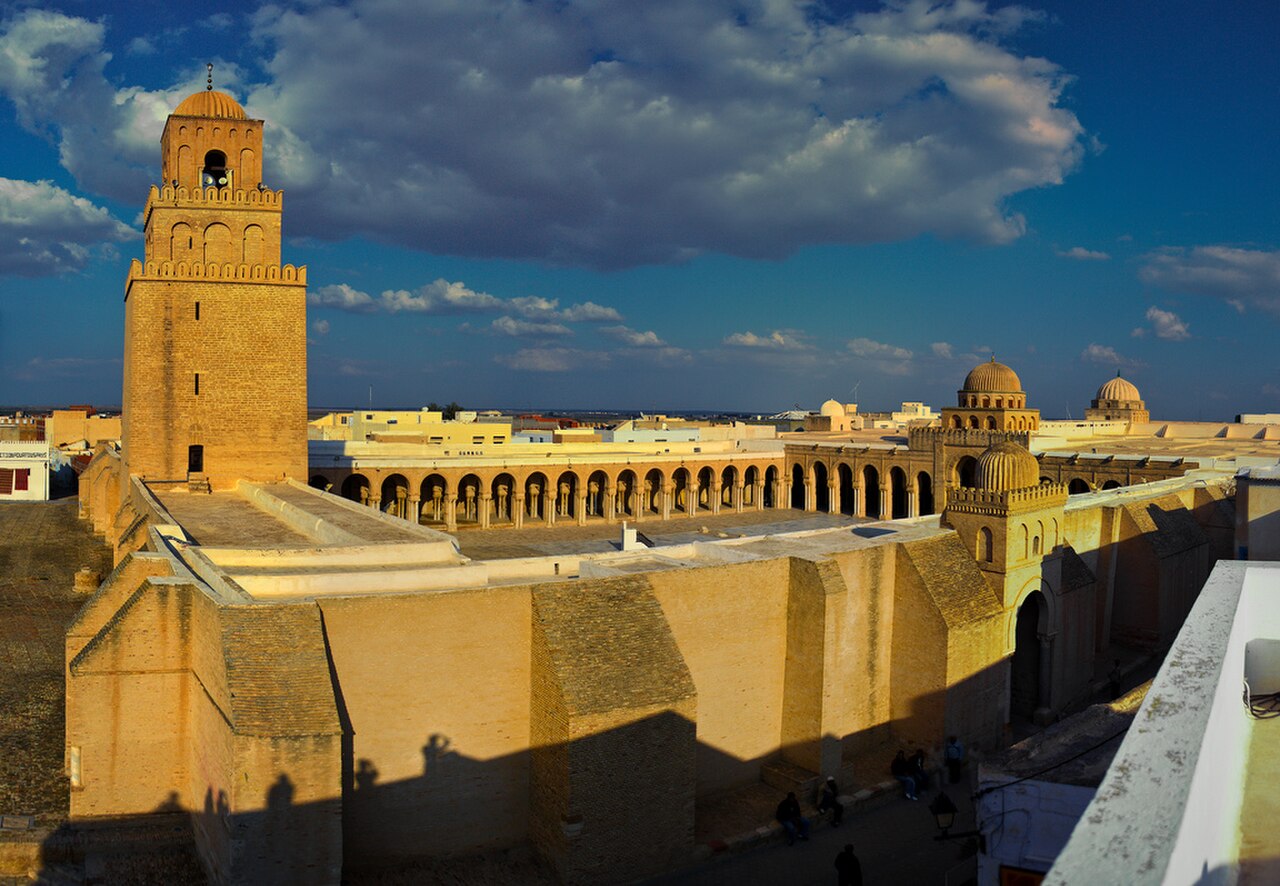
Kairouan, inscribed in 1988, is the fourth holiest city in Islam and the most sacred Islamic site in North Africa — a city founded in 670 CE by the Arab general Uqba ibn Nafi as the base for the conquest of the Maghreb, whose Great Mosque is the oldest surviving mosque in the western Islamic world. Tunisia’s other four inscribed sites — Carthage, the Amphitheatre of El Jem, Dougga, and Kerkouane — create one of the most archaeologically rich heritage circuits in the Mediterranean.
Kairouan: Foundation City of Islamic North Africa Central Tunisia, 160 km south of Tunis
Kairouan (inscribed in 1988 under criteria (i), (ii), (iii), and (v)) is the oldest Arab city in North Africa — founded in 670 CE by Uqba ibn Nafi (also the founder of the Great Mosque) as the military base for the Arab conquest of the Maghreb (North Africa and Andalusia), which was completed by 698 CE. The city served as the capital of the Aghlabid dynasty (800–909 CE), the most culturally productive Islamic dynasty in the Maghreb, under which the Great Mosque was rebuilt in its current form and the city became one of the most important centres of Islamic scholarship, art, and architecture in the medieval world. The city is fourth in holiness in Sunni Islam (after Mecca, Medina, and Jerusalem); the traditional belief holds that seven pilgrimages to Kairouan equal one hajj pilgrimage to Mecca — reflecting its role as the practical substitute for pilgrims in the Maghreb who could not afford the journey to Arabia. The medina (old city) of Kairouan is encircled by walls dating from the seventeenth century (on much older foundations) and preserves approximately 50 mosques, two of the largest ninth-century Islamic water cisterns in existence (the Aghlabid Basins), and a network of artisan workshops producing the wool carpets and ceramics for which the city has been known since the medieval period.
The Great Mosque of Kairouan: Oldest Mosque in the Western World North medina
The Great Mosque of Kairouan (Mosque of Uqba, Jāmiʿ ʿUqba, founded 670 CE, rebuilt under the Aghlabids 836–875 CE) is the oldest surviving mosque in the western Islamic world and one of the most influential buildings in the history of Islamic architecture — the model from which the architectural type of the North African (Maghrebi) mosque derived: a vast rectangular courtyard with a minaret at the north end (the square minaret, three-staged, became the standard for all subsequent Maghrebi minarets, including those of the Koutoubia in Marrakech and the Giralda in Seville), and a covered prayer hall of 17 naves of columns supporting double-tiered horseshoe arches. The prayer hall columns (from Roman and Byzantine buildings in the region) number 414; the marble mihrab (prayer niche, the finest in the Islamic world, added 862–863 CE) is lined with carved marble panels and decorated with 139 lustre tiles imported from Abbasid Baghdad — the earliest known lustre tiles in the western Islamic world. The mosque is still an active place of worship; non-Muslim visitors may enter the courtyard but not the prayer hall.
Amphitheatre of El Jem: Rome in the Saharan Margins 🚗 ~1 hr south
The Amphitheatre of El Jem (inscribed 1979 under criterion (vi)) is the third largest Roman amphitheatre in the world after the Colosseum in Rome and the one in Capua — a free-standing elliptical structure at Thysdrus (modern El Jem) in central Tunisia, 70 km south of Kairouan, built c. 230–238 CE with a capacity of 35,000 spectators. Unlike the Colosseum, which was built into a valley, the El Jem amphitheatre was built free-standing on flat terrain (like Capua) with underground galleries for animals and gladiators preserved in near-perfect condition beneath the arena floor. The theatre was built during the reign of Gordian I, whose brief tenure as emperor (of which the El Jem amphitheatre was the most lasting monument) was declared in the city itself in 238 CE; the city of Thysdrus had grown wealthy from the olive oil trade during the prosperity of the Severan dynasty. The amphitheatre was used as a fortress during the Arab conquest (698 CE) and later as a quarry for building material for Kairouan; the south section was demolished with gunpowder in 1695 CE to flush out Berber rebels. Despite this, the surviving structure is the most intact Roman amphitheatre outside Italy.
Dougga: Rome’s Best-Preserved Maghrebi Town 🚗 ~2 hrs north
Dougga / Thugga (inscribed 1997 under criteria (ii) and (iii)) is 110 km north of Kairouan — the best-preserved Roman town in North Africa. Unlike Timgad (Algeria) or Caesarea Maritima (Israel), Dougga has not been excavated but rather remains on a hilltop site that was never built over in the modern period (the town was relocated to the plain in 1959), preserving the complete urban fabric of a mid-size Roman city of the first through third centuries CE: the Capitolium temple (166–169 CE, with the most intact Roman pediment in North Africa), the theatre (168–169 CE, capacity 3,500, still used for performances), the Forum, the Licinian Baths, the Dar Lachhab Byzantine house, and the pre-Roman Numidian mausoleum (the Mausoleum of Ateban, third–second century BCE, the only complete pre-Roman royal monument in North Africa and the one whose Numidian-Punic bilingual inscription in 1631 provided the first key to deciphering the Phoenician alphabet).
Practical information
Kairouan is 160 km south of Tunis; buses from Tunis Bab Alioua bus station take 2.5 hours, and shared taxis (louages) are faster (2 hours). There is no airport at Kairouan; the nearest is Monastir Habib Bourguiba Airport (MIR, 80 km east). The medina and Great Mosque courtyard are accessible to non-Muslim visitors with a combined ticket for the Great Mosque, the Mosque of the Three Doors (866 CE, the earliest mosque with carved stone facade), and the Aghlabid Basins (available from the tourism office adjacent to the Great Mosque). El Jem is 70 km south by road (or by train from Tunis, stopping at El Jem station). Dougga is 110 km north of Kairouan by road; the site is open daily and the Capitolium and theatre are in excellent condition. Carthage and the Bardo National Museum (best collection of Roman mosaics in the world) are 160 km north, accessible by Tunis metro (TGM line). The best season is March–May and October–November; July–August is very hot (40°C+) at Kairouan and El Jem.
Frequently Asked Questions
Is Kairouan a UNESCO World Heritage Site?
Yes. Kairouan was inscribed in 1988 under criteria (i), (ii), (iii), and (v). The inscription covers the medina and its mosques, the Aghlabid Basins, and the surrounding historic fabric. Tunisia has eight UNESCO World Heritage Sites in total: Kairouan (1988), Amphitheatre of El Jem (1979), Archaeological Site of Carthage (1979), Ichkeul National Park (1980), Punic Town of Kerkouane (1985), Medina of Tunis (1979), Medina of Sousse (1988), and Dougga/Thugga (1997).
Why is Kairouan the fourth holiest city in Islam?
Kairouan’s rank as the fourth holiest city in Islam derives from two historical factors: its founding in 670 CE as the first Arab city in the western Islamic world (preceding all other cities in the Maghreb and Andalusia), and the theological importance attributed to it by North African and Andalusian Islamic scholars from the eighth century onward. The Aghlabid dynasty (800–909 CE) invested heavily in the city’s scholarly reputation; the Great Mosque attracted students from across the Islamic world. The tradition that seven visits to Kairouan equal one hajj — attributed to medieval Maliki legal scholars — reflects the city’s role as the western substitute for the pilgrimage centre when the Saharan and Mediterranean journey to Mecca was prohibitively dangerous or expensive for most Maghrebi Muslims.
Why is the Amphitheatre of El Jem better preserved than the Colosseum?
The Amphitheatre of El Jem is arguably better preserved than the Colosseum in its structural upper levels because it was not systematically quarried for building material in the medieval period (Rome’s Colosseum was extensively mined for marble and travertine from the fifth through eighteenth centuries) and because Thysdrus declined and was replaced by a smaller settlement nearby, rather than being continuously built upon. Its underground galleries (the basement level for animal cages and gladiator quarters) are more intact than those of the Colosseum; the vaulted corridors, ramp systems, and cage pits are clearly legible. The main damage is the breach in the south wall (demolished 1695) and the ordinary erosion of the sandstone seating; but the structural logic and spatial experience of a Roman amphitheatre can be read more clearly at El Jem than anywhere else outside of Verona’s Arena.
Sources
- S1 — Lézine, Alexandre. Mahdiya: Recherches d'archéologie islamique. Klincksieck, 1965. ISBN 978-2-86538-050-3.
- S2 — Bomgardner, David L. The Story of the Roman Amphitheatre. Routledge, 2000. ISBN 978-0-415-16593-8.
Spotted an error? Write to editorial@culturalheritageonline.com and we correct it the same day.