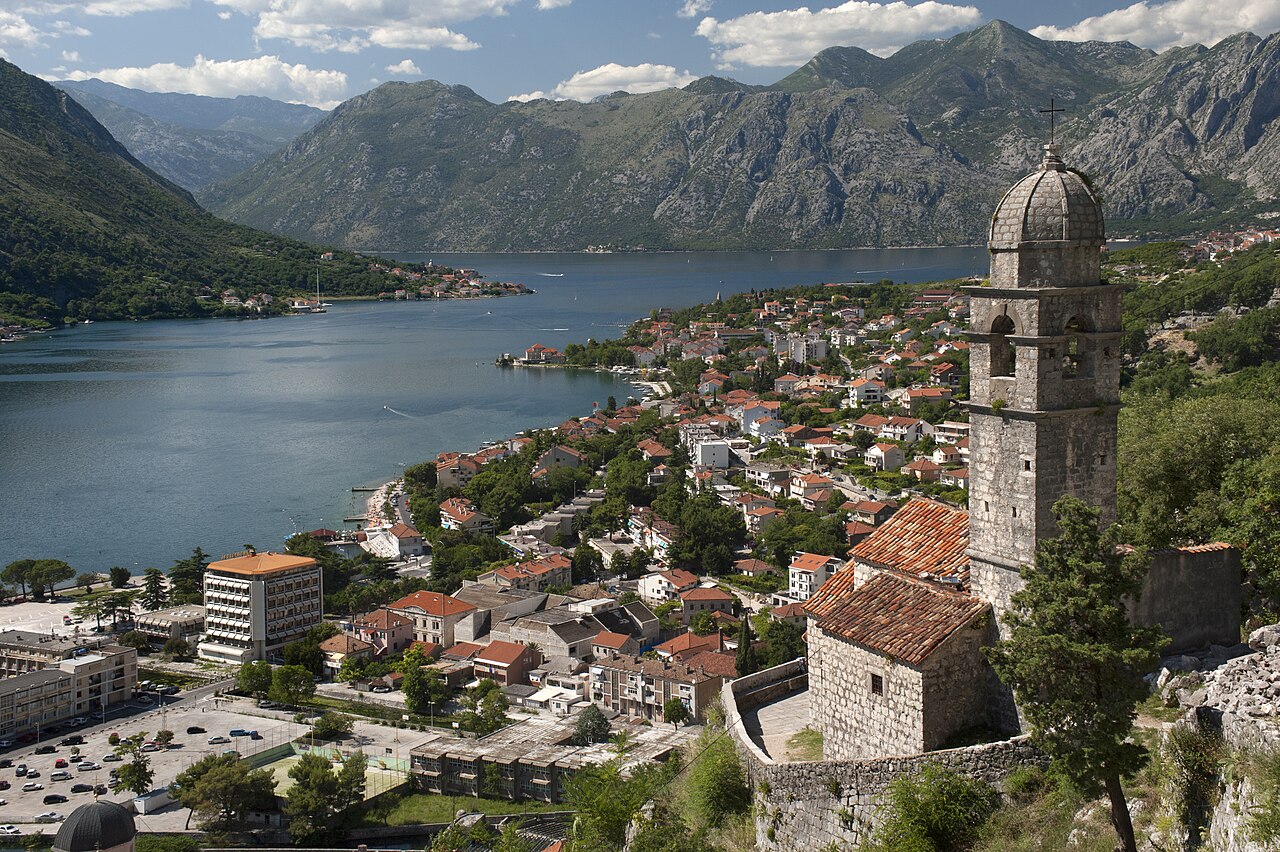
The Natural and Culturo-Historical Region of Kotor has been inscribed since 1979 for its medieval fortified city at the deepest point of the Bay of Kotor — the best-preserved Venetian walled city on the eastern Adriatic. Dubrovnik, Mostar, and the Albanian Riviera extend a Adriatic and western Balkans heritage itinerary of striking historical depth.
Kotor: Venetian Fortress City in a Mountain Bay City centre
The Natural and Culturo-Historical Region of Kotor, inscribed in 1979 under criteria (i), (ii), (iii), and (iv), encompasses the fortified city of Kotor and the Bay of Kotor — an inland sea 28 km long and up to 4 km wide, formed in the last Ice Age when the Sutorina River valley was flooded by the Adriatic. The bay is enclosed by limestone mountains rising to 1,749 metres (Mount Lovćen) directly above the water; the combination of mountain and sea creates a microclimate that supports subtropical vegetation (oleander, palm, olive, and cypress) at the bay’s southern end while snow falls on the peaks above. The city walls of Kotor (12.5 km of wall, 88 towers, 4 gates), built by the Venetians and their predecessors between the ninth and eighteenth centuries, climb the mountain above the old city to the fortress of Saint John at 280 metres — a 1,355-step climb rewarded by a panoramic view of the bay. The Cathedral of Saint Tryphon (twelfth century, rebuilt after 1667), the Church of Saint Luke (twelfth century, serving both Catholic and Orthodox communities simultaneously from 1657 to 1812), and the Venetian clock tower and Loggia complete the historic centre.
Perast and Our Lady of the Rock: Island Church in the Bay 🚌 12 km northwest
Perast, a small Venetian Baroque town 12 km northwest of Kotor along the bay road, preserves 16 baroque palaces from the seventeenth and eighteenth centuries — built by the Perast captains who commanded the Venetian Republic’s galley fleet in the eastern Adriatic during the Ottoman wars. Two small rocky islands sit in the bay off Perast; one is natural (Sveti Đorđe, with a monastery built 1166 CE); the other (Our Lady of the Rock) is entirely artificial — built up stone by stone by Perast sailors from 1452 onward after two brothers found a miraculous icon of the Virgin on a submerged rock. The tradition is maintained: on 22 July each year, local boats circle the island throwing stones into the water to reinforce the underwater base (the fašinada ritual). The baroque church on the island (1630, rebuilt 1722) contains a famous painting by Tripo Kokolja (1682–1688) and a votive tapestry embroidered over 25 years by Jacinta Kunić-Mijović from her own hair and gold thread, incorporating the faces of locals who appear in the border as donors.
Ostrog Monastery: Montenegro’s Most Sacred Site 🚗 ~2 hrs north
The Ostrog Monastery in central Montenegro is not UNESCO-inscribed but is the most important Serbian Orthodox pilgrimage site in Montenegro — a sixteenth-century monastery built directly into a vertical white cliff face at 900 metres, seemingly growing from the rock. The monastery holds the relics of Saint Basil of Ostrog (died 1671), who is credited with numerous miracles; the cave church of the Holy Cross and the larger church of the Presentation of the Virgin Mother are carved into the cliff. Annual pilgrimage at the feast of Pentecost (Trojičin Dan) brings 100,000 pilgrims from across the western Balkans, walking the final approach on their knees as an act of devotion. The mountain road to the monastery (accessible by car or the pilgrim bus from Nikšić) is one of the most dramatically situated religious sites in Europe.
Old City of Dubrovnik: An Hour South on the Adriatic 🚗 ~1 hr south
The Old City of Dubrovnik, inscribed in 1979 under criteria (i), (ii), (iii), and (iv), lies 50 kilometres south of Kotor across the Croatian border — the most direct continuation of the Venetian Adriatic heritage circuit that Kotor represents. The two cities were rivals in the medieval period: Ragusa (Dubrovnik) was an independent republic with its own flag and fleet while Kotor was under Venetian control; both maintained commercial relations with the Ottoman Empire while defending the Adriatic against Ottoman naval aggression. The comparison of the two walled cities — Kotor embedded in its mountain-bay landscape, Dubrovnik asserting its independence against the open sea — is one of the most instructive in Adriatic heritage tourism. Dubrovnik is reached from Kotor by bus (1 hour) or by hydrofoil in summer (1.5 hours, with a Croatian border crossing).
Practical information
Tivat Airport (TIV), 15 minutes from Kotor by taxi, connects to major European cities; Podgorica Airport (TGD) connects to more destinations and is 1.5 hrs from Kotor. The Boka Bay Express bus connects Kotor to Herceg Novi (at the bay entrance, 45 minutes) and continues to Dubrovnik. Dubrovnik Airport (DBV) in Croatia is 2 hours from Kotor. The old city of Kotor is pedestrianised; the wall climb to the fortress takes 45–60 minutes each way and is open daily from 8 a.m. to 11 p.m. in summer. Montenegro’s tourist season runs May–September; the bay is calmer and less crowded in May and September. Cruise ships dock in Kotor from June through October, making mid-morning the busiest time in the old city; early morning and late afternoon visits avoid the peak congestion.
Frequently Asked Questions
Is Kotor a UNESCO World Heritage Site?
Yes. The Natural and Culturo-Historical Region of Kotor was inscribed in 1979 under criteria (i), (ii), (iii), and (iv). The inscription covers the medieval walled city of Kotor, the Bay of Kotor, and the surrounding cultural landscape — one of the earliest UNESCO inscriptions to explicitly include both natural and cultural heritage in a single property.
How do you climb the Kotor city walls?
The main entrance to the city wall climb is at the River Gate (Rijeka Gate) inside the old city near the Trg od Oružja square; there is also an entrance near the Gurdić Gate at the south end. The climb to San Giovanni fortress involves 1,355 steps and takes 45–60 minutes; the path is narrow and can be slippery when wet. The climb is open daily from 8 a.m. and closes at 11 p.m. in summer. Allow 2 hours for the full climb and descent, plus photography stops. Wear walking shoes; the limestone steps are uneven.
What is the Bay of Kotor and why is it unusual?
The Bay of Kotor is a submerged river valley — not a fjord (which requires glacial erosion) but a karst polje flooded by the rising Adriatic after the last Ice Age. It is the southernmost “fjord-like” bay in Europe and one of the very few in the Mediterranean region. The bay’s inner section (Boka Kotorska) is effectively an inland sea, sheltered from Adriatic winds and storms by the surrounding limestone mountains; the water temperature is 2–3°C warmer than the open Adriatic at the same time of year.
Sources
- S1 — Martinović, Jovan. Kotor: Guide to the Old Town. Pobjeda, 1985. ISBN 978-86-309-0012-9.
- S2 — Fine, John V. A. The Late Medieval Balkans. University of Michigan Press, 1987. ISBN 978-0-472-08260-5.
Spotted an error? Write to editorial@culturalheritageonline.com and we correct it the same day.