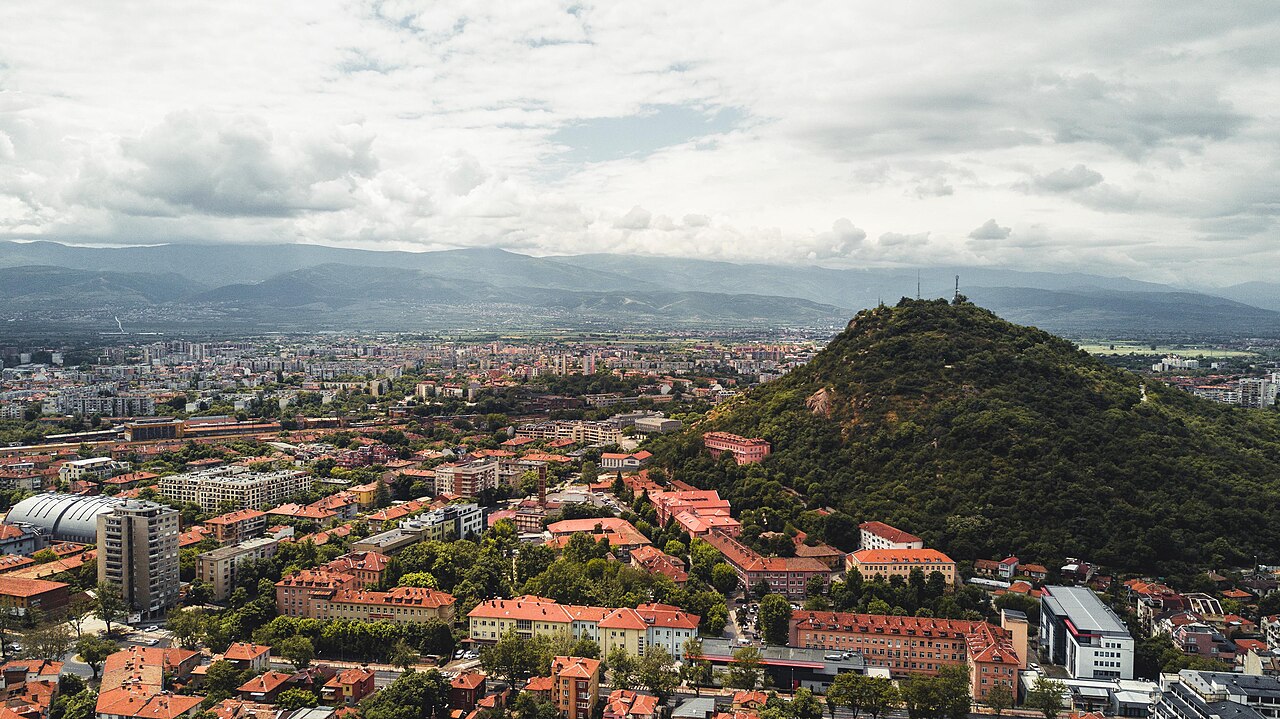
Plovdiv — one of Europe’s oldest continuously inhabited cities, founded in the Neolithic and documented as the Thracian Eumolpias, the Macedonian Philippopolis, and the Byzantine Trimontium — holds one of the best-preserved Roman theatres in the Balkans and a nineteenth-century National Revival old town. The inscribed Ancient City of Nessebar and the Thracian Tomb of Kazanlak extend a Bulgarian heritage itinerary from the Bronze Age to the Byzantine period.
Plovdiv: Philippopolis and its Roman Theatre City centre
Plovdiv (ancient Philippopolis, named for Philip II of Macedon who captured it in 342 BCE) is one of Europe’s oldest continuously inhabited cities — excavations beneath the old town have yielded evidence of settlement from at least the Neolithic period. The Roman city that developed from the first century CE under Trajan and Marcus Aurelius was the capital of the province of Thrace; its odeon (small concert theatre, second century CE), colonnaded street (cardo maximus), forum, and the large theatre (second century CE, capacity 7,000, restored and in use for the Plovdiv Opera Festival) are the most substantial Roman urban remains in Bulgaria. The Kapana quarter (the former artisan district) and the National Revival old town on the three hills (tepeta) above the city preserve nineteenth-century Bulgarian merchant houses — extended upper stories on timber frames, painted facades, wooden balconies — in one of the most intact examples of the Bulgarian National Revival architectural style outside Koprivshtitsa.
Ancient City of Nessebar: Byzantine Jewel on the Black Sea 🚗 ~2.5 hrs east
The Ancient City of Nessebar, inscribed in 1983 under criteria (iii) and (iv), is a small peninsula in the Black Sea connected to the mainland by a narrow causeway — a natural island site that has been continuously occupied since the Thracian Menebria (sixth century BCE) and was successively a Greek colony (Mesambria), a Roman town, and a Byzantine fortress. The Byzantine Churches of Nessebar — eleven medieval churches surviving from a total of forty documented, built between the fifth and eighteenth centuries in a characteristic style of alternating courses of brick and stone with ceramic ornaments — are the primary UNESCO element. Sveta Sofia (fifth–sixth century), the Basilica of Christ Pantokrator (fourteenth century), and the Church of Sveti Yoan Aliturgetos (fourteenth century, with its triple-apse exterior articulated in blind arcading and ceramic roundels) are the finest. The town’s medieval street plan and fortification walls are substantially intact.
Thracian Tomb of Kazanlak: Hellenistic Fresco Masterwork 🚗 ~1.5 hrs north
The Thracian Tomb of Kazanlak, inscribed in 1979 under criteria (i), (iii), and (iv), preserves a beehive-domed burial chamber from the third century BCE — one of the finest examples of Hellenistic painting in the Balkans. The painted frieze of the circular burial chamber shows a funerary feast with Thracian nobles, horses, and servants in a narrative style that combines Hellenic naturalism with Thracian compositional conventions; the colour palette, preserved by two millennia of sealed conditions, remains vivid. The original tomb is closed to prevent humidity damage; a full-size replica has been built adjacent. The Kazanlak Valley — the “Rose Valley” — is Bulgaria’s centre of rose-oil production, and the May Rose Harvest Festival (late May–early June) combines the heritage visit with the extraordinary sight and scent of 4,000 hectares of Bulgarian Rosa damascena in flower.
Rila Monastery: Orthodox Jewel in the Mountains 🚗 ~2 hrs west via Sofia
The Rila Monastery, inscribed in 1983 under criteria (ii), (iv), and (vi), is the most important Bulgarian Orthodox monastery — founded in the tenth century by Saint John of Rila, rebuilt multiple times after fires, and reaching its current form in the nineteenth century National Revival rebuilding of 1834–1837 under the monk Neophyte of Rila. The main church’s exterior is covered in black-and-white striped arcading under which a continuous painted fresco programme documents Orthodox theology in 1,200 panels; the church tower (Hrelyu’s Tower, 1335) is the oldest surviving element. The monastery houses a major collection of medieval icons, manuscripts, and the wooden cross of Brother Raphael — carved between 1790 and 1802 with 140 miniature biblical scenes, a work of extraordinary intricacy that cost the monk his eyesight. The monastery sits in a gorge of the Rila Mountains at 1,147 metres, surrounded by the Rila National Park.
Practical information
Plovdiv is served by its own international airport (PDV) with flights from Western Europe, and by frequent trains from Sofia (2 hrs) and Bulgaria’s Adriatic coast cities. The Roman theatre, odeon, and old town are all within walking distance of the historic centre; Kapana and the Djumaya Mosque (fifteenth century, built under Ottoman rule) complete the circuit. Nessebar is 150 km east on the Black Sea coast, best reached by bus from Plovdiv via Burgas (3.5 hrs total). Kazanlak is 1.5 hrs north by direct bus. Rila Monastery requires a full day excursion — most conveniently from Sofia (2 hrs by bus or organised tour) though accessible from Plovdiv via a scenic mountain road. Plovdiv was European Capital of Culture in 2019, generating new museum spaces and public art in the Kapana quarter.
Frequently Asked Questions
Is Plovdiv a UNESCO World Heritage Site?
Plovdiv itself is not yet inscribed as a UNESCO World Heritage Site — the Ancient City of Philippopolis/Plovdiv is on Bulgaria’s UNESCO Tentative List but has not received formal inscription as of 2026. However, Plovdiv is a major hub for visiting Bulgaria’s inscribed sites: Nessebar (1983) is 2.5 hours east, the Kazanlak Thracian Tomb (1979) is 1.5 hours north, and Rila Monastery (1983) is 2 hours west.
What is the Bulgarian National Revival architecture in Plovdiv’s old town?
The Bulgarian National Revival (Balgarski Vazrazhdane) was an eighteenth and nineteenth century cultural movement that developed a distinctive architectural style: multi-story merchant houses with extended second-floor overhangs on carved wooden brackets, symmetrical painted facades, interior rooms decorated with painted ceilings depicting cities the owner had visited, and hidden storage spaces within the thick walls. The Plovdiv old town preserves more than 150 houses in this style; the Hindliyan House (1835) and the Kuyumdzhioglu House (now the Ethnographic Museum, 1847) are the finest examples.
When is the Plovdiv Roman Theatre open?
The Ancient Theatre of Philippopolis is open daily (10 a.m.–6 p.m. in summer, shorter hours in winter). It is used as an active performance venue for the Plovdiv Opera Summer Festival (July–August) and special concerts; on performance days, access to the seating area closes in the afternoon for stage setup. The best light for photography is in the morning when the southern sun illuminates the marble seats from the east.
Sources
- S1 — Detev, Petar. Plovdiv: Antiquity and Modernity. Nauka i Izkustvo, 1981. ISBN 978-954-430-012-8.
- S2 — Crampton, R. J. A Concise History of Bulgaria. Cambridge University Press, 2005. ISBN 978-0-521-61637-9.
Spotted an error? Write to editorial@culturalheritageonline.com and we correct it the same day.