The Historic Centre of Oaxaca and the Archaeological Zone of Monte Albán share a single UNESCO inscription from 1987 — the Zapotec hilltop capital, one of the first planned cities in the Americas, paired with the colonial Baroque city below it. Palenque and Teotihuacán extend a Mesoamerican heritage itinerary spanning 2,500 years of urban civilisation.
Monte Albán: The First Planned City in the Americas 🚗 10 km west of Oaxaca city
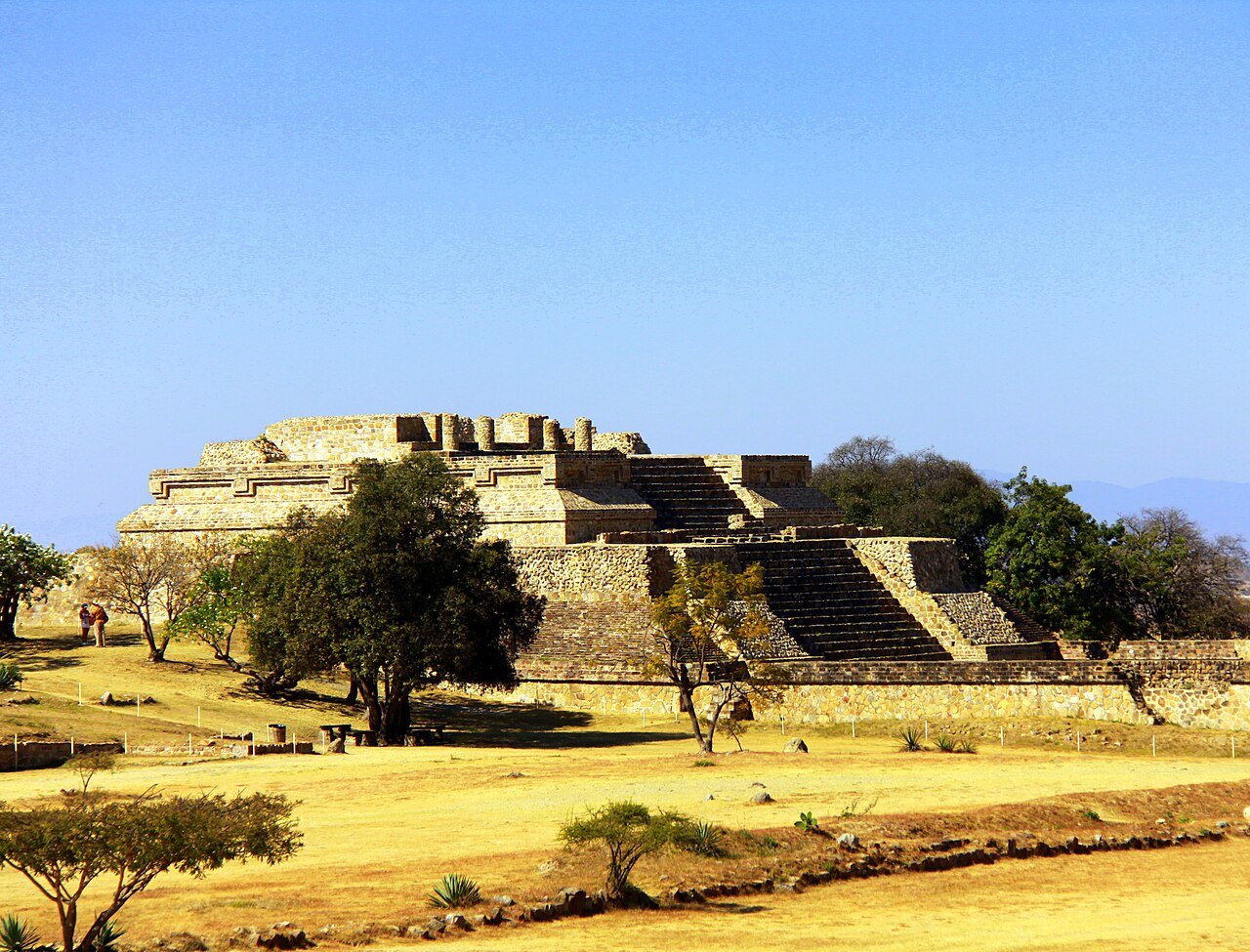
The Archaeological Zone of Monte Albán and Historic Centre of Oaxaca, inscribed together in 1987 under criteria (i), (ii), (iii), and (iv), preserve the Zapotec capital built on a flattened hilltop at 1,940 metres in the Valley of Oaxaca — one of the first deliberately planned cities in the Americas, inhabited from c. 500 BCE to 700 CE. The main plaza of Monte Albán (300 by 200 metres) was created by levelling the natural hill and filling the valleys between the summits, an engineering project requiring the movement of millions of tonnes of soil. The platform arrangement places the Ball Court, the Observatory pyramid (oriented 45° from the cardinal directions to align with the zenith passage of the sun and the Pleiades), and the Dancers’ monument (a building covered in carved stone slabs depicting mutilated captives, the earliest datable figurative sculpture in Mesoamerica) around the perimeter of the plaza. The city’s population at its height is estimated at 20,000, declining to abandonment by 700 CE as the Zapotec civilisation fragmented.
Historic Centre of Oaxaca de Juárez: Baroque Green Stone City City centre
The Historic Centre of Oaxaca, co-inscribed with Monte Albán in 1987, was founded by the Spanish in 1529 on the site of a Mixtec settlement. The city’s distinctive green volcanic stone (cantera verde) gives its Baroque churches and civic buildings a colour unique in Mexico: the Church of Santo Domingo de Guzmán (1570–1608), with its gilded interior vault rising over a ceiling of bas-relief saints and genealogical trees of the Dominican family, is the finest Baroque church in southern Mexico. The Zócalo (main square) is surrounded by arcaded government buildings and café terraces on a ground plan maintained since the sixteenth century; the indigenous market of Etla (60 km north) and the artisan markets of Tlacolula and Teotitlán del Valle bring Zapotec weaving, black pottery (barro negro), and cochinilla (red dye from cactus insects) from across the Oaxacan valleys every week.
Palenque: Classic Maya in the Chiapas Jungle 🚌 ~8 hrs southeast
Pre-Hispanic City and National Park of Palenque, inscribed in 1987 under criteria (i), (ii), (iii), and (iv), is the most architecturally refined Classic Maya site — a palace complex and temple group built in the Usumacinta River basin of Chiapas between the fifth and eighth centuries CE under the rulers Pakal the Great (reg. 615–683 CE) and his successors. The Temple of the Inscriptions, a nine-tiered pyramid built as a funerary monument for Pakal, contains the sarcophagus lid famously misread by Erich von Däniken as an “astronaut” — correctly identified as Pakal descending into the Xibalba (underworld) in the standard Maya funerary iconography. The palace complex, with its corbel-vault galleries and four-story tower (the only multi-story tower in Maya architecture), and the aqueduct that channelled the Otolum stream underground through the city, demonstrate an urban engineering quality that no other Classic Maya site matches in the Usumacinta region.
Mexico City Historic Centre and the Ancient Aztec Capital 🚌 ~5.5 hrs north
Historic Centre of Mexico City and Xochimilco, inscribed in 1987 under criteria (ii), (iii), (iv), and (v), preserves the capital of the Aztec Empire (Tenochtitlán, founded 1325 CE) and the colonial city built on its ruins — the only major city in the Americas to have been a major capital under two successive civilisations on the same site. The Templo Mayor (Greater Temple of Tenochtitlán) was discovered beneath the colonial streets by a PEMEX cable crew in 1978; excavations have exposed the Aztec city’s ceremonial centre, which was 200 metres from the Spanish Cathedral — the metropolitan cathedral of Mexico City built between 1573 and 1813 on Aztec foundations using stones from the demolished Templo Mayor. The Xochimilco chinampas (floating gardens), 25 kilometres south of the city centre, are the only surviving example of the Aztec agricultural landscape that once surrounded Tenochtitlán.
Practical information
Oaxaca Xoxocotlán Airport (OAX) connects to Mexico City (1 hr), Guadalajara, Monterrey, and several US cities. The historic centre is walkable; Monte Albán is 10 km west and best reached by the tourist shuttle from the second-class bus terminal (hourly, 30 minutes). The site closes at 5 p.m. and is open daily. Palenque is reachable by overnight bus from Oaxaca (8 hours) or by a combination of routes through San Cristóbal de las Casas. The Guelaguetza festival in Oaxaca (last two Mondays of July) brings indigenous dance and music troupes from the valley communities and is one of Mexico’s most spectacular cultural events. The Day of the Dead celebrations in Oaxaca (November 1–2) have become internationally famous for their pre-Columbian resonance.
Frequently Asked Questions
Is Oaxaca a UNESCO World Heritage Site?
Yes. The Historic Centre of Oaxaca and the Archaeological Zone of Monte Albán were jointly inscribed in 1987 under criteria (i), (ii), (iii), and (iv). The inscription covers both the Zapotec hilltop capital (Monte Albán) and the Spanish colonial city in the valley below (Oaxaca de Juárez).
What is the significance of the Observatory at Monte Albán?
The Observatory at Monte Albán (Building J) is the oldest purpose-built astronomical observatory in the Americas — a building oriented 45° from the cardinal directions to align with the zenith passage of the sun and the heliacal rise of the Pleiades. Its arrow-shaped floor plan and the sight-lines through its windows were used to track these celestial events, which the Zapotec associated with agricultural planting cycles and ritual calendars. The building dates from approximately 300–100 BCE.
What is Oaxacan black pottery?
Barro negro (black clay) is a distinctive pottery tradition of San Bartolo Coyotepec, a village 12 kilometres from Oaxaca city, where the potter Doña Rosa Real de Nieto developed the burnishing technique in the 1950s that produces the characteristic glossy black surface. The craft was recognised by Doña Rosa’s son Valente and has since spread to hundreds of workshops in the village; the clay is fired in wood-burning kilns and polished with quartz stones before firing to achieve the metallic black finish.
Sources
- S1 — Blanton, Richard E. Monte Albán: Settlement Patterns at the Ancient Zapotec Capital. Academic Press, 1978. ISBN 978-0-12-104250-9.
- S2 — Marcus, Joyce, and Kent V. Flannery. Zapotec Civilization. Thames & Hudson, 1996. ISBN 978-0-500-05078-1.
Spotted an error? Write to editorial@culturalheritageonline.com and we correct it the same day.