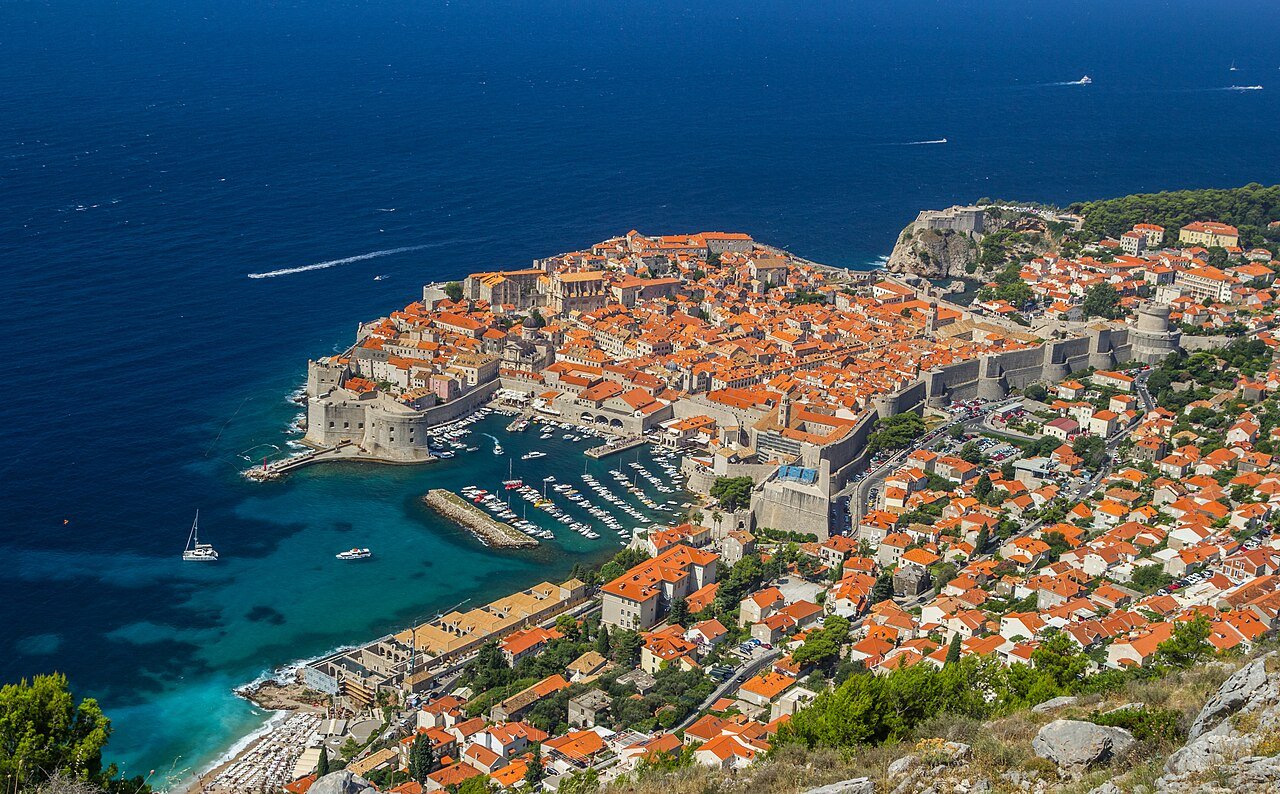
Dubrovnik’s Old City — its complete medieval walls still intact, its marble streets still closed to cars — is one of the Adriatic’s most coherent UNESCO sites. An hour’s drive south brings the Bay of Kotor in Montenegro; two hours north lies Split’s Diocletian Palace. The Dalmatian coast forms a heritage corridor without parallel on the Mediterranean.
Old City of Dubrovnik: The Pearl of the Adriatic City centre
The Old City of Dubrovnik, inscribed in 1979 (expanded 1994) under criteria (i), (iii), and (iv), is a medieval city that functioned as an independent republic — the Republic of Ragusa — from 1358 to 1808, one of the first states in the world to formally abolish the slave trade (in 1416) and the first to recognise the United States. The city walls, 1,940 metres in complete circuit and up to 25 metres high, were built primarily in the fourteenth and fifteenth centuries. Inside them, the main artery — the Stradun, paved with polished limestone — runs between the Pile Gate and the Old Harbour; the baroque churches, medieval palaces, and Jesuit staircase rise off it in a grid that has barely changed since the earthquake of 1667 triggered a Baroque reconstruction of the Gothic city. The wall walk, a 1.5-hour circuit with views over the terracotta rooftops and the Adriatic, is the essential Dubrovnik experience.
Natural and Culturo-Historical Region of Kotor: Montenegro’s Bay 🚗 ~1 hr south into Montenegro
The Natural and Culturo-Historical Region of Kotor in Montenegro, inscribed in 1979 under criteria (i), (ii), (iii), and (iv), protects the medieval walled city of Kotor at the innermost point of the Bay of Kotor — a drowned river canyon that is the southernmost fjord in Europe. The city’s Venetian walls climb the cliff behind it to a fortress 260 metres above; the walk up takes an hour and returns views over the bay that explain why the Venetian Republic maintained the town for four centuries. The Cathedral of Saint Tryphon (1166) holds Romanesque capitals and a treasury of Byzantine icon painting. The town of Perast across the bay, with the island churches of Our Lady of the Rocks and Saint George, completes the itinerary.
Old City of Split with the Diocletian Palace: A Roman Emperor’s Retirement Home 🚗 ~2.5 hrs north
The Old City of Split with the Palace of Diocletian, inscribed in 1979 under criteria (ii), (iii), and (iv), is a Roman imperial palace built between 295 and 305 CE that a living city has grown inside. Diocletian, the only Roman emperor to voluntarily abdicate, built his retirement palace on the Dalmatian coast; within 200 years of his death, refugees from the fall of Salona had moved into the cellars, converted the mausoleum into a cathedral, and turned the streets between the palace columns into a residential quarter. The result — still inhabited today — is the only place in the world where you can eat dinner inside a Roman imperial peristyle. Mestrovic Gallery, a short walk from the palace, displays the work of the most significant Croatian sculptor of the twentieth century.
Stari Grad Plain: Two and a Half Millennia of Agriculture ⛴ 2 hrs by ferry from Split (Stari Grad, Hvar)
Stari Grad Plain on Hvar island, inscribed in 2008 under criteria (ii), (iii), and (iv), is an ancient Greek agricultural landscape — the chora of Pharos, divided by the colonists of Syracuse in the fourth century BCE into regular plots using a system of dry-stone walls and boundary markers that is still recognisable in the modern field pattern. The ancient Agora town of Stari Grad preserves the street grid, and the landscape between town and the inland hills retains 2,400 years of continuous agricultural use. Taking the ferry from Split to Stari Grad and walking the plain gives a perspective on Mediterranean land use unavailable elsewhere in Europe.
Practical information
Dubrovnik Airport lies 19 kilometres south of the old city; buses connect it in 30 minutes. The Montenegro border is 30 kilometres south; driving requires insurance valid in Montenegro (available at the border). Split is 230 kilometres north on the coastal D8 road or by ferry (9 hrs overnight) or fast catamaran (2.5 hrs); the road passes through several Adriatic towns and is one of Europe’s more scenic coastal drives. Dubrovnik’s high season (June–September) is extremely crowded; the maximum daily visitor limit to the Old City walls applies on peak days. November to March is quiet, with limited ferry services to the islands.
Frequently Asked Questions
Is the Old City of Dubrovnik a UNESCO World Heritage Site?
Yes. The Old City of Dubrovnik was first inscribed in 1979 and extended in 1994. It is listed under criteria (i), (iii), and (iv) for its well-preserved medieval urban fabric and its role as the Republic of Ragusa, a significant medieval maritime state.
Can you walk the walls of Dubrovnik Old City?
Yes. The wall walk (approx. 1.5 hours) is accessible from the Pile and Ploce gates. Tickets are purchased on-site; queues build by mid-morning in summer. Early morning or late afternoon is cooler and less crowded. Photography of the terracotta roofscape from the walls is the classic Dubrovnik view.
Is it easy to cross into Montenegro from Dubrovnik?
Yes. The border at Debeli Brijeg is 30 kilometres south and typically takes 15–30 minutes to cross. You need insurance valid in Montenegro (Green Card); rental cars from Dubrovnik may or may not include this — confirm before renting.
Sources
- S1 — Harris, Robin. Dubrovnik: A History. Saqi Books, 2003. ISBN 978-0-86356-332-4.
- S2 — Carter, Francis W. Dubrovnik (Ragusa): A Classic City-State. Seminar Press, 1972. ISBN 978-0-12-812950-0.
Spotted an error? Write to editorial@culturalheritageonline.com and we correct it the same day.