In 1944 the SS broke into a studio in Rome and destroyed what was in it. The painter who worked there was by then a partisan commander, and almost everything he had made before the war went with the furniture. Rebuilding him took an archive, founded seventy-three years later, that had to go and find him inside other institutions’ filing cabinets.
Published in collaboration with the Archivio Filiberto Sbardella, which supplied the photographs and the documentation on the archive’s work.
Filiberto Sbardella was born at Palestrina, in the hills east of Rome, on 30 October 1909, and died in Rome on 28 December 1983. In between he was a painter, a mosaicist, a stage designer, an architect and a partisan, in roughly that order and often in more than one at a time. He entered the studio of the orientalist painter Gustavo Simoni at fourteen, went on to the encaustic master Tito Venturini Papari, then north to the Accademia di Brera. By his late twenties he was showing at the Galleria Barbaroux and the Galleria Gian Ferrari in Milan and taking part in the VI Triennale alongside Carlo Carrà and Corrado Cagli. At the VII Triennale, invited by Gio Ponti and Giuseppe Pagano, he took the first prize and the gold medal.
Six hundred square metres of glass
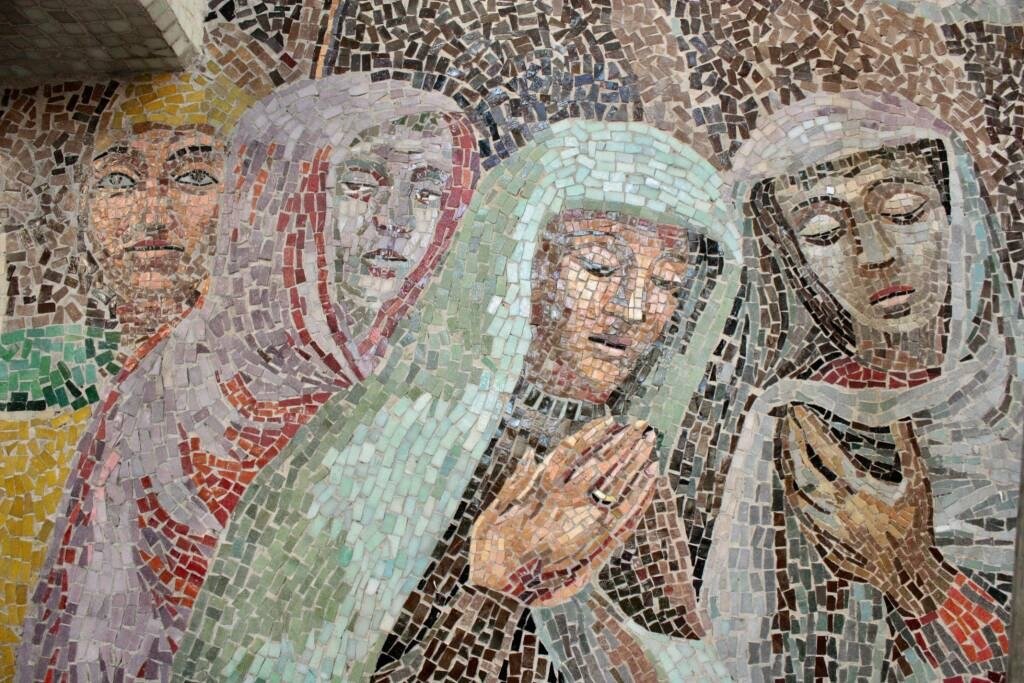
The work that survives best is the work that could not be carried off. In the early 1940s Sbardella lined the interior of the Tempio dei Caduti at San Pellegrino Terme — Luigi Angelini’s memorial church of 1921–24, built for the dead of the First World War — with roughly six hundred square metres of mosaic: the dome, the pendentives, the nave walls, the space above the main door. He worked with the De Min firm, under Angelini’s direction. Biblical episodes run along the walls and scenes of war run with them, which is an unusual pairing for a church and the reason the building is worth the detour up the Brembana valley.
The detail above shows what that means at close range. Four veiled heads, each built from a different family of tesserae — brick reds and ochres for one face, a cold pale green for the veil of the woman at prayer, browns going almost to black in the shadow — and hands raised in a gesture that the mosaicist has cut from twenty different flesh tones so that the light moves across the fingers. It is not devotional decoration applied to a wall. It is drawing done in stone.
Bandiera Rossa
In 1943 the work stopped. Called to Rome by his brother Mario, Sbardella joined the liberation struggle and made contact with the group around Enzio Malatesta, Salvatore Riso, Raffaele De Luca, Orfeo Mucci and Aladino Govoni; he left the Movement of Proletarian Unity for the Communist Movement of Italy, known to everyone as Bandiera Rossa, which was the largest partisan force in occupied Rome. He took part in armed actions and, in January 1944, helped found the group that called itself Armata Rossa. According to the biography kept by ANPI, the national partisans’ association, he wrote to a German diplomat in an attempt to stop the massacre at the Fosse Ardeatine. The attempt failed.
The SS looted and destroyed his studio. That single fact governs everything that came afterwards, including the existence of the archive this article is about: of the painter who had exhibited in Milan through the 1930s, very little material remained in his own hands.
Concrete, and a circus at EUR
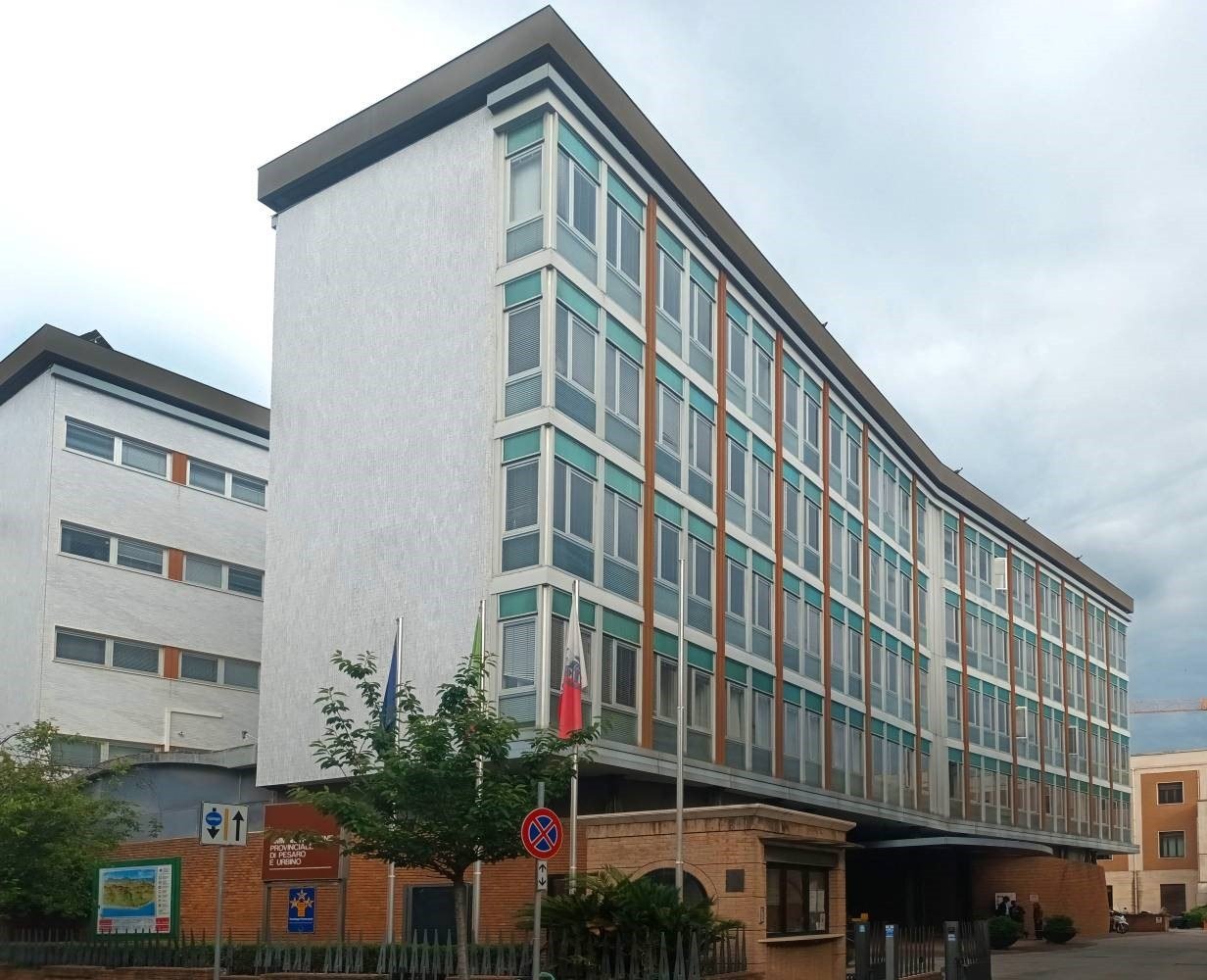
After the war he took a degree in engineering at Geneva and turned to building. The list is a map of a particular Italy: housing at Labaro and Tor Bella Monaca on the edges of Rome, the CGIL trade-union school at Ariccia, the Communist Party headquarters in via dei Frentani, an office block in via Palestro now occupied by a state agency, a Mercedes-Benz plant in Milan, and at Pesaro the building above — put up for the Marche regional administration and now the seat of the province of Pesaro and Urbino. Ribbon windows, a projecting eaves slab, a wedge-shaped plan that follows the street: unshowy postwar public architecture of the kind that gets demolished before anyone thinks to list it.
There was also a detour through cinema. In 1954 Sbardella designed the sets of Riccardo Freda’s Teodora, imperatrice di Bisanzio together with Antonio Valente, rebuilding the hippodrome of Constantinople in the EUR district of Rome: two banks of eight tiers, a hundred and twenty metres long, reportedly using more than a thousand cubic metres of marble, travertine and porphyry for the chariot race. Between 1978 and 1979, near the end of his life, he was received several times by President Sandro Pertini.
An archive assembled from other people’s archives
The Archivio Filiberto Sbardella was constituted in 2017, starting from what was left of the professional studio’s paperwork. Since then, according to the archive, the holdings have grown by systematic search through public and private collections: the Archivio Centrale dello Stato, the Galleria Nazionale d’Arte Moderna e Contemporanea, the MART at Rovereto, the Biennale di Venezia, the Accademia di Brera, the Triennale di Milano and the archives of the CGIL. Drawings, projects, photographs, correspondence and testimony have been brought back together from institutions that had each been holding one piece of a career without knowing what the others held. The archive also reports working with the Department of Architecture of the University of Bologna, and with local authorities, professional bodies and research institutes.
The public face of that work is an itinerant exhibition project, La terra è di chi la coltiva — the land belongs to those who work it — conceived and curated by the sociologist Pasquale Biagio Cicirelli and the architect Claudio Gatti, and running since 2019. It has been shown at the Museo della Terra Pontina at Latina, through most of 2020; at Palestrina, the artist’s birthplace, in July 2021; and in September and October 2023 inside the Tempio dei Caduti itself, where the mosaics are the exhibition. Other chapters have followed: Ritorno a Palestrina, Exhibit: il ‘900 di Filiberto Sbardella, Architettura per il sociale, I mosaici del Tempio. Each showing has tended to shake loose more material — the San Pellegrino edition brought out unpublished writings from the diocesan archive of Bergamo and the parish archive, dating from the months when the mosaics were being laid.
That circularity is the point, and it is the reason this is a story about heritage rather than about one artist’s reputation. An archive is usually thought of as the end of a life: what is left when the work stops. This one had to be built the other way round, from the outside in, because the inside had been destroyed in 1944. What it recovers is not only Sbardella but a whole layer of twentieth-century Italian work — murals, mosaics, union schools, public housing — that sits below the threshold at which art history usually starts paying attention.
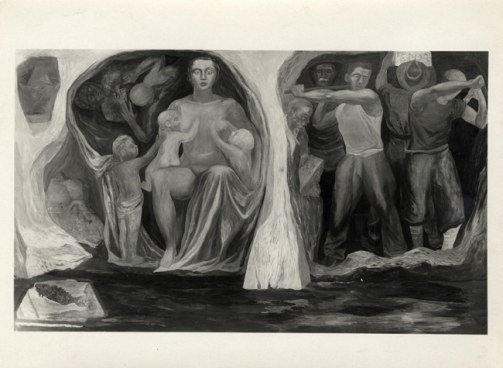
About these images. The works reproduced here — the mosaics of the Tempio dei Caduti, the mural for the VII Triennale and the Pesaro building — are by Filiberto Sbardella, who died in 1983; under Italian law (L. 633/1941) rights run for seventy years from the death of the author, so they remain protected. They are published here for documentation, study and critical purposes, under Art. 70 of L. 633/1941 and the fair-use provision of 17 U.S.C. §107, from photographs supplied to Cultural Heritage Online by the Archivio Filiberto Sbardella. No reproduction rights are granted and the images are not offered for sale; any request concerning the works should be addressed to the archive and to the rights holders. See our terms and the DMCA contact published there.
Sources
- S1 — Bossaglia, Rossana. Il Novecento italiano: Cronache, memorie, documenti. Feltrinelli, 1979. ISBN 978-88-07-81012-1.
- S2 — Crispolti, Enrico. Storia e critica del Futurismo e delle avanguardie. Laterza, 1986. ISBN 978-88-420-2712-6.
Related
- Tempio dei Caduti, San Pellegrino Terme — the building that holds the mosaics.
- Composizione by Filiberto Sbardella, 1943 — a note published on this site in 2020.
Spotted an error? Write to editorial@culturalheritageonline.com and we correct it the same day.