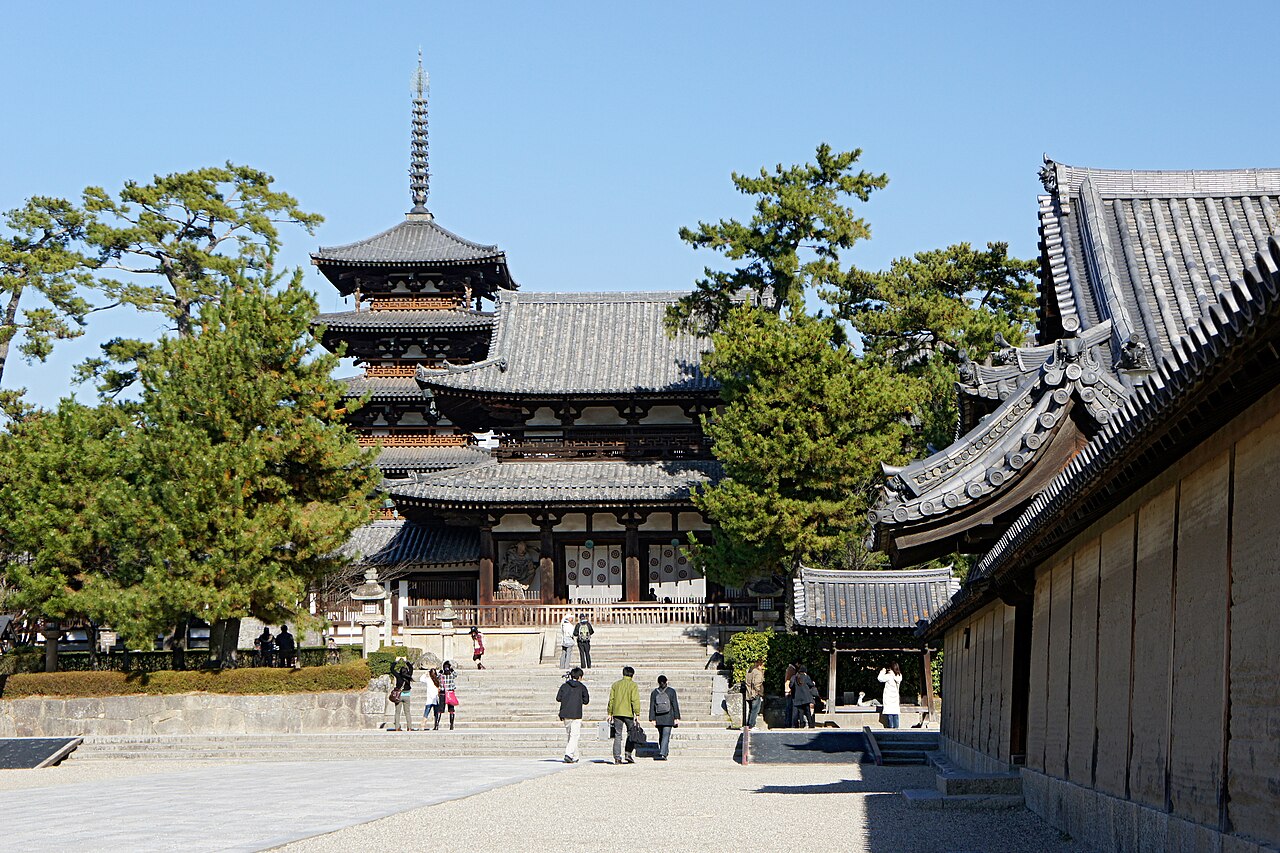
The Buddhist Monuments in the Horyu-ji Area, inscribed by UNESCO in 1993, contain 48 structures dating from the 7th and 8th centuries — the oldest surviving wooden buildings on earth. The complex stands in Ikaruga, Nara Prefecture, 10 kilometres southwest of the ancient capital; Prince Shotoku founded the first structures here in 607 CE and established a site that has remained central to Japanese Buddhist scholarship ever since.
The Kinki plain and the ancient capitals Nara · Osaka · Kyoto — 10 to 50 km
Ten kilometres east of Horyu-ji by JR Yamatoji Line, the Historic Monuments of Ancient Nara form the nearest UNESCO cluster in Japan’s main island. Nara served as the country’s first permanent capital from 710 to 784 CE, and the eight inscribed properties include Todai-ji, whose 15-metre bronze Buddha was cast using Japan’s entire treasury reserve of copper and zinc. The Daibutsuden hall containing it is the largest wooden building in the world by floor area: burned and rebuilt at two-thirds the original scale in 1709 CE, it still measures 57 metres wide and 49 metres high. In the surrounding park, 1,200 sika deer have grazed under imperial protection since the 8th century, regarded as divine messengers of the Kasuga Taisha shrine. The nearby Yakushiji temple was originally built in Fujiwara (the capital before Nara) in 680 CE and relocated stone by stone when the court moved; reconstruction of its remaining halls continues under traditional methods.
Forty kilometres north by JR Nara Line, the 17 properties of the Historic Monuments of Ancient Kyoto cover 13 Buddhist temples, 3 Shinto shrines, and 1 castle across Kyoto City, Uji, and Otsu. Kyoto served as Japan’s imperial capital from 794 to 1869 CE — the longest consecutive tenure in Japanese history. The Kinkaku-ji pavilion, rebuilt in 1955 after a monk burned the 14th-century original, covers its upper two floors entirely in gold leaf and reflects in Kyokochi pond. The Ryoan-ji rock garden places 15 stones on white raked gravel in an arrangement where only 14 are visible from any single viewpoint along the wooden veranda. Nijo Castle, built in 1603 for the first Tokugawa shogun’s visit to Kyoto, contains “nightingale floors” — boards fitted with iron clamps that squeak under footstep pressure to detect movement at night. A day at Horyu-ji and a half-day at Nara’s monuments, with a morning Shinkansen connection to Kyoto, forms the core of the Yamato-Kinai UNESCO circuit.
Forty-five kilometres west of Nara, accessible by Kintetsu from Osaka-Namba, the Mozu-Furuichi Kofun Group in Osaka Prefecture completes the Kinki UNESCO picture with a pre-Buddhist dimension. The 49 burial mounds inscribed in 2019 were built for Kofun-period rulers between the 3rd and 6th centuries CE — one to three generations before Buddhism arrived from the Korean Peninsula via the Baekje kingdom. Nintoku-tenno-ryo Kofun, the largest mound in the group, measures 486 metres in total length and its footprint exceeds that of the Great Pyramid of Giza. Its triple-moated keyhole shape — a round mound attached to a trapezoidal forecourt — is specific to Japanese burial culture of this period; Chinese and Korean contemporaries used rectangular earthworks. The Imperial Household Agency restricts interior access, but the outer moat perimeter path provides a circumnavigation of approximately 2.8 kilometres. The contrast between the austere forested mounds of Mozu-Furuichi and the lacquered, gilded halls of Horyu-ji built one or two generations later shows the speed with which Buddhism transformed Japanese material culture after 552 CE.
One hundred kilometres south of Horyu-ji by JR to Wakayama and local services into the Kii Peninsula, the Sacred Sites and Pilgrimage Routes in the Kii Mountain Range inscribe the most extensive UNESCO property on Japan’s main island. The three Grand Shrines of Kumano — Hongu Taisha, Nachi Taisha, and Hayatama Taisha — were connected by 237 kilometres of pilgrimage road that carried emperors, retired sovereigns, and court nobles from the Heian period. Nachi Taisha sits directly above Nachi Falls, which drops 133 metres in a single unbroken fall and is itself worshipped as a deity. Mount Koya in the northern section holds 117 sub-temples within a monastic compound founded by the monk Kukai in 819 CE; the Okunoin cemetery at its centre has accumulated 200,000 stone markers around Kukai’s mausoleum, where Shingon adherents believe he remains in eternal meditation and receive a formal meal twice daily. The Kumano Kodo network’s Nakahechi Route has been designated a dual World Heritage route alongside Spain’s Camino de Santiago, the only such pairing in UNESCO history.
West along the Seto Inland Sea Himeji · Hiroshima · Shimane — 80 to 480 km
Eighty kilometres west of Horyu-ji by Shinkansen from Shin-Osaka, Himeji Castle is the largest and best-preserved feudal castle in Japan. The 83-building complex was inscribed alongside Horyu-ji in 1993, and the two sites together represent the earliest and finest examples of Japan’s two great construction traditions — Buddhist temple architecture and samurai castle engineering. Himeji-jo’s white-plastered exterior, applied as fire protection over its wooden frame, gives the complex its common name Shirasagi-jo, the White Heron Castle. The castle changed hands 48 times but was never destroyed by fire, earthquake, or successful siege. Its defensive path — three concentric gate sequences that switch direction repeatedly, each designed to trap attackers in a covered killzone — represents the mature form of Japanese castle planning as developed during the Sengoku wars of the 16th century. The main tower’s six interior floors retain original mechanisms for dropping stones, pouring boiling liquid, and firing from over 1,000 loopholes.
Three hundred thirty kilometres west by Sanyo Shinkansen, the two Hiroshima UNESCO inscriptions present the sharpest historical contrast in Japan’s heritage inventory. The Hiroshima Peace Memorial — the skeletal ruin of the 1915 Industrial Promotion Hall that stood directly below the atomic bomb’s detonation point on 6 August 1945 — was preserved by city resolution in the first postwar decade and inscribed by UNESCO in 1996 over Japanese government opposition at the time. The building’s dome survived only because the detonation was nearly directly overhead, directing the main blast force downward rather than laterally into the structure. On Miyajima Island, 20 minutes from Hiroshima Station by JR and ferry, the Itsukushima Shrine was built over a tidal channel beginning in the 6th century, with the present buildings dating from the 12th-century patronage of Taira no Kiyomori. The 16-metre O-torii gate stands 200 metres offshore; at high water it appears to float; at low tide visitors can walk to its base through exposed sand.
Four hundred eighty kilometres west in Shimane Prefecture, the Iwami Ginzan Silver Mine and its Cultural Landscape was the most productive silver source in the world during the 1580s, supplying an estimated one-third of global silver production at its peak. The mine is notable in the UNESCO list for preserving not merely the shafts and processing facilities but the entire operational landscape: 700 mine entrances driven into the mountain, the valley processing areas and furnace foundations below, and the preserved port-route town of Tomogaura, which shipped the refined silver to traders at Hakata and Sakai. At peak extraction the area supported a population of 200,000, with 53 temples and shrines recorded within the site boundaries. The silver financed the Tokugawa state’s consolidation of power and was traded with Portuguese and Dutch merchants, connecting Iwami Ginzan to early modern global commerce before Japan’s period of isolation began in 1633. From Hiroshima, the mine is reached by limited express to Oda City Station (80 minutes) and bus to Omori Ginzan (15 minutes).
Practical information
Horyu-ji is reached by JR Horyuji Station on the Yamatoji Line, 11 minutes from JR Nara Station and 25 minutes from JR Tennoji in Osaka. The Western Precinct (Nishi-in, containing the pagoda and Kondo main hall) and Eastern Precinct (Higashi-in, containing the Yumedono Hall of Dreams) share a combined entry ticket. Opening hours are 8:00–17:00 from late February to November, narrowing to 8:00–16:30 in winter; the site closes one hour after the posted last entry time. The complex requires approximately 2 hours for a thorough visit. A JR Kansai Area Pass covers the Yamatoji Line from both Osaka and Nara, making Horyu-ji a natural stop between the two cities without additional ticketing. The nearest international airports are Kansai International (approximately 75 minutes combining JR Haruka to Osaka and the Yamatoji Line south) and Osaka Itami (45 minutes to Osaka by limousine bus, then 25 minutes on the Yamatoji Line).
Frequently Asked Questions
Why are the Buddhist Monuments of Horyu-ji considered the oldest surviving wooden buildings in the world?
Horyu-ji’s buildings survive because of an unusual convergence of location, construction technique, and historical fortune. The West Precinct was rebuilt following the destruction of the original 607 CE foundation by fire in 670 CE; the existing structures date from the early 8th century, making them older than any surviving wooden building in China, Korea, or anywhere else. The site’s position in rural Ikaruga kept it away from the castle sieges and urban fires that destroyed competing monuments in Kyoto and Nara. The Five-Storey Pagoda incorporates a central pillar — the shinbashira — that is not structurally joined to the surrounding floors, allowing each level to sway independently during earthquakes; the same principle was applied at a vastly larger scale in the design of Tokyo Skytree, completed in 2012. Carbon dating of the pagoda timbers and dendrochronological analysis of the main hall beams consistently place the existing structures in the early 8th century. Ernest Fenollosa, the American art historian, opened the sealed Yumedono Hall in 1884 and found the principal Kannon statue wrapped in cloth that dissolved on contact with air after more than 1,000 years undisturbed — the most dramatic evidence of the site’s long preservation without modern intervention.
How do I combine Horyu-ji with Ancient Nara and Ancient Kyoto in a practical itinerary?
The standard three-day approach uses Kyoto or Osaka as a base. On the Nara day, take JR Nara Line from Kyoto (45 minutes) or JR from Osaka-Namba (35 minutes), spend the morning at Todai-ji, Kasuga Taisha, and the deer park, then continue by Yamatoji Line to JR Horyuji Station (10 minutes from JR Nara) in the early afternoon, allowing 2 hours at Horyu-ji before returning. A JR Kansai Area Pass covers all segments. The light on the Five-Storey Pagoda is particularly strong between 13:00 and 15:00, and crowds thin noticeably after 14:30. If arriving from Tokyo on a JR Pass, stop at Horyu-ji first (southbound train to Osaka, then Yamatoji Line north to Horyuji), proceed to Nara by afternoon, and continue to Kyoto to overnight — the itinerary follows the rail geography without backtracking. Mozu-Furuichi Kofun mounds in Osaka are most efficiently visited on the day of arrival or departure, as they require a Kintetsu connection from Osaka that is separate from the JR network.
What is the best time of year to visit the UNESCO sites of the Kinki region?
Late October to mid-November combines autumn foliage, cool temperatures, and full site access. The Kii Mountain pilgrimage trails through Yoshino and Kumano are particularly striking when the maple canopy turns; Yoshino itself, while not part of the UNESCO inscription, holds approximately 30,000 wild cherry trees on the mountain accessible from Kintetsu Yoshino Line, which doubles as the approach to the Kii inscription’s northern sector. Spring cherry-blossom season (late March to mid-April) fills every inn and hotel in the Kinki region with months of advance booking and premium pricing; it is spectacular but logistically difficult. Summer is hot and humid throughout the Yamato plain — Nara regularly exceeds 35°C in August — and the rainy season (mid-June to mid-July) affects trail conditions in the Kii Mountains. December to February offers the lowest crowds at Horyu-ji, Ancient Nara, and Kyoto, with clear winter skies ideal for exterior photography and some secondary structures in Kyoto temple gardens closed for maintenance. The JR Kansai Wide Area Pass (5 consecutive days) covers Shinkansen to Himeji and return, the Haruka to Kansai Airport, and all ordinary express services on the Kinki network.
Sources
- S1 — UNESCO World Heritage Centre — Buddhist Monuments in the Horyu-ji Area (Ref. 660) — https://web.archive.org/web/20230601000000/https://whc.unesco.org/en/list/660/
- S2 — Horyu-ji Temple Official Portal — https://whc.unesco.org/en/list/660/
- S3 — Paine, Robert Treat, and Alexander Soper. <em>The Art and Architecture of Japan</em>. Yale University Press, 1981. ISBN: 978-0-8248-2337-5.
Spotted an error? Write to editorial@culturalheritageonline.com and we correct it the same day.