Palau has one UNESCO World Heritage Site: the Rock Islands Southern Lagoon (inscribed 2012) — a 100,200-hectare mixed natural and cultural site containing 445 limestone mushroom-shaped islets, a marine lake system with unique marine life (including marine jellyfish without nematocysts), and evidence of pre-European Palauan cultural occupation. Ngerulmud, the world’s least-populated national capital (population approximately 400), is in Melekeok State on the island of Babeldaob, 35 km from the tourist and commercial hub of Koror. From Cultural Heritage Online.
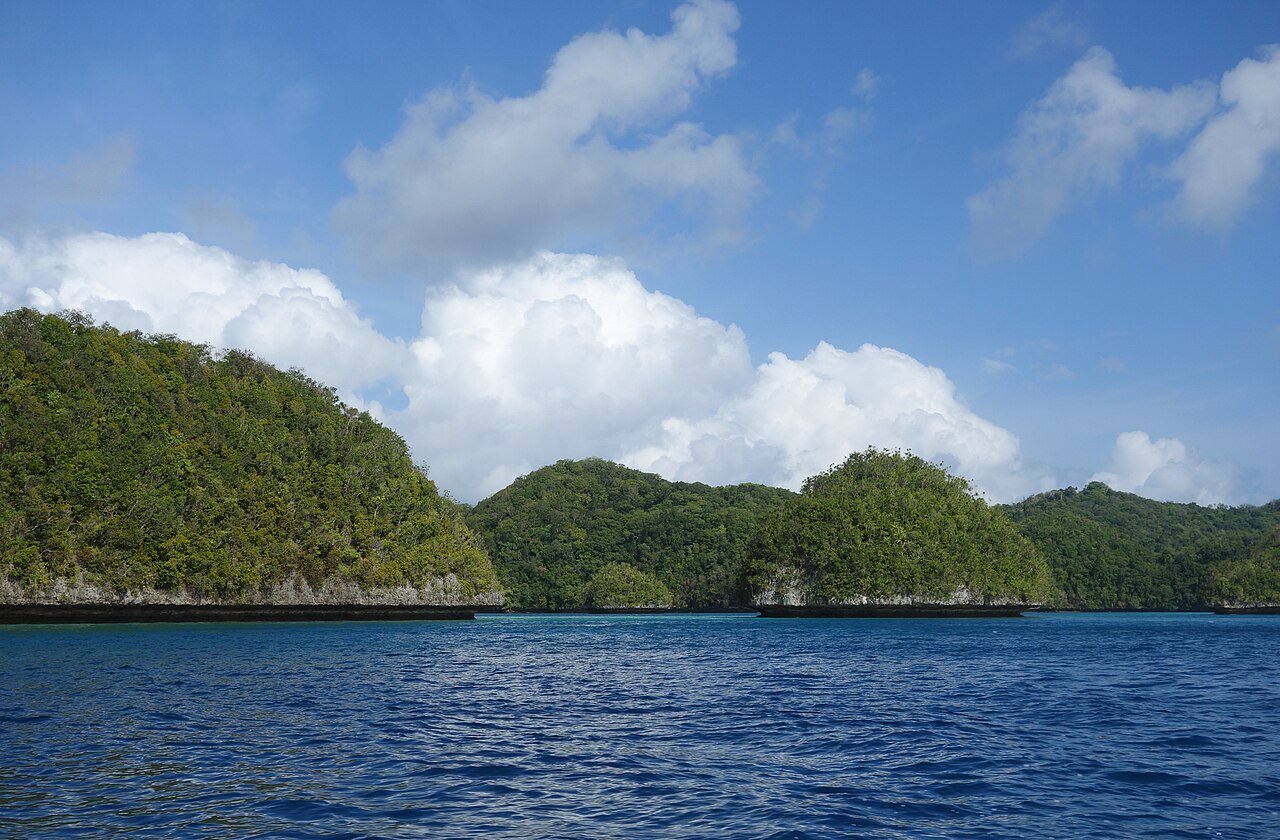
Rock Islands Southern Lagoon 35 km south of Ngerulmud — accessible by boat from Koror
The Rock Islands are 445 limestone and coral islets in the southern lagoon of Palau, rising from the sea in characteristic mushroom shapes — the wider upper portions densely forested, the narrower lower sections undercut by wave action and seawater dissolution to give the distinctive mushroom silhouette. The lagoon is a globally recognised diving destination; it contains some of the highest coral diversity in the Pacific, with approximately 385 coral species, 1,000 fish species, and unusually diverse assemblages of marine invertebrates in the protected lagoon waters.
The most unusual feature of the Rock Islands ecosystem is the system of marine lakes — approximately 50 saltwater lakes enclosed within the limestone islands, connected to the ocean through seawater seeping through porous rock rather than by open channels. Several of these lakes, most famously Jellyfish Lake (Ongeim’l Tketau), have evolved isolated populations of marine organisms that have diverged significantly from their open-ocean relatives over thousands of years. Jellyfish Lake is home to two species of jellyfish — the mastigias jellyfish (Mastigias papua etpisoni) and the moon jellyfish (Aurelia sp.) — that have lost most or all of their stinging capacity, having evolved in an environment without predators. Snorkelers can swim through millions of these jellyfish without being stung. UNESCO inscribed the site as a mixed (natural and cultural) site in 2012, recognising both the marine biodiversity and the evidence of Palauan cultural occupation of the islands over 3,000 years.
Getting there from Ngerulmud: The Rock Islands are accessible by boat from Koror (the commercial capital, 35 km from Ngerulmud/Melekeok) in approximately 30–45 minutes. Most visitors arrive at Palau International Airport near Koror. Day tours to the Rock Islands and Jellyfish Lake (if open — it was closed 2016–2019 following jellyfish population collapse due to El Niño drought) depart from Koror daily. Allow: 2–3 days minimum for Rock Islands diving/snorkelling; add 1 day for Ngerulmud’s new government complex. Best for: Coral reef diving; jellyfish swimming; marine biodiversity.
Frequently Asked Questions
How many UNESCO World Heritage Sites does Palau have?
One: the Rock Islands Southern Lagoon, inscribed as a mixed natural and cultural site in 2012. It is the only UNESCO World Heritage Site in Micronesia (excluding the Federated States of Micronesia’s Nan Madol, inscribed 2016, which is technically in the eastern Pacific rather than Micronesia proper in some classifications).
Why can visitors swim with jellyfish at Jellyfish Lake?
Jellyfish Lake is one of Palau’s marine lakes — a saltwater lake enclosed within a limestone island, connected to the ocean by underground seepages through porous rock but isolated from open-ocean water circulation. The mastigias jellyfish (Mastigias papua etpisoni) and moon jellyfish (Aurelia sp.) have been isolated in this lake for an estimated 12,000 years (since the post-glacial rise of sea level flooded the limestone basin). In the absence of natural predators — no sea turtles, few fish that eat jellyfish — the species evolved reduced stinging capacity. The stinging cells (nematocysts) are vestigial and insufficient to penetrate human skin. The lake was closed to swimming from 2016 to 2019 after a prolonged El Niño drought caused the lake to stratify differently, reducing the oxygen available to the jellyfish and causing a dramatic population collapse. The population has since recovered.
What is the significance of Ngerulmud as a capital?
Ngerulmud is one of the smallest national capitals in the world by population, with approximately 400 permanent residents. It became the capital of Palau in 2006 when a new government complex was inaugurated in Melekeok State on Babeldaob Island, replacing Koror as the seat of government. The government complex, built with Japanese aid, consists of large neoclassical buildings (modelled partly on the US Capitol Building) set in open grounds on a hilltop above Babeldaob’s interior. The decision to move the capital from Koror to Melekeok was driven in part by concerns about overdevelopment in Koror and a desire to spread economic activity to the less-developed main island of Babeldaob.
What is the Palau Pledge and how has it affected tourism?
Since 2017, all foreign visitors to Palau must sign the Palau Pledge upon arrival — a commitment, stamped in the visitor’s passport, to “tread lightly, act kindly, and explore mindfully.” The pledge commits visitors to specific behaviours: not to harm the reef, not to collect marine organisms, not to use single-use plastics, and to support local conservation efforts. Palau was the first country to mandate such a pledge as a condition of entry. The pledge has attracted significant international attention as a model for sustainable tourism management and has been accompanied by other conservation measures, including a ban on reef-damaging sunscreen chemicals (2020) and a substantial expansion of marine protected areas (the Palau National Marine Sanctuary, established 2015, covers approximately 80% of Palau’s exclusive economic zone and bans all commercial fishing there).
Sources
- S1 — Rainbird, Paul. The Archaeology of Micronesia. Cambridge University Press, 2004. ISBN 978-0-521-65630-6.
- S2 — Kirch, Patrick Vinton. On the Road of the Winds: An Archaeological History of the Pacific Islands. University of California Press, 2000. ISBN 978-0-520-22347-9.
Spotted an error? Write to editorial@culturalheritageonline.com and we correct it the same day.