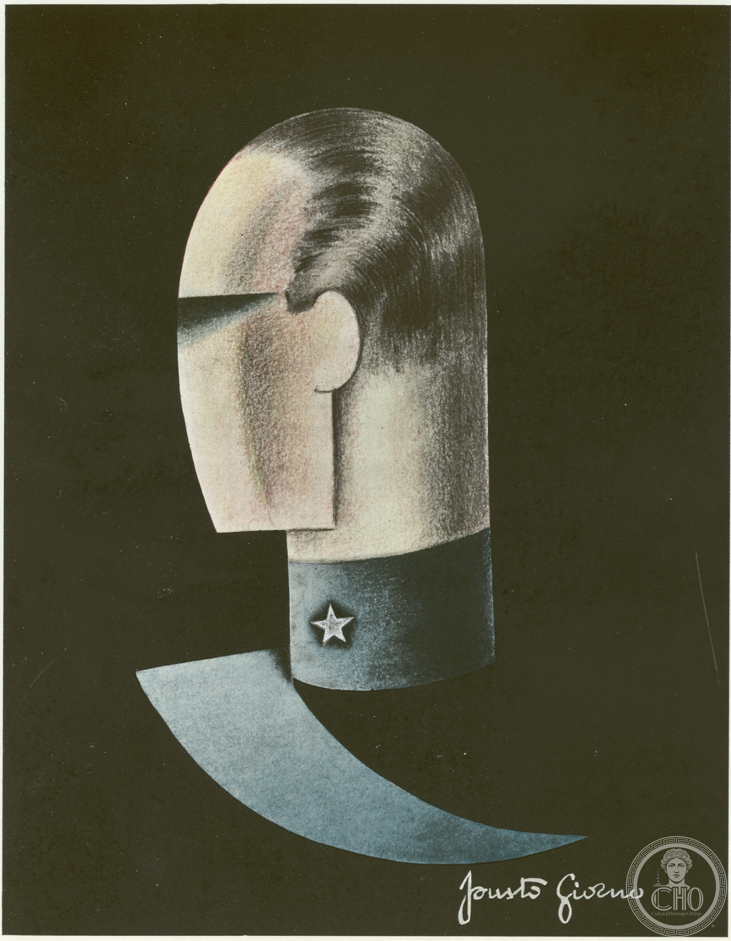
A head reduced to a few curved planes: cream and grey pencil against a black ground, a military collar with a single star, and underneath it a blue shape that could be a sash, a cape or nothing at all. The signature reads «Fausto Giorno».
The drawing does not try to resemble its subject in the ordinary sense. The profile is built from three or four simplified surfaces — a shaved dome of hair rendered in parallel pencil strokes, a smooth cheek, a jaw cut off at a sharp angle — the kind of synthesis that Italian illustrators of the early 1930s borrowed from Futurism without going as far as full abstraction. The star on the collar and the erect bearing are the only clues to rank; everything else is left to the geometry. Below the neckline, a single curved wedge of blue hangs disconnected from the figure, more a graphic accent than a piece of clothing.
The subject, per the collector, is Umberto di Savoia — Crown Prince Umberto, heir to the Italian throne he would occupy for a few weeks in 1946. The date given is January 1933.
The signature belongs to Fausto Giorno, the pen name of Tiburzio Notte, born in Marostica (Vicenza) in 1899: an obscure Futurist whose work has only recently been reconstructed by the art historian Anna Maria Damigella, in a 2021 study tracing his path «da Lipari a Bologna» — from a period of political confinement on the island of Lipari between 1928 and 1931, where his drawing style formed under the influence of Balla and Depero, to a stint as staff illustrator for the Bologna city magazine Il Comune di Bologna between November 1931 and April 1933. Damigella’s research describes numerous portraits and graphic works from that Bologna period. This drawing, dated January 1933, falls squarely inside it, though no published record of this specific portrait has been found: this may be the first time it surfaces publicly. No death date for the artist has been established, and the attribution rests on the collector’s reading of the signature and on the fit with Giorno’s documented Bologna years, not on a catalogued source for this exact sheet.
About this image. The work is still protected by copyright: under Italian law (L. 633/1941) rights run for 70 years from the death of the author, and no death date for Fausto Giorno has been established, so that term cannot be considered expired. It is reproduced here for documentation, study and critical purposes only, under Art. 70 of L. 633/1941 and the fair-use provision of 17 U.S.C. §107. The scan was made by the collector from his own copy of the work — part of the period material he keeps in a private archive: owning the physical sheet is not the same as holding the rights to the work. The image is not offered for sale, no reproduction rights are granted, and any request concerning the work should be addressed to the rights holders. Cultural Heritage Online publishes this material to document it, with no celebratory intent; see our terms and the DMCA contact published there.
Sources
- S1 — Oliva, Gianni. I Savoia: Novecento anni di una dinastia. Mondadori, 1998. ISBN 978-88-04-42513-7.
- S2 — Bossaglia, Rossana. Il Novecento italiano: Cronache, memorie, documenti. Feltrinelli, 1979. ISBN 978-88-07-81012-1.
Spotted an error? Write to editorial@culturalheritageonline.com and we correct it the same day.