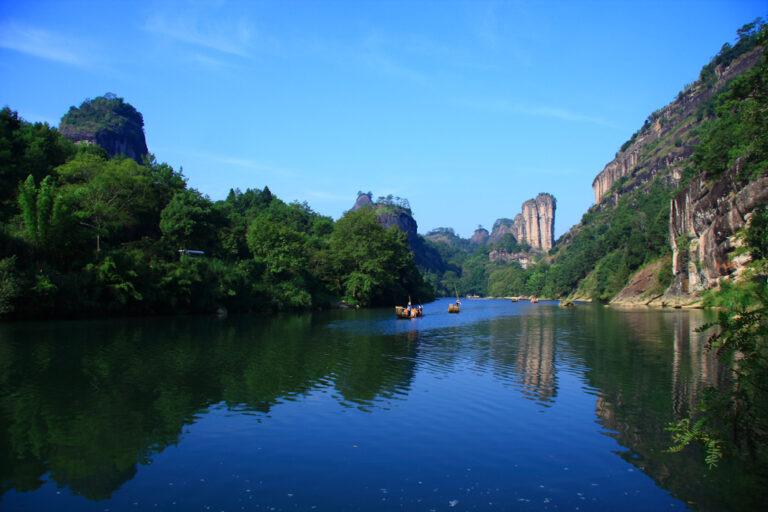
Brunei has no UNESCO World Heritage Sites. The nearest inscribed sites are in the Malaysian state of Sarawak (bordering Brunei on Borneo): Gunung Mulu National Park (inscribed 2000), a limestone karst landscape with the world’s largest cave passage, and Kinabalu National Park (inscribed 2000), centred on Southeast Asia’s highest mountain. From Cultural Heritage Online.
Gunung Mulu National Park, Malaysia ~150 km east of Bandar Seri Begawan — domestic flight from Miri or boat via Miri
Gunung Mulu National Park covers approximately 52,864 hectares of the Kelabit Highlands of Sarawak, centred on a dramatic limestone karst massif rising from tropical lowland rainforest. The park is most famous for its cave systems — the most extensive explored cave network in tropical Asia. The Sarawak Chamber, within the Gua Nasib Bagus cave, is the world’s largest known cave chamber by volume: approximately 600 metres long, 415 metres wide, and 80 metres high, large enough to contain 40 Boeing 747 aircraft. The Deer Cave is the world’s largest cave passage open to the public (over 100 metres wide and high in places), home to approximately 3 million wrinkle-lipped free-tailed bats (Chaerephon plicatus) that emerge in a column at dusk, circling in thousands above the cave entrance before dispersing to feed — one of the most spectacular natural wildlife shows in Southeast Asia.
The park is also significant for its biodiversity: it contains one of the most species-rich lowland dipterocarp forests in Borneo, the world’s largest flower cluster (Coelogyne spp. of orchid) in some areas, pitcher plants of the genus Nepenthes, and classic examples of both the Pinnacles — sharp-tipped limestone spires rising up to 50 metres, accessible by a challenging climb — and the biodiversity of the dipterocarp forest. UNESCO inscribed the site in 2000. Access from Miri (Sarawak) is by 45-minute domestic flight or a full-day overland/river journey.
Brunei’s Own Heritage — The Kampong Ayer Water Village
Bandar Seri Begawan is unusual among Southeast Asian capitals for its Kampong Ayer (Water Village) — a network of approximately 4,200 buildings on stilts over the Brunei River, connected by 36 km of wooden walkways and inhabited by approximately 13,000 people. The water village has been continuously occupied for at least 400 years (some estimates place it much earlier), and was described by the explorer Pigafetta, who visited with Magellan’s fleet in 1521, as a “Venice of the East.” The village has its own mosques, schools, a fire brigade, and a police station, all on stilts over the water.
Getting there from Bandar Seri Begawan: Gunung Mulu NP: fly Brunei International Airport to Miri, Sarawak (45 min), then fly Miri to Mulu (35 min MASwings); or Miri to Mulu by boat and road (8 hours). Water Taxi from BSB waterfront to Kampong Ayer: 5 minutes, running constantly. Allow: Mulu NP: minimum 2–3 nights. Kampong Ayer: 1–2 hours. Best for: Cave exploration; limestone karst landscape; stilt village heritage.
Frequently Asked Questions
Does Brunei have any UNESCO World Heritage Sites?
No. Brunei has no inscribed UNESCO World Heritage Sites. The Kampong Ayer water village in Bandar Seri Begawan, the Ulu Temburong National Park (a nearly untouched lowland rainforest that covers approximately 70% of the Temburong district), and the Tasek Merimbun Heritage Park (Brunei’s largest freshwater lake and ASEAN Heritage Park) have been discussed as potential candidates, but no formal nomination has been submitted.
What is the Sarawak Chamber and why is it significant?
The Sarawak Chamber in Gunung Mulu National Park is the world’s largest known cave chamber by volume. It measures approximately 600 metres long, 415 metres wide, and up to 80 metres high, giving it a volume of approximately 10 million cubic metres — large enough to accommodate 40 Boeing 747 aircraft or eight full-size football pitches simultaneously. It was discovered in 1981 by a joint British-Malaysian expedition. The chamber is formed in Melinau Limestone, a massive bedded limestone deposit that underwent uplift and was progressively dissolved from within by acidic water over millions of years, eventually creating the vast void that is now the Sarawak Chamber.
What makes Brunei wealthy, and how does oil affect the heritage landscape?
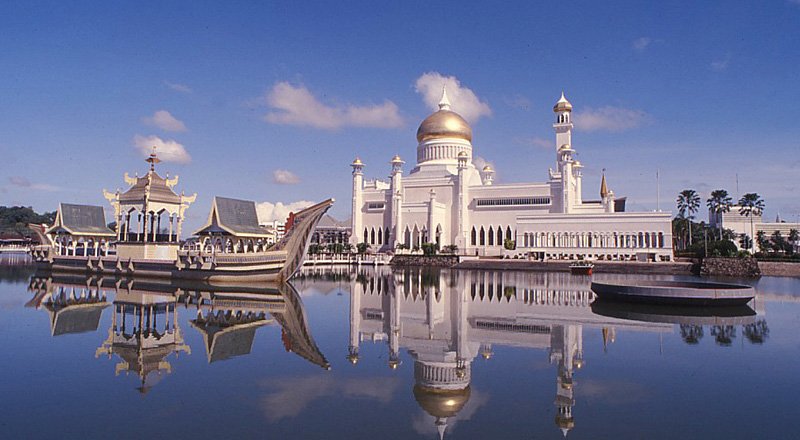
Brunei discovered offshore oil in 1929 and has been one of the wealthiest nations per capita in Southeast Asia since the oil boom of the 1970s. The sultanate’s economy is dominated by petroleum revenues, which fund a welfare state that provides free healthcare, education, and heavily subsidised housing to citizens. The oil wealth has resulted in a built environment strongly influenced by modern construction: Bandar Seri Begawan is a relatively recent, purpose-built capital landscape rather than an organic historic city. The most significant historic structures are the Omar Ali Saifuddien Mosque (1958) and the Istana Nurul Iman (1984, one of the largest residences in the world), both constructed in the oil era.
What is Kampong Ayer and how many people live there?
Kampong Ayer (“Water Village” in Malay) is a network of wooden structures, walkways, mosques, schools, and community buildings on stilts over the Brunei River in Bandar Seri Begawan. It currently houses approximately 13,000 people, down from approximately 30,000 in the 1950s, as many residents have moved to land-based housing provided by the government. The settlement has been continuously occupied for at least 400 years; Magellan’s expedition described it in 1521. Despite its age and historic character, many buildings in the water village are relatively modern — continuous replacement and upgrading of the timber stilt structures has been occurring throughout the settlement’s history.
Sources
- S1 — Saunders, Graham. A History of Brunei. RoutledgeCurzon, 2002. ISBN 978-0-7007-1698-2.
- S2 — MacKinnon, Kathy, et al. The Ecology of Kalimantan: Indonesian Borneo. Periplus Editions, 1996. ISBN 978-0-945971-73-3.
Spotted an error? Write to editorial@culturalheritageonline.com and we correct it the same day.