Grenada has no UNESCO World Heritage Sites. The island’s most significant heritage includes the historic fortifications ringing Saint George’s harbour, the nutmeg plantation landscape of the interior, and the underwater sculpture park off Molinière Point — one of the first such permanent art installations in the Caribbean. The nearest inscribed UNESCO site is Brimstone Hill Fortress National Park in St Kitts, approximately 300 km northwest. From Cultural Heritage Online.
Fort George and the Saint George’s Fortifications
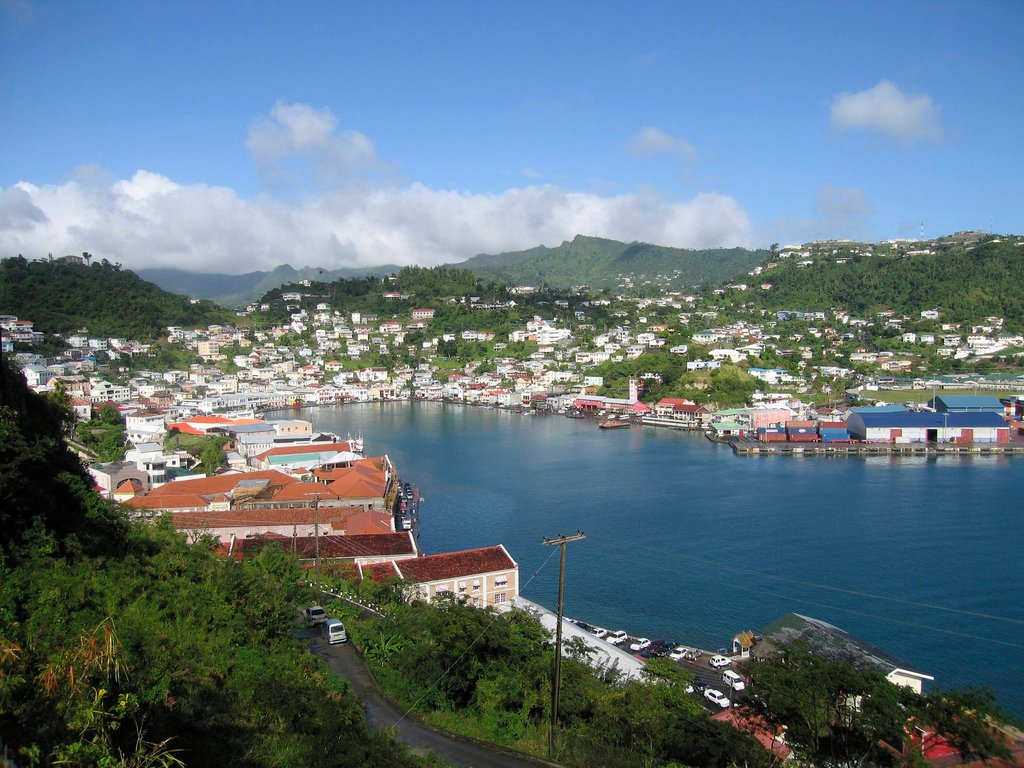
Saint George’s is protected by a ring of British colonial fortifications that define the character of the hillsides above the harbour. Fort George (1705), the oldest and largest, sits on the headland above the harbour entrance, with views extending across the Carenage (the inner harbour) and out to the Atlantic. Fort Frederick (1779) and Fort Matthew occupy the ridge above the town; together the three forts give the capital a skyline of battlements and towers distinctive among Caribbean cities. Fort George gained historical notoriety on 19 October 1983, when Prime Minister Maurice Bishop and several cabinet members were executed there by a faction of the ruling New Jewel Movement — an event that preceded the US military intervention three days later.
The inner harbour of Saint George’s, the Carenage, is a former volcanic crater that forms one of the most sheltered natural anchorages in the Caribbean. The horseshoe of Georgian and Victorian commercial buildings facing the waterfront, built in local volcanic stone, gives the capital a distinctly European flavour unusual among Eastern Caribbean towns. A walk around the Carenage and up to the ridge of Fort George takes two to three hours and encompasses the most significant built heritage in Grenada.
Molinière Bay Underwater Sculpture Park
The Molinière Beausejour Marine Protected Area, approximately 4 km north of Saint George’s, contains the Underwater Sculpture Park created by British sculptor Jason de Caires Taylor, installed from 2006. The park consists of approximately 65 life-size human figures and forms arranged on the seabed at depths of 3–8 metres, now colonised by coral, sponges, and encrusting organisms that have transformed the sculptures into artificial reefs supporting significant marine biodiversity. The site is accessible by snorkel and scuba from Saint George’s and is one of the most visited dive sites in the Eastern Caribbean.
Getting there from Saint George’s: Fort George is a 10-minute walk from the town centre. The Molinière Underwater Sculpture Park is approximately 15 minutes by boat from Saint George’s harbour (dive operators run daily trips). Brimstone Hill (St Kitts, nearest UNESCO site) is reachable by ferry to Nevis or by island-hopping flight. Best for: Colonial fortifications; underwater sculpture; spice heritage; Caribbean history.
Frequently Asked Questions
Does Grenada have any UNESCO World Heritage Sites?
No. Grenada has no inscribed UNESCO World Heritage Sites. The island’s fortifications (Fort George, Fort Frederick, Fort Matthew), the colonial town fabric of Saint George’s, and the spice plantation landscape of the interior have been discussed as potential candidacies, but no formal Tentative List submission has been developed. The Underwater Sculpture Park is an unusual case of a contemporary art installation that has taken on heritage and ecological significance, but it is too recent for UNESCO consideration.
What is the “Spice Island” heritage of Grenada?
Grenada is the world’s second-largest producer of nutmeg (after Indonesia) and is known as the “Spice Island” for its production of nutmeg, mace (the outer covering of the nutmeg seed), cinnamon, cloves, and ginger. The cultivation of nutmeg was introduced to Grenada by British planters in the early nineteenth century as a hedge against dependence on sugar; by the late nineteenth century Grenada was producing a significant proportion of the world’s supply. The nutmeg industry collapsed in 2004 when Hurricane Ivan destroyed approximately 80% of Grenada’s nutmeg crop; replanting has been slow. The landscape of nutmeg estates, processing facilities, and plantation buildings in the island’s interior represents an agricultural heritage of significant economic and social history.
What happened at Fort George in 1983?
On 19 October 1983, Prime Minister Maurice Bishop of Grenada — leader of the New Jewel Movement that had taken power in a 1979 coup — was placed under house arrest by a faction within his own party led by Deputy Prime Minister Bernard Coard. Bishop was freed by supporters and taken to Fort George, the old colonial fortress above the harbour of Saint George’s. There, soldiers loyal to Coard retook the fort; Bishop, three cabinet ministers, and several supporters were shot and killed. Three days later, on 25 October 1983, a US-led multinational force invaded Grenada in Operation Urgent Fury, citing the threat to American medical students on the island and the instability created by Bishop’s assassination. The intervention, which met limited military resistance, ended within days and led to the installation of a government acceptable to the United States.
What is the nearest UNESCO site to Saint George’s Grenada?
The nearest inscribed UNESCO World Heritage Sites to Saint George’s are Brimstone Hill Fortress National Park in St Kitts and Nevis (approximately 300 km northwest by sea) and the Historic Area of Willemstad in Curaçao (approximately 400 km southwest). Within the immediate sub-region, the Pitons Management Area in Saint Lucia (approximately 200 km north) and Morne Trois Pitons National Park in Dominica (approximately 350 km north) are the most significant natural sites. Historic Bridgetown and its Garrison in Barbados (approximately 200 km southeast) is the nearest heritage site.