
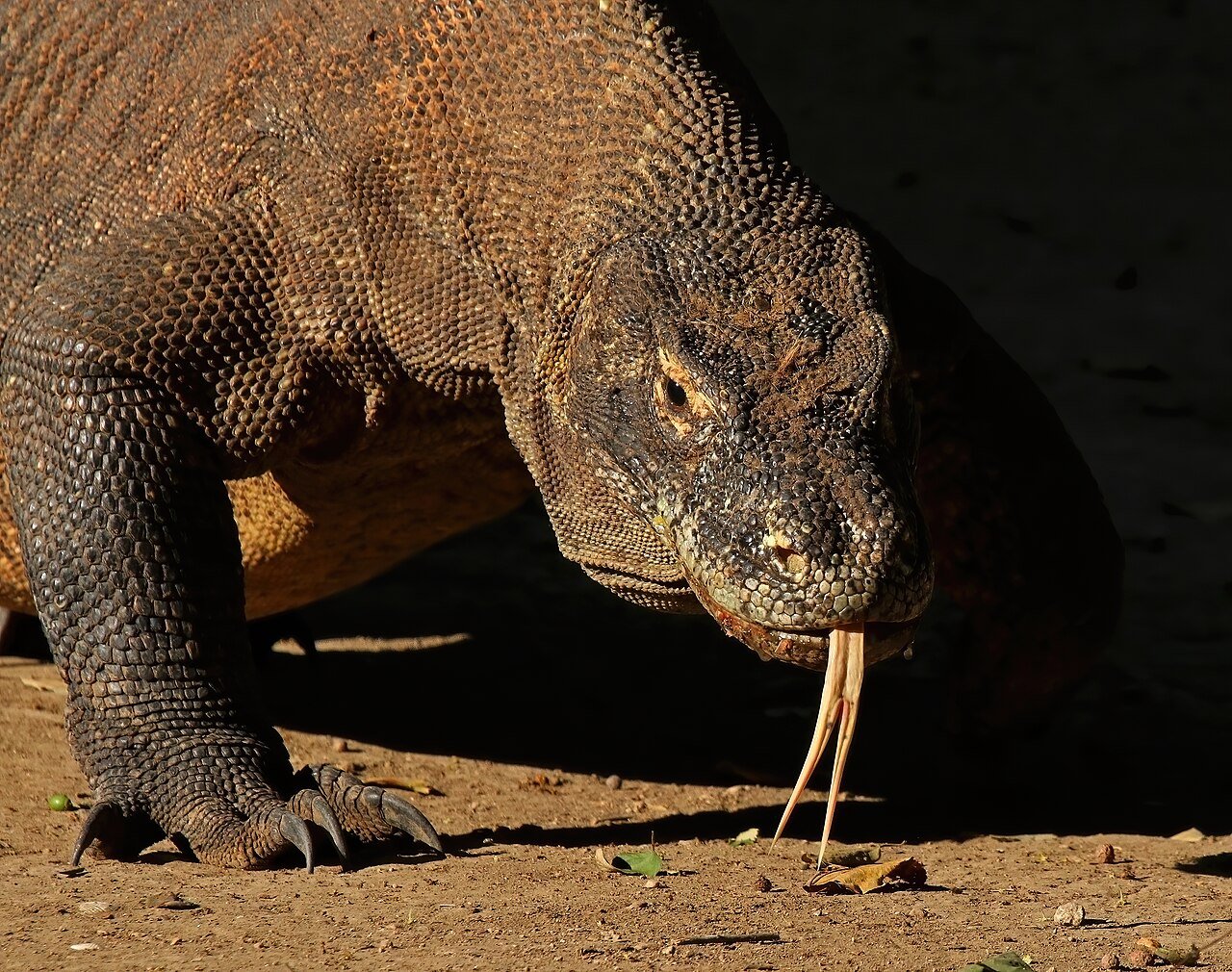
Timor-Leste (East Timor) has no UNESCO World Heritage Sites. As one of the world’s youngest nations (independent since 2002), it has not yet developed a formal UNESCO candidacy programme. The nearest inscribed site is the Komodo National Park in Indonesia, approximately 1,000 km west — home to the world’s largest living lizard. From Cultural Heritage Online.
Komodo National Park, Indonesia ~1,000 km west — flight Dili–Denpasar then onward to Labuan Bajo
Komodo National Park, inscribed as a UNESCO World Heritage Site in 1991, covers approximately 1,733 square kilometres of land and sea in the transition zone between the Asian and Australasian ecological regions, straddling the Wallace Line in East Nusa Tenggara province of Indonesia. The park encompasses three main islands — Komodo, Rinca, and Padar — and numerous smaller islands and coral reef areas. It is famous worldwide for the Komodo dragon (Varanus komodoensis), the world’s largest living lizard, which reaches up to 3 metres in length and 70 kg in weight.
Approximately 5,700 Komodo dragons survive in the wild, almost exclusively within the national park boundaries (small populations also exist on the island of Flores near the park’s eastern edge). The species is classified as Endangered by the IUCN; the population has been stable or slightly increasing within the park due to protection. The dragons are apex predators: despite lacking venom for most of their evolutionary history (recent research has confirmed they do have venom glands in addition to bacteria-laden saliva), they hunt deer, water buffalo, pigs, and occasionally humans by biting and then tracking prey over days as blood loss and infection weaken the victim.
The marine environment of Komodo National Park is equally significant: the park lies at the intersection of the Indian and Pacific Ocean current systems, creating nutrient upwelling that supports extraordinarily diverse coral reefs — over 260 coral species, 1,000 fish species, dugongs, marine turtles, dolphins, manta rays, and whale sharks in the surrounding waters. The park is considered one of the richest marine biodiversity areas in the world.
Timor-Leste’s Heritage Context
Timor-Leste’s own heritage includes significant pre-colonial cultural traditions (the uma lulik — sacred houses — of Timorese communities, which serve as centres of ancestral veneration and clan identity), a colonial-era built environment left by Portuguese administration from 1702 to 1975, and the memorials and sites associated with the Indonesian occupation (1975–1999) and the independence movement. The Balibo Fort and the site of the Balibo Five incident (1975) is one of the most internationally recognised historical sites; the Santa Cruz Cemetery massacre site (1991) is a site of national commemoration. Timor-Leste does not yet have a Tentative List for UNESCO.
Getting there from Dili: Komodo NP: fly from Dili’s Presidente Nicolau Lobato International Airport to Bali/Denpasar (2.5 hours), then fly to Labuan Bajo, Flores (1.5 hours), then liveaboard or day boat into the park (1–3 hours). Allow: 3–5 days for Komodo; see dragons on day 1 from Rinca, snorkel/dive remaining days. Best for: Wildlife (Komodo dragon, marine biodiversity); diving; natural heritage.
Frequently Asked Questions
Does Timor-Leste have any UNESCO World Heritage Sites?
No. Timor-Leste, independent since 2002, has no inscribed UNESCO World Heritage Sites and has not submitted a Tentative List. The sacred houses (uma lulik) of Timorese communities, the Portuguese colonial architecture of Dili and other towns, and the sites of the Indonesian occupation and independence struggle have been discussed as potential heritage candidates, but no formal candidacy has been developed.
How does the Komodo dragon hunt its prey?
The Komodo dragon uses a combination of ambush predation and pursuit over time. A Komodo dragon will bite prey — typically deer, pigs, or water buffalo — with its venom glands (discovered in 2009) and bacteria-laden saliva, and then track the wounded animal over hours or days as it weakens from blood loss and infection. A buffalo can survive a dragon bite for days or weeks before dying; a dragon may follow the same animal for extended periods, checking on its condition regularly. The dragon’s forked tongue, like that of snakes, picks up chemical traces in the air, allowing it to follow wounded animals over considerable distances. Multiple dragons will converge on a carcass once the animal dies.
What is the Wallace Line and why is it ecologically significant at Komodo?
The Wallace Line is a biogeographic boundary first described by the naturalist Alfred Russel Wallace in 1863, running between the Indonesian islands of Bali and Lombok and continuing north between Borneo and Sulawesi. West of the line, the fauna is predominantly Asian (tigers, elephants, orangutans, hornbills); east of the line, the fauna is predominantly Australasian (marsupials, cockatoos, bower birds). Komodo lies east of the Wallace Line and hosts a biogeographically transitional fauna — the Komodo dragon itself represents a lineage that colonised the islands from Australia approximately 4 million years ago. The mixing of Asian and Australian faunal elements in the Wallacea zone creates the exceptionally high biodiversity of the Komodo marine environment.
What is the uma lulik tradition in Timor-Leste?
The uma lulik (“sacred house”) is the central institution of traditional Timorese community life. Each lineage group maintains an uma lulik — a physically distinctive structure (traditionally of timber and thatch, elevated on posts) that serves as the repository of clan objects (heirlooms, textiles, weapons, ancestor statues) and as the site of ritual practice connecting the living community with its ancestors. Decision-making, conflict resolution, life-cycle ceremonies (birth, marriage, death), and agricultural rituals all centre on the uma lulik and the authority of the elder who maintains it. The institution survived Portuguese colonialism, Indonesian occupation, and the destruction of the 1999 post-referendum violence, and is undergoing a significant cultural revival in independent Timor-Leste.
Sources
- S1 — Fox, James J., and Dionisio Babo Soares, eds. Out of the Ashes: The Destruction and Reconstruction of East Timor. ANU E Press, 2003. ISBN 978-0-9751229-1-4.
- S2 — Lansing, J. Stephen. Priests and Programmers: Technologies of Power in Bali. Princeton University Press, 2007. ISBN 978-0-691-13376-8.
Spotted an error? Write to editorial@culturalheritageonline.com and we correct it the same day.



.jpg)