Laos holds two UNESCO World Heritage Sites, and both are reachable from its capital, Vientiane: the living heritage town of Luang Prabang to the north and the ancient Khmer sanctuary of Vat Phou to the south. Together they span more than fifteen centuries of continuous human reverence for the sacred landscape of this landlocked country. From Cultural Heritage Online.
Town of Luang Prabang 220 km north — 2 hr by train or 40 min by air
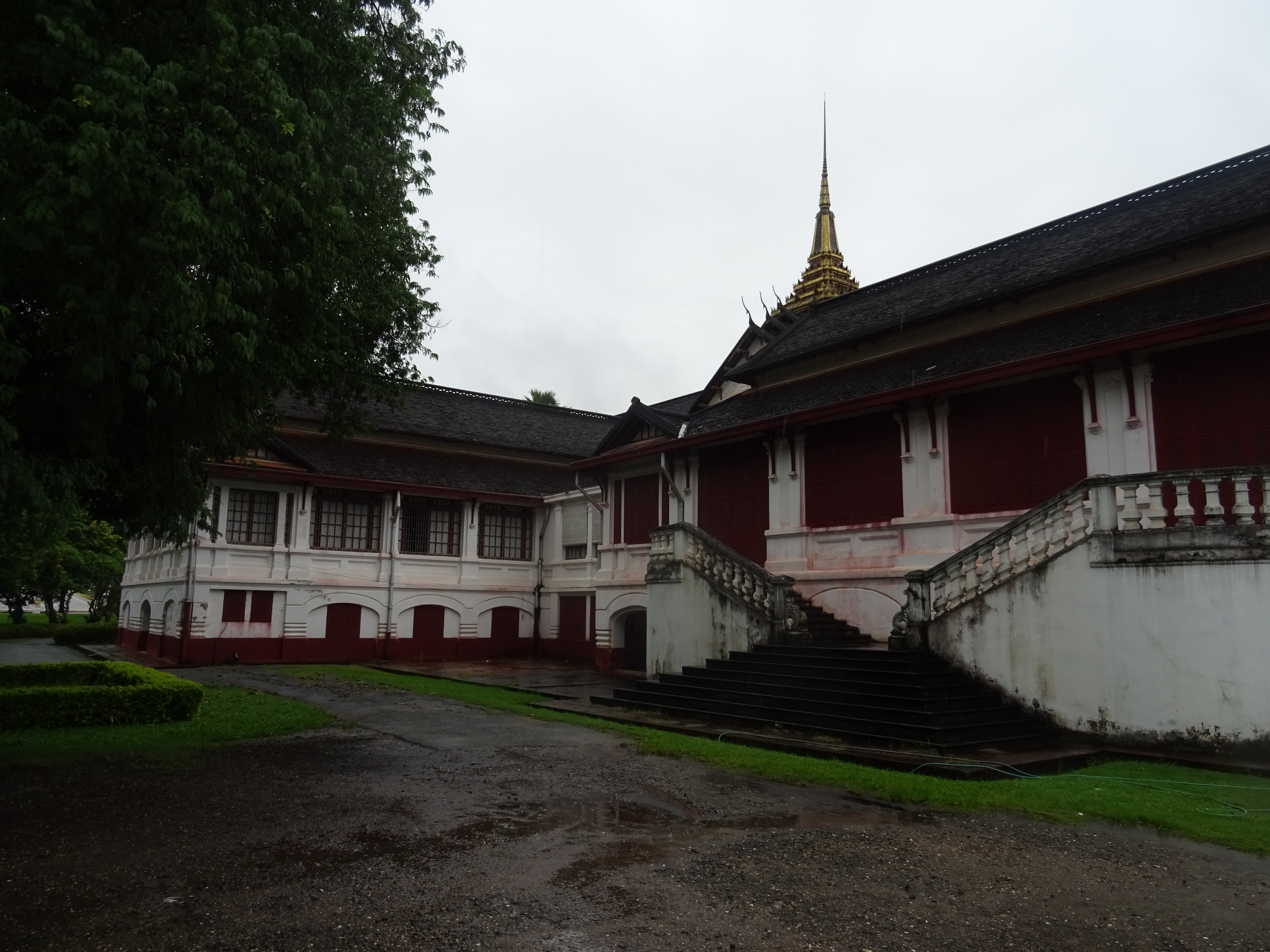
Luang Prabang occupies a long peninsula at the confluence of the Mekong and the Nam Khan rivers, and its shape on the map — a narrow finger of land edged by water on three sides — defines the experience of the place as much as any single building. UNESCO inscribed the town in 1995 for the outstanding integration of two architectural traditions that, in most of the world, never had the chance to coexist: the temple compounds of Theravada Buddhism and the shuttered colonial villas of the French Protectorate (1893–1953). Both survive intact across the same few streets, and neither looks out of place.
Approximately thirty-two Buddhist wats stand within the inscribed area, the oldest and most significant of which is Wat Xieng Thong, built in 1560 at the northern tip of the peninsula near the royal crematorium. Its low, sweeping roof descends almost to the ground in the classic Luang Prabang style, and its rear wall is covered in colourful glass mosaic panels depicting the Tree of Life. A carved boat shelter beside the main sim houses the royal funeral chariot. The town’s living heritage is most visible at dawn, when monks in saffron robes walk in single file along the main street to collect rice — the tak bat almsgiving ceremony — a daily ritual that has continued without interruption for generations. The Royal Palace, built in 1904 at the tip of the peninsula and converted into the National Museum of Laos after 1975, holds the Prabang, a gold Buddha image that gives the city its name.
The Laos-China Railway, which opened in 2021, now connects Vientiane and Luang Prabang in approximately two hours, making what was once a full day’s drive a practical morning excursion. The train runs through the mountain spine of northern Laos via some forty tunnels and passes over more than one hundred bridges — a journey that is itself a reason to travel by rail rather than fly.
Getting there: Laos-China Railway from Vientiane (Km Zero station) to Luang Prabang, approximately 2 hr; domestic flight approximately 40 min; road via Route 13, approximately 10 hr. Allow: Minimum two nights; three nights to cover Wat Xieng Thong, the Royal Palace, Phou Si Hill, and the Mekong riverfront properly. Best for: Travellers combining architectural heritage with living Buddhist culture and river landscapes.
Vat Phou and the Champasak Cultural Landscape 600 km south — 1 hr by air to Pakse, then 45 min by road

Vat Phou sits at the foot of Phou Kao Mountain in Champasak Province, 600 kilometres south of Vientiane, and the geometry of the site makes clear why it was chosen. A sacred spring emerges from a cleft in the cliff face high above the main sanctuary — the spring, dedicated to Shiva, is the spiritual origin of the entire complex. From the Mekong River, a processional axis 1.4 kilometres long leads through a planned urban grid, past two large ornamental ponds, and up a series of stone terraces to the sanctuary built directly against the cliff. UNESCO inscribed the site in 2001 not just for the temple but for this entire cultural landscape, which includes the ancient cities of Huei Thamo, Noen Nakhon, and Muang Kao.
The history of Vat Phou predates Angkor by several centuries. The site served as the spiritual centre of Chenla, the pre-Angkor Khmer kingdom that controlled much of mainland Southeast Asia between the 5th and 9th centuries. The surviving stone structures — the gopuras, the nandi pavilions, and the main sanctuary with its carved lintels — date mainly from the 10th to 12th centuries, when Angkor-period rulers rebuilt and enlarged the earlier foundations. Bas-reliefs on the sanctuary walls show scenes from Hindu mythology alongside Buddhist iconography added in later centuries, a layering of belief that makes Vat Phou distinct from its Cambodian contemporaries. The spring still flows at the summit, and the cliff face above the sanctuary remains an active place of worship.
The approach from Pakse by road passes through the flat agricultural plain of Champasak, with the Mekong visible to the west and the mountain silhouette of Phou Kao ahead. The site receives far fewer visitors than the temples of Angkor and preserves a quality of quiet that is increasingly rare at major Khmer monuments.
Getting there: Domestic flight from Vientiane to Pakse (approximately 1 hr), then road transfer to Champasak town and the site (approximately 45 min). Alternatively, overnight sleeper bus from Vientiane to Pakse (approximately 10 hr). Allow: Full day at the site; overnight in Champasak or Pakse recommended to visit at dawn or dusk when the light on the stone is best. Best for: Travellers with an interest in pre-Angkor Khmer history, Hindu-Buddhist syncretism, and sites with minimal visitor pressure.
Frequently Asked Questions
How many UNESCO World Heritage Sites are near Vientiane?
Laos has two UNESCO World Heritage Sites in total, and both can be reached from Vientiane: the Town of Luang Prabang (inscribed 1995), approximately 220 kilometres north, and Vat Phou and the Associated Ancient Settlements within the Champasak Cultural Landscape (inscribed 2001), approximately 600 kilometres south.
What is the fastest way to reach Luang Prabang from Vientiane?
The Laos-China Railway connects Vientiane (Km Zero station) to Luang Prabang in approximately two hours, making it both the fastest surface option and a more scenic alternative to the 40-minute domestic flight. Tickets are available at the station and through online booking platforms; seats sell out during Lao New Year (mid-April) and major Buddhist festivals.
Can Luang Prabang and Vat Phou be visited in the same trip?
Yes. A practical itinerary from Vientiane runs north to Luang Prabang first (two to three nights), returns by train or air, then flies south to Pakse for Vat Phou (one to two nights). The two sites are not easily combined in a single overland loop without significant backtracking. Budget a minimum of five days to do justice to both. The dry season (November to April) is the most comfortable time for travel, though the rainy season (May to October) brings a greener landscape at Champasak and fewer crowds at both sites.
How much older is Vat Phou than the temples of Angkor?
The site of Vat Phou was already a sacred centre during the Chenla kingdom period, from at least the 5th century CE, making it several centuries older than the main Angkor complex in Cambodia, which was built primarily from the late 9th century onward. The surviving stone structures at Vat Phou date mainly from the 10th to 12th centuries — roughly contemporary with Angkor — but they were constructed on a site with a continuous sacred history predating Angkor by four hundred years or more.