
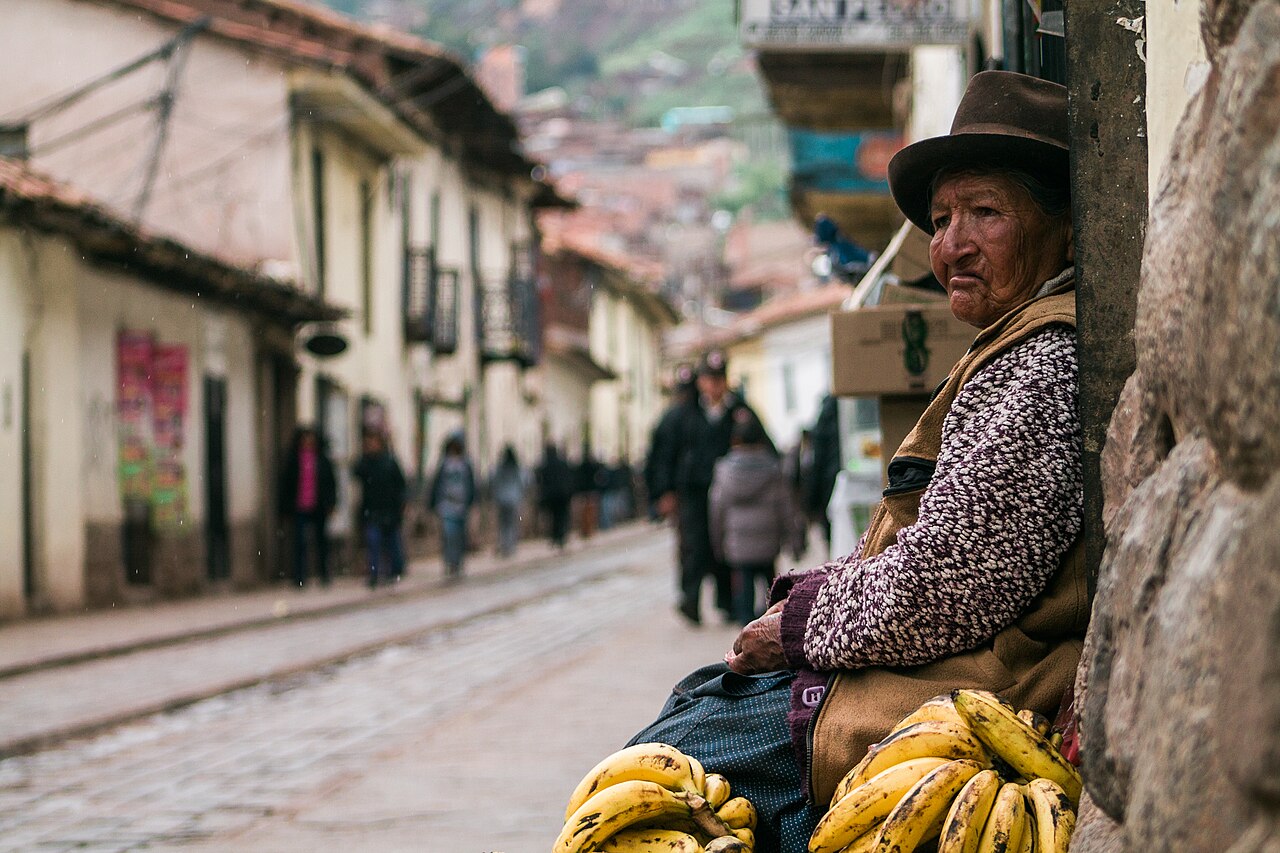
Cusco sits at 3,400 metres in the Peruvian Andes and holds more UNESCO World Heritage designations within reach than any other city in South America. Three inscriptions — the historic city itself, the sanctuary of Machu Picchu, and the trans-continental Qhapaq Nan road system — place a full week of extraordinary heritage within a 90-kilometre radius. From Cultural Heritage Online.
City of Cusco City centre — within walking distance
Cusco was inscribed on the UNESCO World Heritage List in 1983 as the former capital of the Inca Empire, the largest pre-Columbian state in the Americas. What makes the city architecturally singular is the layering of civilisations made literally visible: Spanish colonial buildings from the 16th and 17th centuries rise directly from Inca stone foundations, their walls fitted with precision-cut granite blocks that have endured five centuries without mortar. On Hatun Rumiyoc street, the twelve-angle stone — a single granite block carved to interlock perfectly with twelve neighbouring stones — draws visitors who run their fingers along the seams searching for a gap and find none.
At the heart of the historic centre, the Qorikancha was the most sacred temple in the Inca world, its interior walls once lined with gold sheets. The Spanish built the Convent of Santo Domingo over its foundations in the 1530s; today you move between the two buildings in the same visit, stepping from a Renaissance cloister into the surviving curved Inca sanctuary walls beneath. The Plaza de Armas — the former Inca ceremonial square Huacaypata — remains the social core of the city, framed by the Cathedral and the Jesuit church of La Compañía de Jesús, both built on the foundations of Inca palaces.
The historic centre is compact and walkable. Allow at least half a day to move through the main plazas, San Blas neighbourhood, and the Qorikancha without rushing.
Getting there: Walking distance from any central hotel; the historic core is pedestrianised in parts. Allow: Half a day to a full day. Best for: History travellers, architecture enthusiasts, and anyone seeking a base with its own UNESCO status.
Historic Sanctuary of Machu Picchu 80 km northwest — 3.5 hr train + 30 min bus
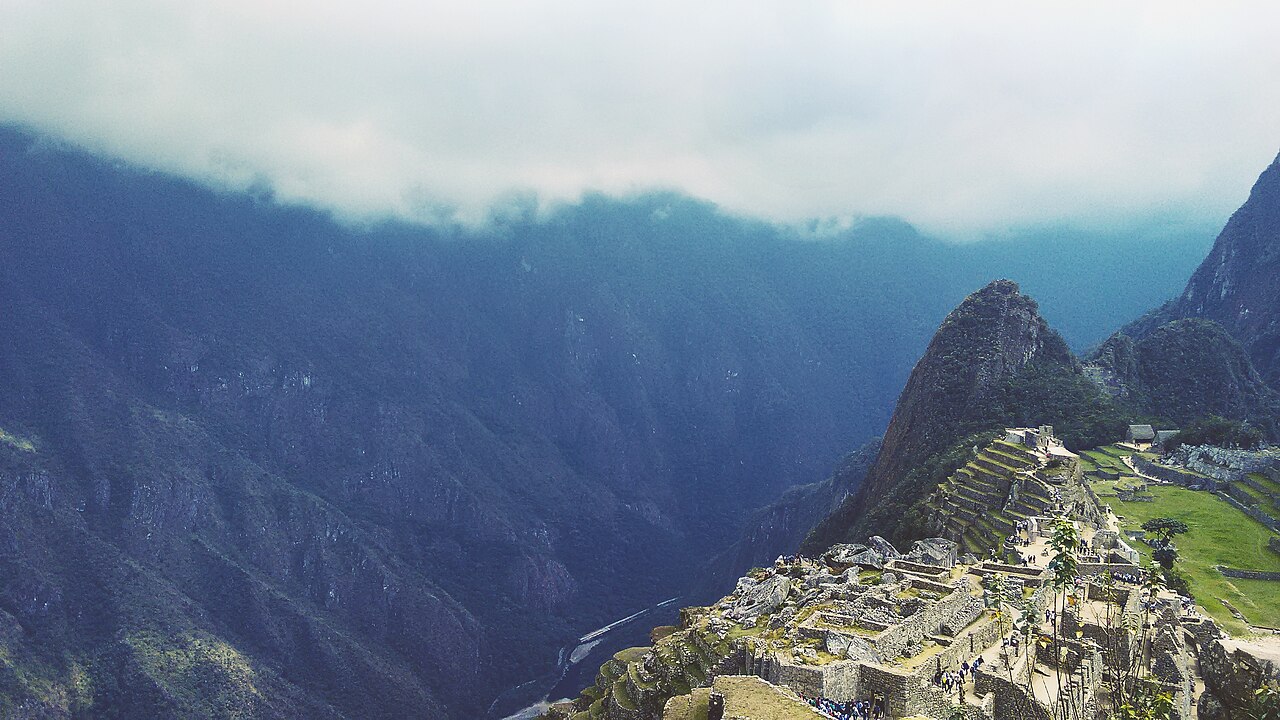
Machu Picchu sits on a narrow ridge at 2,430 metres above sea level, flanked by sheer drops and wrapped in cloud forest that turns gold in the early morning light. Emperor Pachacuti ordered its construction in the mid-15th century as a royal estate and ceremonial centre; it was occupied for roughly a century before being quietly abandoned, likely during the Spanish conquest, and remained unknown to the outside world until Hiram Bingham reached it in 1911. UNESCO inscribed the Historic Sanctuary in 1983, recognising both the citadel’s outstanding universal value and the surrounding cloud forest ecosystem.
The site divides into agricultural terraces that cascade down the slopes and an urban sector of temples, palaces, and plazas. The Temple of the Sun is built around a natural granite outcrop, its trapezoidal windows aligned with the June solstice sunrise. The Intihuatana stone — a carved granite pillar that may have functioned as an astronomical instrument — stands at the highest point of the ceremonial precinct, with a panoramic view of the mountain amphitheatre around it. The Room of the Three Windows frames the surrounding peaks in a way that feels deliberate even now.
Daily visitor numbers are capped and time-slot entry is mandatory. Book tickets at least two weeks in advance during the dry season (May to September) and well ahead for the Inca Trail, which must be reserved months out.
Getting there: Train from Cusco (Poroy or Wanchaq station) to Aguas Calientes, approx. 3–3.5 hours; bus from Aguas Calientes to the site, 30 minutes. Alternatively, hike the Inca Trail (4 days). Allow: Full day minimum; overnight in Aguas Calientes recommended. Best for: Anyone visiting Peru — this is a non-negotiable site.
Qhapaq Nan – Andean Road System Various access points from Cusco; Inca Trail trailhead ~82 km
Inscribed in 2014 across six countries — Argentina, Bolivia, Chile, Colombia, Ecuador, and Peru — Qhapaq Nan is the largest pre-Columbian engineering project ever recognised by UNESCO. The Inca road network extends roughly 22,000 kilometres through some of the most demanding terrain on earth: high-altitude plateaus, deep canyons, and coastal desert. It enabled the Inca state to move armies, relay information by runner, and transport goods from Patagonia to present-day Colombia within weeks.
From Cusco, the network is most tangibly experienced on the Camino del Inca — the Inca Trail — a 43-kilometre trekking route through cloud forest and mountain passes that ends at the Sun Gate (Inti Punku) above Machu Picchu, where the citadel comes into view at dawn. The trail passes Inca ruins, orchid-thick forest, and the Dead Woman’s Pass at 4,215 metres. In the Sacred Valley, sections of the original road connect Pisac to Ollantaytambo along the Urubamba River, accessible on day trips from Cusco and walkable in parts without a multi-day commitment.
The Inca Trail requires permits booked months in advance; groups are limited to 500 people per day including guides and porters. The Sacred Valley road sections can be explored independently on foot or by local transport.
Getting there: Inca Trail trailhead (Km 82) is 82 km from Cusco by road, approx. 2 hours; Sacred Valley sections via Pisac or Ollantaytambo, 1–1.5 hr from Cusco. Allow: 4 days for the full Inca Trail; half a day for Sacred Valley road sections. Best for: Trekkers, history researchers, and travellers wanting context for the broader Inca network.
Frequently Asked Questions
How many UNESCO World Heritage Sites are near Cusco?
There are three UNESCO World Heritage Sites in and around Cusco. The City of Cusco and the Historic Sanctuary of Machu Picchu were both inscribed in 1983. Qhapaq Nan — the Andean Road System — was inscribed in 2014 across six South American countries, with several of its most accessible sections running through the Cusco region, including the Inca Trail to Machu Picchu.
How do you get from Cusco to Machu Picchu?
The standard route is by train from Cusco’s Poroy or Wanchaq station to Aguas Calientes (approximately 3 to 3.5 hours), followed by a 30-minute bus ride up the switchback road to the citadel entrance. Several rail operators run daily services, including PeruRail and Inca Rail. Alternatively, the classic 4-day Inca Trail trek arrives at Machu Picchu on foot through the Sun Gate — this requires a permit booked well in advance, particularly for the dry season (May–September).
When is the best time to visit Cusco’s UNESCO sites?
The dry season (May to September) offers the clearest skies, best trekking conditions on the Inca Trail, and peak visibility at Machu Picchu — but also the highest visitor numbers and prices. The wet season (November to March) brings lower crowds, greener landscapes, and cheaper accommodation, though mountain passes on the Inca Trail can be closed in February. June 24 is the winter solstice festival Inti Raymi at Sacsayhuamán, one of the largest Andean celebrations in South America.
Why did the Incas build with such precisely fitted stones?
Inca ashlar masonry — stones fitted without mortar through a technique called polygonal or coursed stonework — was not purely aesthetic. The Andes sit on a major seismic zone, and the flexibility of dry-stone joints allows walls to move slightly during an earthquake and resettle, rather than cracking under rigid mortar. This engineering logic is why Inca foundations throughout Cusco have survived centuries of earthquakes that destroyed the colonial buildings above them. The precision fitting was achieved by hand with stone and bronze tools, without the wheel or iron.
.jpg)
.jpg)