Moscow sits at the centre of one of Europe’s densest concentrations of UNESCO-listed heritage. Within the city itself stand the fortified towers of the Kremlin, the baroque campanile of Novodevichy Convent, and the soaring tent-roofed church of Kolomenskoye. A suburban train carries visitors 70 kilometres northeast to the gilded domes of the Trinity-Sergius Lavra in Sergiev Posad. Further along the same corridor, the medieval limestone cathedrals of Vladimir and Suzdal — older than Moscow itself — reward the traveller who allocates a full day or an overnight stay. This guide covers all five sites with precise transport details and honest time estimates. From Cultural Heritage Online.
Moscow Kremlin and Red Square City centre — Metro lines 1, 2, 3
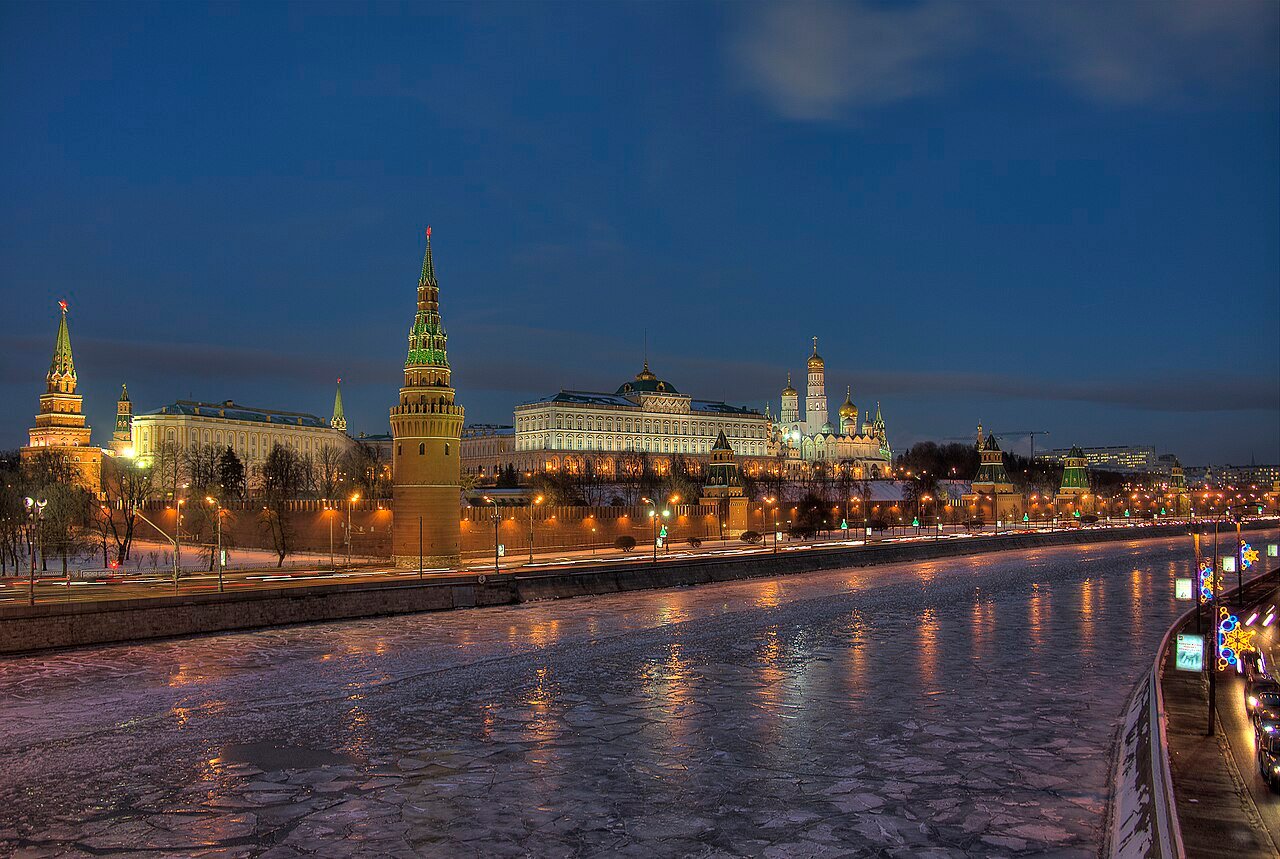
Inscribed on the UNESCO World Heritage List in 1990, the Moscow Kremlin and Red Square form the symbolic core of a millennium of Russian statehood. The current fortress walls — stretching 2,235 metres with heights ranging from 5 to 19 metres — were raised between 1485 and 1495 by a team of Italian Renaissance masters, among them Aristotele Fioravanti, who also designed the Cathedral of the Dormition, and Pietro Antonio Solari, who shaped the main towers. Twenty towers punctuate the red brick perimeter, the tallest being the Troitskaya Tower at 80 metres. Inside the walls, five palaces and four cathedrals cluster around Cathedral Square, where the gilded domes catch the light at almost any hour of the day. The Tsar Bell — 202 tonnes, never rung — and the Tsar Cannon stand as baroque exercises in ambition. Red Square, flanking the east wall, combines Saint Basil’s Cathedral, the Lenin Mausoleum, and the GUM arcade in a single open space that feels simultaneously ceremonial and human in scale.
Getting there: Kremlin stop on Metro lines 1, 2, and 3 (Okhotny Ryad, Biblioteka Imeni Lenina, Borovitskaya) — all within a five-minute walk of the Borovitskaya gate. Allow: 3–4 hours for the Kremlin grounds and cathedrals; Red Square can be visited separately at any time. Best for: Anyone seeking to understand the architectural and political centre of Russian history from the 15th century to the present.
Novodevichy Convent and Cemetery 25 min by Metro from Okhotny Ryad
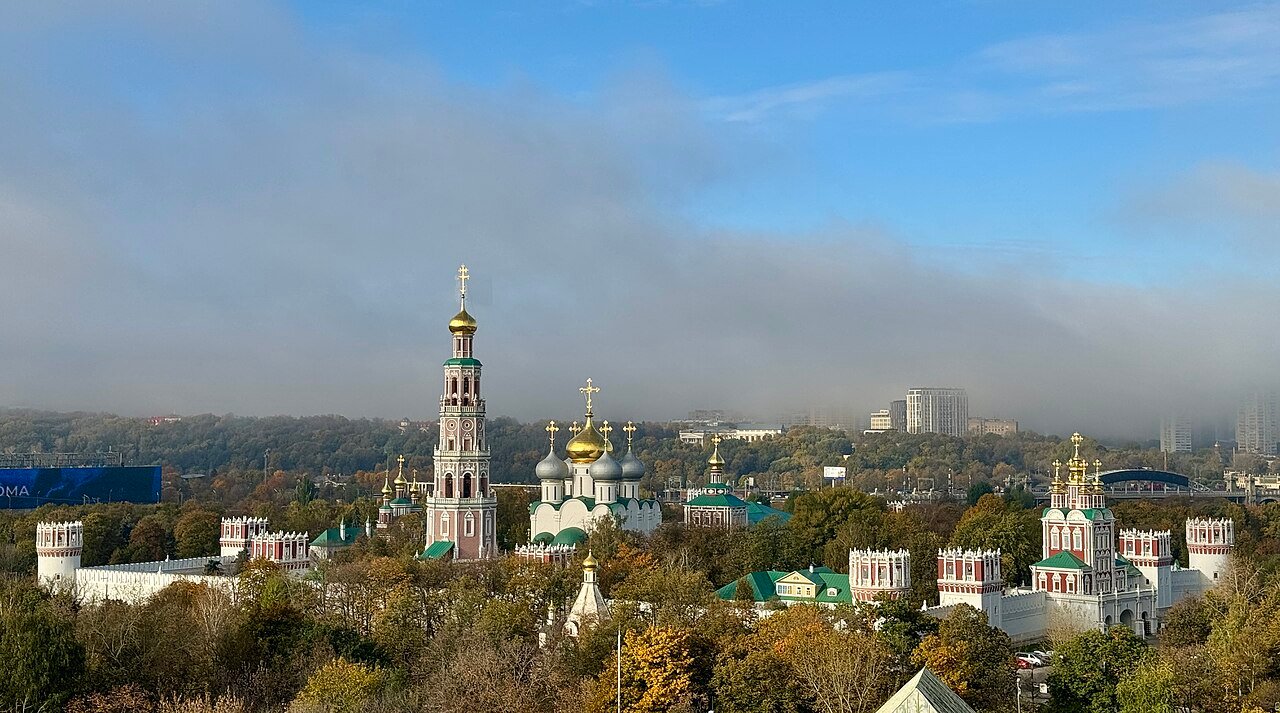
Novodevichy Convent was founded on 13 May 1524 by Grand Duke Vasily III to commemorate the Russian recapture of Smolensk in 1514 and dedicated to the Smolensk Icon of the Mother of God. UNESCO inscribed it in 2004, citing the quality of its Muscovite Baroque architecture — a style that matured here more completely than almost anywhere else in the city. The ensemble’s 12-tower red masonry wall encloses the six-domed Smolensky Cathedral of 1524–25, whose frescoes rank among the finest surviving 16th-century painting in Moscow. The octagonal bell tower, completed in 1689–90 by architect Peter Potapov, rises 72 metres in a composition that moves from tier to tier with unusual lightness. The adjacent Novodevichy Cemetery, established in 1898, holds the graves of composer Sergei Prokofiev, cellist Mstislav Rostropovich, and Soviet premier Nikita Khrushchev, among hundreds of others. The combination of convent and cemetery gives the visit a particular depth. Unlike many Moscow cloisters, the ensemble has remained virtually intact since the 17th century.
Getting there: Metro line 1 (Sokolnicheskaya) to Sportivnaya, then a 10-minute walk; total journey from Okhotny Ryad is around 25 minutes. Allow: 2 hours. Best for: Visitors interested in Muscovite Baroque architecture and Russian cultural history of the 16th–20th centuries.
Church of the Ascension, Kolomenskoye 35 min by Metro to Kolomenskaya
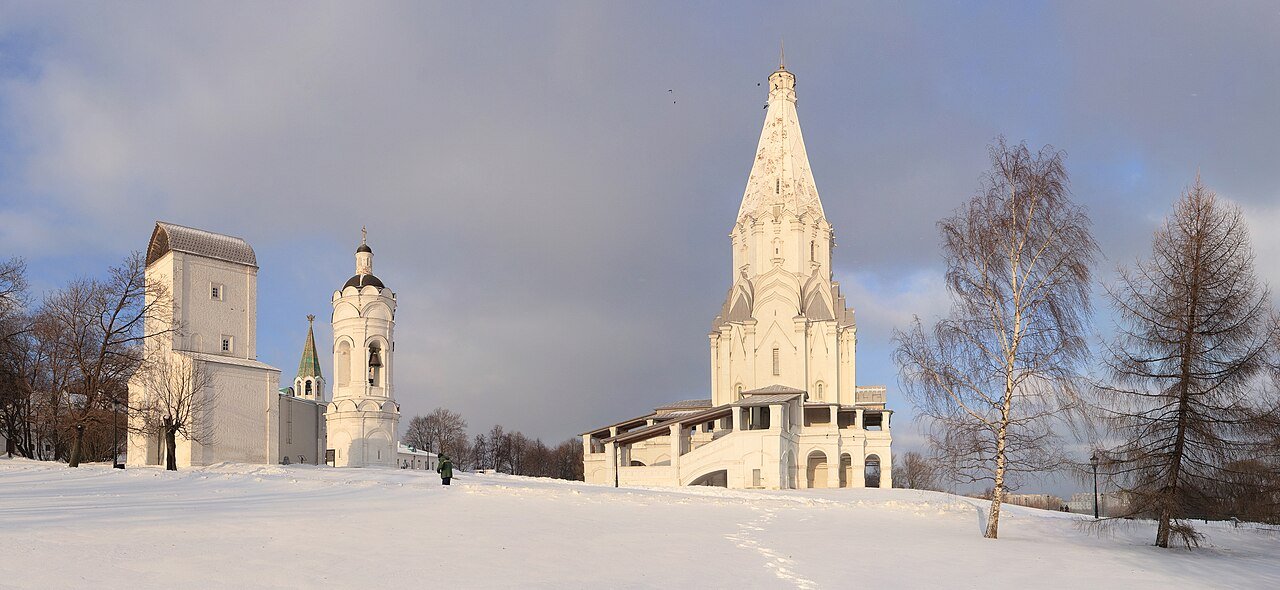
Completed in 1532 to mark the birth of the future Ivan the Terrible, the Church of the Ascension at Kolomenskoye holds a specific place in architectural history as the first stone church in Russia built in the tent-roof form — a dramatic departure from the Byzantine domed tradition that had defined Russian religious architecture for five centuries. UNESCO inscribed it in 1994. The structure rises from a low gallery through a stepped octagonal body to a white limestone tent spire, its vertical rhythm underlined by tiered kokoshnik gables and arrow-shaped windows. Standing on the steep bank of the Moskva River, the church reads from a distance as a single vertical element against the sky — an effect that makes the surrounding 390-hectare estate feel unexpectedly large and quiet for a site within the Moscow city limits. The estate’s oak groves, ravines, and riverside meadows add a natural dimension that most urban heritage sites cannot offer.
Getting there: Metro line 2 (Zamoskvoretskaya) to Kolomenskaya, then a 10-minute walk; total journey from central Moscow is around 35 minutes. Allow: 1–2 hours for the church and immediate grounds; up to half a day if exploring the full estate. Best for: Architectural history, landscape, and a calm half-day away from the city centre.
Trinity-Sergius Lavra, Sergiev Posad 1 hr 30 min by suburban train from Yaroslavsky Vokzal
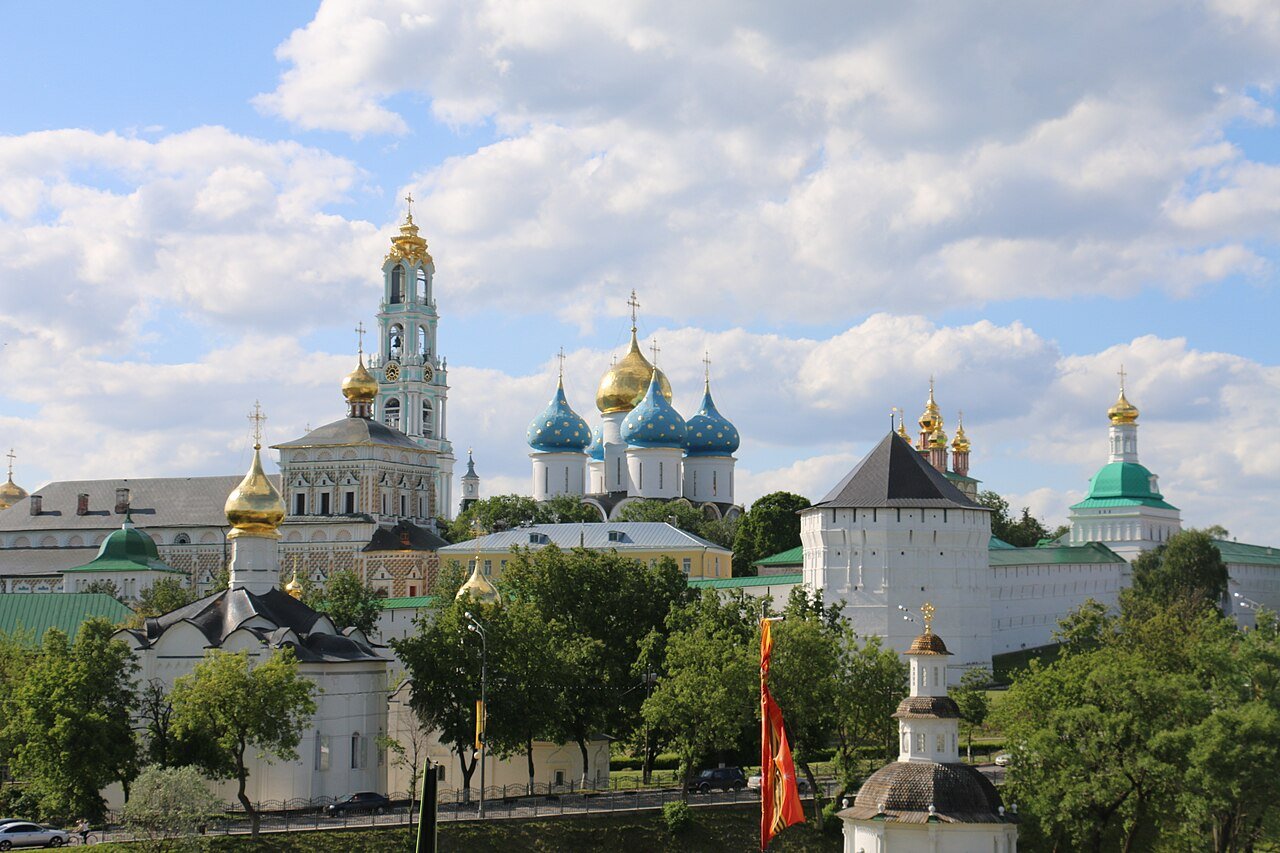
Founded in 1337 by Sergius of Radonezh on a wooded hill northeast of Moscow, the Trinity-Sergius Lavra is the most important monastery in the Russian Orthodox Church and has been a living pilgrimage site for nearly seven centuries. UNESCO inscribed the ensemble in 1993 under the designation “Architectural Ensemble of the Trinity Sergius Lavra in Sergiev Posad.” The complex contains structures from multiple periods: the Trinity Cathedral of 1422, whose interior was painted by Andrei Rublev and Daniil Chyorny; the six-pillared Assumption Cathedral commissioned by Ivan the Terrible in 1559–85; the 1476 Church of the Holy Spirit, one of the rare Russian churches combining bell tower and sanctuary in a single volume; and the 88-metre baroque bell tower designed by Ivan Michurin and Dmitry Ukhtomsky in the 18th century. The 1.5-kilometre defensive wall, built in the 1550s, encloses a compound where over 300 monks still live. The checkerboard-patterned facades of the royal palace and refectory, set against blue and gold cathedral domes, give the lavra a visual density unlike any other monastic ensemble in Russia.
Getting there: Elektrichka (suburban train) from Yaroslavsky Vokzal in Moscow to Sergiev Posad — journey is approximately 1 hour 30 minutes; trains run frequently throughout the day. Allow: 3–4 hours minimum; a full day is comfortable. Best for: Anyone seeking a complete monastic ensemble still in active religious use, with centuries of architecture visible within a single walled precinct.
White Monuments of Vladimir and Suzdal 3 hrs 30 min by intercity bus or train to Vladimir
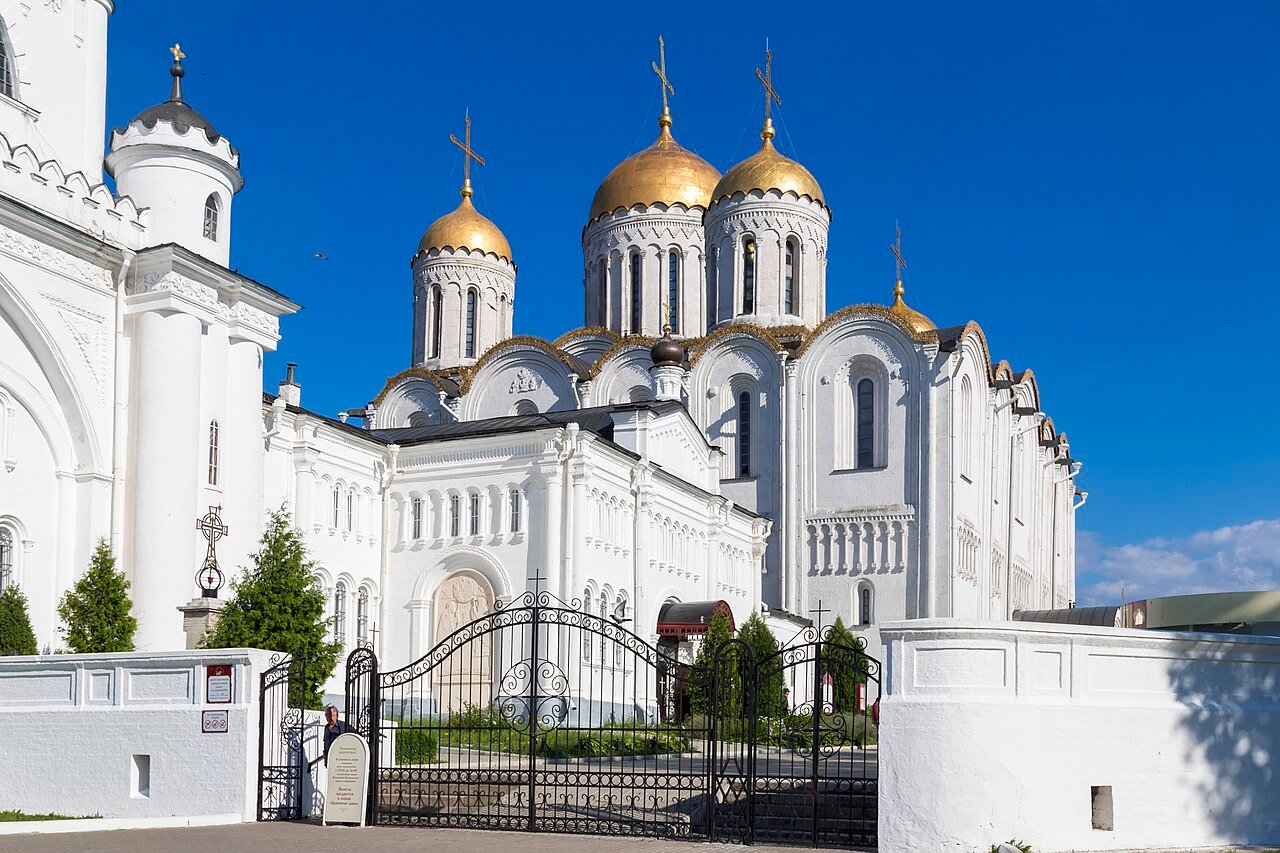
The White Monuments of Vladimir and Suzdal, inscribed on the UNESCO World Heritage List in 1992, comprise eight medieval limestone structures built between the late 12th and early 13th centuries in the Zalesye region northeast of Moscow — predating the Kremlin walls by three centuries. Vladimir holds the most celebrated monuments: the Cathedral of the Assumption (1158–60, expanded 1185–89), whose white limestone exterior and golden domes established the visual language of Russian Orthodox architecture for generations; the Cathedral of Saint Demetrius (1194–97), famous for its elaborately carved stone facade; and the 12th-century Golden Gate, a defensive arch that still stands on the main road. Suzdal, 30 kilometres further by bus, adds a Kremlin with the Cathedral of the Nativity, the Monastery of Our Saviour and St Euthymius, and the Church of Sts Boris and Gleb at Kideksha. The cumulative effect — white stone rising above flat river meadows — is unlike anything in Moscow or Sergiev Posad. Vladimir alone requires a full day. Combining both cities requires an overnight stay in Vladimir or Suzdal.
Getting there: Intercity bus from Moscow’s Shchelkovskaya bus station (approximately 3 hours 30 minutes) or train from Kursky Vokzal; Suzdal is 30 minutes further from Vladimir by local bus. Allow: Full day for Vladimir alone; overnight recommended for Vladimir and Suzdal together. Best for: Visitors who want to see pre-Mongol Russian architecture in its original landscape context — this requires a separate day trip or overnight stay and is a significantly different experience from the Moscow city sites.
Frequently Asked Questions
How many UNESCO World Heritage Sites are near Moscow?
Five UNESCO World Heritage Sites are in or near Moscow. Three are within the city itself: the Moscow Kremlin and Red Square (inscribed 1990), Novodevichy Convent (2004), and the Church of the Ascension at Kolomenskoye (1994). The Trinity-Sergius Lavra in Sergiev Posad (1993) is 70 kilometres away by suburban train, and the White Monuments of Vladimir and Suzdal (1992) require around 3 hours 30 minutes by bus or train.
What is the closest UNESCO World Heritage Site to central Moscow?
The Moscow Kremlin and Red Square is the closest, located in the city centre and directly accessible from three Metro lines. Novodevichy Convent is the second closest, about 5 kilometres southwest of the Kremlin. Kolomenskoye, further south along the Metro line 2, is the third site within Moscow’s city limits.
Do visitors from Western Europe or North America need a visa to visit Russia?
As of mid-2026, citizens of most Western European countries and the United States require a visa to enter Russia. The situation has been complicated by diplomatic restrictions in place since 2022, and some nationalities face significant obstacles obtaining visas through normal channels. Travellers should consult their national foreign ministry for current entry requirements well before planning a trip.
What is the best season to visit the Moscow-area UNESCO sites?
Late May through early September offers the most comfortable conditions for outdoor sites such as Kolomenskoye and the journey to Vladimir and Suzdal, with long daylight hours and mild temperatures. The Kremlin, Novodevichy Convent, and the Trinity-Sergius Lavra are visitable year-round; winter visits bring snow-covered domes and fewer crowds, though some outdoor areas and museum buildings may have reduced hours between November and March.
Sources
- UNESCO World Heritage List — Russian Federation inscriptions
- Wikipedia: Moscow Kremlin
- Wikipedia: Novodevichy Convent
- Wikipedia: Trinity Lavra of St. Sergius
- Wikipedia: White Monuments of Vladimir and Suzdal