Tsodilo is four quartzite hills rising abruptly from the flat Kalahari sandveld of northwestern Botswana — a landscape so unexpected in the surrounding flatness that its sacred status among the San people requires no explanation the moment you see it. On the cliff faces, overhangs and shelters of these hills, more than 4,500 individual rock paintings have been made over roughly 24,000 years, creating the highest concentration of rock art per square kilometre anywhere on Earth. UNESCO inscribed Tsodilo in 2001, describing it as the “Louvre of the Desert.”
Four hills, one sacred centre Northwestern Botswana, near the Namibian border
From a distance, the Tsodilo Hills look like anomalies — four masses of quartzite pushed up through the flat, featureless Kalahari sandveld, the tallest rising around 400 metres above the surrounding plain. The hills are not a range in any conventional sense; they stand in relative isolation, their flanks covered in thin woodland, their upper faces of bare rock catching light differently at every hour of the day. In the surrounding landscape, where the ground is sand and the horizon is unbroken in every direction, they function as landmarks in the deepest possible sense: not just navigational reference points but places that clearly belong to a different order of things.
The four hills are named in San tradition as Male, Female, Child, and an unnamed fourth, smaller hill. The Male Hill is the tallest. The Female Hill carries the greatest concentration of rock paintings. In San cosmology as recorded by ethnographers working with the !Kung San communities of the area, Tsodilo is the place of creation: where the Creator — known as Xuba, the Great God, also referred to in some accounts as N!adima — first danced after making the world, leaving footprints on the rock that the San identify in specific formations to this day. It is where the first rain fell on the newly-made earth. It is where the first eland was created. And it is the place where the San people themselves were set down on the earth at the beginning of time.
This cosmological centrality is not merely historical; the Tsodilo Hills are still an active sacred landscape. San people and members of the Hambukushu and Bayei communities who arrived in the region during the 18th and 19th centuries bring offerings, pray, and conduct ceremonies at the hills. Certain areas are accessible only to initiated adults. Visitors are expected to behave with the seriousness appropriate to a religious site, and San guides — available through the community trust that manages the site — carry knowledge of which areas require particular respect and which stories can appropriately be shared with outsiders.
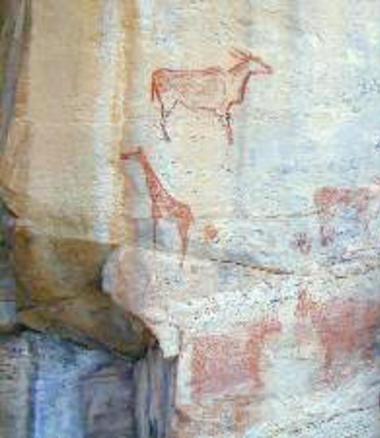
The rock surfaces themselves bear the record of perhaps 24,000 years of human presence. The earliest paintings yet identified date from around 24,000 BCE, though the majority cluster in a period from roughly 5,000 years ago to the 19th century CE. They were made in ochre, haematite, charcoal and white clay, applied directly to the rock in combinations that have proved remarkably durable in the dry Kalahari climate. The paintings range from small individual figures to complex multi-figure compositions spread across several metres of cliff face.
The eland at the centre of everything San rock art and cosmology
Among the thousands of individual painted figures at Tsodilo, the eland appears more than any other animal — and this disproportion is not accidental. In San religion, the eland (a large antelope, Taurotragus oryx, the largest of the African bovids) occupies a position of absolute centrality that has no direct equivalent in Western religious frameworks. The fat of the eland is used by healers in trance rituals as a medium of power. The blood of the eland connects the living world with the realm of the dead and the ancestral spirits. When a healer (a man or woman who can enter trance — the San do not restrict this capacity by gender) dances into a trance state during a healing ceremony, they are understood to take on something of the eland’s power and spirit, a process represented in the rock art by figures with eland characteristics: hooves instead of feet, tails, the hunched posture of an animal in its death throes (which resembles the posture of a deep trance state).
The paintings at Tsodilo are therefore not a naturalistic record of the animals the San hunted, though they also provide that kind of documentation. They are a record of religious experience — specifically of the trance states during which healers travel to the spirit world to bring back health for the sick, rain for the dry season, or guidance from the ancestors. Figures that appear to bleed from the nose (a common feature in the paintings) represent the haemorrhage that accompanies deep trance in San healing practice. The dots and grid patterns that appear throughout the paintings are interpreted by researchers including David Lewis-Williams as entoptic phenomena — visual hallucinations generated by the nervous system during trance, which occur consistently across human cultures and neurological states.
Other species in the Tsodilo paintings complicate what might otherwise seem like a purely local tradition. Hippos appear in abundance — significant because no hippos have lived in the immediate area for many centuries, suggesting the Okavango Delta’s ancient extent reached much closer to the hills. More puzzling are penguins and what appear to be whales — animals from the southern ocean, thousands of kilometres distant. Whether these represent trading contacts, migrations, ancient geographic memory, or the products of trance vision remains a matter of genuine scholarly debate. The geometric symbols — grids, spirals, concentric circles, chevrons — appear across San rock art throughout southern Africa and are now understood within Lewis-Williams’s neuropsychological model as the visual vocabulary of trance rather than writing or counting systems.
Practical information
Tsodilo is one of the most remote UNESCO sites in Africa. The nearest town of any size is Shakawe, approximately 20 kilometres away via sand tracks, on the Botswana side of the Okavango Panhandle. From Maun — the main hub for Okavango Delta tourism and the site of the nearest airport — the overland distance is approximately 450 kilometres, a journey of four to six hours on tar road to Sehitwa and then north through Nokaneng and Sepupa, finishing on sand tracks. A 4WD vehicle is essential for the final approach regardless of season.
Accommodation on-site is limited to the community campsite, which provides basic facilities. There is no commercial accommodation within the site itself. The nearest guesthouse-standard options are in Shakawe. San guides are available through the community trust and their engagement is strongly encouraged — both because the rock art is dispersed across the hills and requires a guide to navigate effectively, and because the contextual knowledge they provide transforms the experience of what would otherwise be marks on rock into something with legible meaning.
The best seasons for a visit are the dry months of May through September, when the sand tracks are passable and daytime temperatures, while warm (25–35°C), are manageable. Summer months (November–March) bring rain that can make the tracks impassable and temperatures that regularly exceed 40°C. Bring more water than you think you need — the site has no running water available to visitors — and fuel, as refuelling options between Maun and Tsodilo are limited.
Frequently Asked Questions
Why is the eland so important in San rock art?
The eland is not simply the most-painted animal at Tsodilo because the San admired it or hunted it in large numbers — though both are true. Its centrality in San rock art reflects its position at the core of San religious life. In San cosmological thinking, the eland is the most potent of all animals in terms of supernatural power, a quality described in the San language with a word that translates roughly as “potency” or “n/um” in some !Kung dialects. This power is concentrated especially in the fat of the eland, which healers apply to their bodies before and during trance dance ceremonies, and in its blood, which is understood to carry the capacity to cross between the world of the living and the world of the spirits and ancestors.
During the healing dance — a regular communal ceremony in San life — one or more healers enter a trance state through sustained rhythmic dancing and hyperventilation, assisted by the singing and clapping of the community. In this state they are understood to travel to the spirit world to intercede with the powers that cause illness or withhold rain. The paintings document this experience: the half-human, half-eland figures in the rock art represent the healer in trance, taking on eland characteristics at the moment of transformation. The nose-bleed figures represent the physical haemorrhage that accompanies deep trance. The geometric symbols represent the visual field of the trance state itself. The eland is therefore not a symbol imposed on the art from outside — it is structurally inseparable from the religious practice the art records.
Who painted at Tsodilo and over what period?
The paintings at Tsodilo were made by San hunter-gatherer communities, specifically ancestors of the groups today known as the !Kung San (also written Ju/!hoansi), over a period spanning approximately 24,000 years from the Upper Palaeolithic to the 19th century CE. The dating of individual paintings is technically difficult — the organic content of the pigments is generally too small for reliable radiocarbon dating, and the rock surfaces cannot themselves be dated — but contextual evidence including the tools and ochre-grinding equipment found at habitation sites around the hills, along with stratigraphy and stylistic analysis, supports the broad chronological range.
Not all periods are equally represented. The most recent layers of painting show contact with the iron-using Bantu-speaking farmers (the Hambukushu and Bayei) who arrived in the area during the 18th and 19th centuries and whose domestic animals and metal tools begin to appear in the painted record. Paintings of cattle and horses, for instance, postdate European and Bantu contact with the region. The oldest images are the hardest to read: pigment degraded by millennia of weathering, superimposed by later paintings, and sometimes only visible under raking light. A relatively small number of specialists have studied the site in depth, and the full documentation of Tsodilo’s 4,500-plus individual paintings remains incomplete — a project that would take years of systematic field survey to accomplish.
How difficult is the journey to Tsodilo, and is it worth the effort?
The journey is genuinely demanding by most tourism standards, and this is not an exaggeration designed to discourage casual visitors. Tsodilo sees a fraction of the visitor numbers of better-known African heritage and wildlife sites — estimates suggest a few hundred to low thousands of visitors per year, compared to hundreds of thousands at sites like the Okavango Delta camps or Chobe National Park. The sand tracks from Shakawe require a competent 4WD driver, the site has no tourist infrastructure beyond the community campsite and the visiting community, and the distance from any major population centre means that a visit takes at minimum two or three days out-and-back from Maun.
Whether it is worth it depends entirely on what kind of traveller you are. For visitors interested in rock art, San history, or the deep human past in Africa, Tsodilo is one of the most significant places on the continent. The scale of the painted record — 4,500 images on a set of hills in the middle of one of Africa’s most remote inhabited landscapes — has no close parallel in sub-Saharan Africa, and the quality of some of the painting, particularly on the Female Hill’s main rock face, is extraordinary. The experience of being in the landscape itself, in the early morning or late afternoon when the light is low and the hills glow ochre against the sandveld, is one that many visitors describe as the single most memorable experience of their Botswana travels. For visitors primarily interested in wildlife or creature-comfort safari, this is probably not the right detour.
Sources
- S1 — Campbell, Alec, and Larry Robbins. Tsodilo: Hills of the Gods. Botswana Society, 2003. ISBN 978-99912-511-1-0.
- S2 — Lewis-Williams, David, and David Pearce. San Spirituality: Roots, Expressions, and Social Consequences. AltaMira Press, 2004. ISBN 978-0-7591-0432-7.
Spotted an error? Write to editorial@culturalheritageonline.com and we correct it the same day.