Yemen has three UNESCO World Heritage Sites on UNESCO’s List of World Heritage in Danger, more than almost any country outside Syria and Iraq — a reflection of the catastrophic toll the Yemeni civil war has taken on one of the Arabian Peninsula’s oldest and most layered civilisations. Two further sites, the Historic Town of Zabid and the Socotra Archipelago, face compounding pressures that place their long-term survival in doubt. From Cultural Heritage Online.
Yemen’s layered civilisations
Yemen sits at the southern tip of the Arabian Peninsula, a crossroads of ancient trade routes linking the Mediterranean world to East Africa and South Asia. The incense trade made cities here extraordinarily wealthy by the first millennium BCE, and the Kingdom of Saba — the biblical Sheba — left behind temples, dams, and urban centres that remain among the most significant pre-Islamic archaeological complexes in the Arab world.
That depth of civilisation is reflected in Yemen’s UNESCO World Heritage portfolio: five inscribed properties spanning mudbrick skyscrapers, medieval Islamic scholarship centres, ancient Sabean monuments, and a remote archipelago with one of the highest rates of plant endemism on Earth. The country has more World Heritage Sites than most of its neighbours — and, as of 2025, three of them are formally classified as endangered.
Three sites on the danger list
UNESCO added the Old City of Sana’a and the Old Walled City of Shibam to its List of World Heritage in Danger in 2015, within months of the Saudi-led coalition’s intervention in Yemen’s escalating civil war. In 2023, the Landmarks of the Ancient Kingdom of Saba, Marib — inscribed that same year — was placed immediately on the danger list, a rare simultaneous inscription and endangerment that signals the severity of the threat.
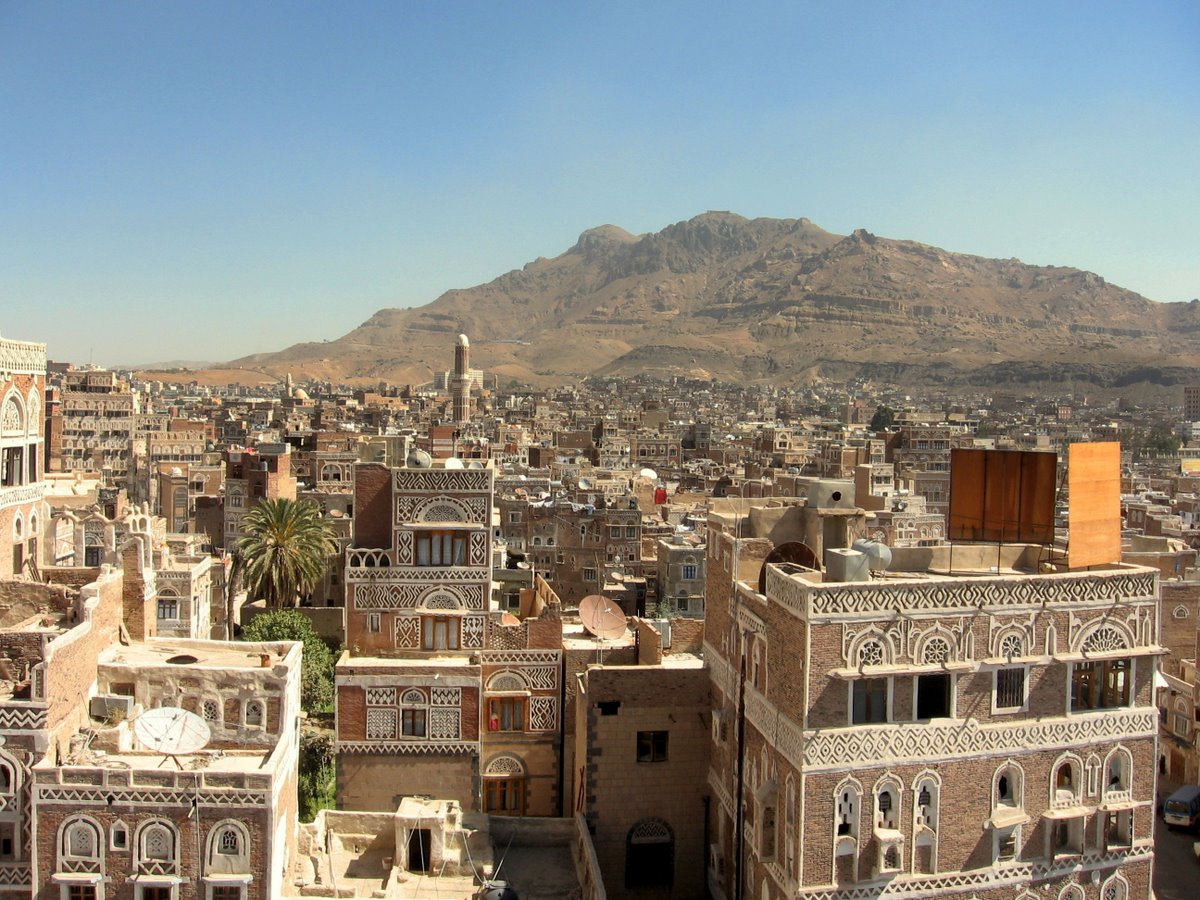
- Old City of Sana’a — inscribed 1986; added to danger list 2015. Inhabited for more than 2,500 years, the city holds over 100 mosques, 12 hammams, and 6,500 multi-storey tower houses decorated with geometric friezes and stained-glass fanelights. Airstrikes and ground fighting have damaged structures within and around the historic perimeter.
- Old Walled City of Shibam — inscribed 1982; added to danger list 2015. Sometimes called the Manhattan of the desert, Shibam’s roughly 500 mudbrick tower houses rise between five and eleven storeys from the valley floor — one of the earliest examples of planned vertical urbanism anywhere in the world. The city already faced erosion and flood damage from a 2008 cyclone; armed conflict has compounded those structural vulnerabilities.
- Landmarks of the Ancient Kingdom of Saba, Marib — inscribed 2023; added to danger list 2023. A serial property of seven archaeological sites in Marib Governorate, including the Awam Temple, the Barran Temple, and the ancient Marib Dam system. The Marib region was a frontline in some of the conflict’s most intense fighting, placing irreplaceable pre-Islamic monuments in immediate physical danger.
War, neglect, and the forgotten heritage
The civil war that erupted in 2015 is not Yemen’s only heritage crisis. The Historic Town of Zabid — a medieval city that served as Yemen’s cultural and intellectual capital under the Rasulid dynasty (1229–1454) and once held between 230 and 240 mosques — was added to the danger list as early as 2000, well before the conflict. By then, roughly 40 percent of its historic buildings had already been replaced by concrete construction, and the ancient souk was deteriorating. Coalition airstrikes in 2015 damaged historic homes, adding military destruction to decades of neglect and unmanaged development.
The danger list inscription is not a penalty: under Article 11.4 of the 1972 World Heritage Convention, it is a mechanism for mobilising emergency funding and international political pressure. For Yemen, however, the mechanism’s effectiveness has been severely limited by the collapse of central authority, ongoing hostilities, and restricted humanitarian access. Conservators and archaeologists have been largely unable to reach the sites; condition assessments rely increasingly on satellite imagery and remote monitoring.
Socotra: a natural heritage at risk
The Socotra Archipelago, inscribed as a natural World Heritage Site in 2008, is not currently on the danger list — but it sits in precarious ecological balance. The islands hold approximately 37 percent endemic plant species, 90 percent endemic reptile species, and 95 percent endemic land snails. The dragon blood tree (Dracaena cinnabari), with its umbrella-shaped canopy, has become one of the most recognisable images of the archipelago’s singular ecology, earned it the designation “the Galapagos of the Indian Ocean.”
Climate change is altering precipitation patterns and intensifying winds, threatening forests adapted to narrow climatic conditions. Invasive species introduced since the opening of the archipelago to outside contact, road construction causing habitat fragmentation, and the near-total collapse of Yemen’s conservation infrastructure due to the civil war all compound the risk. Socotra’s absence from the formal danger list should not be read as reassurance.
How to find Yemen’s sites on the map
All of Yemen’s UNESCO-listed properties sit within a country that is almost entirely off-limits to independent travel, which makes reliable digital documentation of their location and condition more important than ever. Sana’a stands in the western highlands at roughly 2,300 metres elevation; Shibam occupies the Hadhramaut Valley in the east; Marib lies in the desert interior; Zabid sits on the coastal plain of the Tihama; and Socotra is a distant island chain in the Arabian Sea, closer to Somalia than to the Yemeni mainland.
These sites sit alongside thousands of others on CHO’s interactive heritage map, with GPS coordinates and sourced editorial history. See our complete guide to UNESCO Sites in Danger and our explainer on UNESCO criteria.
Frequently Asked Questions
How many UNESCO World Heritage Sites does Yemen have in danger?
As of 2025, Yemen has three UNESCO World Heritage Sites formally listed as endangered: the Old City of Sana’a and the Old Walled City of Shibam (both added in 2015 due to the civil war), and the Landmarks of the Ancient Kingdom of Saba, Marib (inscribed and added to the danger list simultaneously in 2023). The Historic Town of Zabid has been on the danger list since 2000, predating the conflict.
Why is Sana’a on the UNESCO danger list?
The Old City of Sana’a was added to UNESCO’s List of World Heritage in Danger in 2015 following the outbreak of the Yemeni civil war. Airstrikes and ground combat have caused direct damage to buildings within and near the historic city walls, while the collapse of civil administration has made routine conservation maintenance impossible. The city’s distinctive multi-storey tower houses, many over a century old, require continuous upkeep that the conflict has prevented.
What is the Historic Town of Zabid and why was it endangered before the war?
Zabid is a medieval Yemeni city that served as an important centre of Islamic learning and was capital of Yemen under the Rasulid dynasty. UNESCO added it to the danger list in 2000 — fifteen years before the civil war — because unregulated concrete construction had already replaced approximately 40 percent of its historic mudbrick buildings, and its ancient market was deteriorating. The 2015 conflict then added direct military damage to a conservation crisis that was already severe.
Is the Socotra Archipelago at risk of losing its World Heritage status?
Socotra is not currently on UNESCO’s danger list, but conservation experts consider it ecologically vulnerable. The archipelago’s extraordinary endemism rates — including roughly 37 percent of its plant species found nowhere else on Earth — depend on stable climatic and ecological conditions that are being disrupted by climate change, invasive species, and habitat fragmentation. Yemen’s civil war has effectively suspended formal conservation programmes on the islands, removing the institutional capacity needed to manage these pressures.
Sources used in this article
- UNESCO — UNESCO World Heritage — Yemen.
- UNESCO — List of World Heritage in Danger.
- Wikipedia — List of World Heritage in Danger (cross-checked June 2026).
- CHO magazine — What is a World Heritage Site?
- CHO — Interactive map of heritage sites.