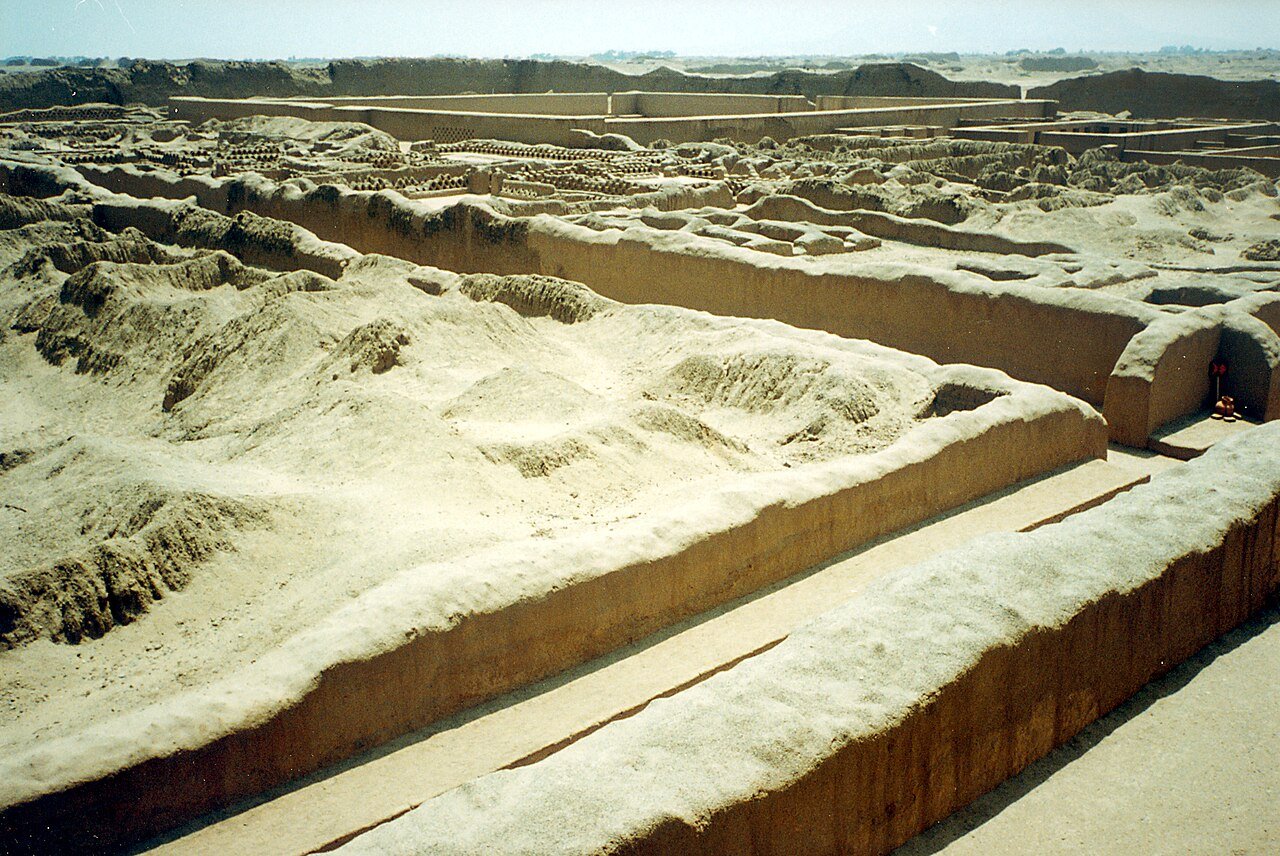
Chan Chan, on the northern coast of Peru, is the largest pre-Columbian city in South America and the largest adobe city in the world — a 20-square-kilometre urban complex built from sun-dried mud brick on a desert plain between the Pacific Ocean and the Andean foothills. It was the capital of the Chimu Empire from around 900 CE until the Inca conquest of the 1470s. UNESCO inscribed Chan Chan in 1986 and placed it on the In Danger list in the same year, where it remains today.
The capital of the Chimu Empire 5 km from Trujillo, northern Peru — 550 km from Lima
The Chimu — whose kingdom is also called the Kingdom of Chimor — occupied the northern coast of Peru from roughly 900 CE onward, building a state that eventually stretched approximately 1,000 kilometres along the Pacific littoral and controlled a population of around 500,000 people at its height. They were heirs to the earlier Moche civilisation that had occupied the same coastal valleys from the 1st to the 8th century CE, and they incorporated Moche artistic traditions — particularly in ceramics and metalwork — into their own cultural synthesis.
Chan Chan itself was built on the arid coastal plain near the Moche River mouth, between the modern city of Trujillo and the ocean. The site covers approximately 20 square kilometres and supported a peak population estimated at between 30,000 and 60,000 inhabitants. Its organisation is unlike other pre-Columbian capitals: instead of a single centralised planning scheme, it grew through a series of self-contained royal compounds added sequentially over roughly six centuries.
The defining feature of Chan Chan’s urban organisation is the ciudadela system — nine massive royal enclosures, each surrounded by adobe walls between 9 and 12 metres tall. The word ciudadela (little city) is accurate: each compound is a self-contained administrative and ceremonial centre roughly 400 by 200 metres in extent, with its own internal structure of corridors, plazas, storage rooms, wells and funerary platforms. The system reflects the Chimu practice of “split inheritance”: when a Chimu king died, he retained ownership — through his mummy, his court and his descendants — of all the wealth and palaces he had accumulated during his lifetime. His successor received the royal title and the right to levy tribute but had to build an entirely new compound from scratch. Over six or seven reigns, this produced nine ciudadelas arranged roughly in order of construction from the oldest in the south to the most recent in the north.
This system had economic consequences. Each new king needed to generate sufficient resources to fund a new construction programme of enormous scale, which drove territorial expansion and intensified tribute extraction. The Chimu were exceptional craftspeople — particularly in the working of gold, silver and copper alloys — and their metalwork became tribute items of choice across the northern Andes. The wealth accumulated in the ciudadela burial platforms, where kings were interred with sacrificed retainers and extraordinary quantities of precious metal objects, made Chan Chan a target for looting that began during the Spanish colonial period and has continued intermittently ever since.
Adobe, friezes and the maritime cosmology of the Chimu On UNESCO’s In Danger list since 1986 — El Niño erosion ongoing
The walls of Chan Chan’s ciudadelas are not bare mud brick. Their interior surfaces are decorated with carved and moulded adobe friezes covering extensive areas — geometric patterns, stylised animals and composite mythological beings that encode the Chimu understanding of the natural world and the supernatural order. The dominant motifs are marine: fish arranged in procession, seabirds (pelicans, cormorants), sea otters, fishing nets and wave patterns. This is not arbitrary decoration. The Chimu were fundamentally a maritime culture — their settlements hugged the Pacific coast, their economy depended on the rich cold-water upwelling of the Humboldt Current, and their mythology centred on the ocean as the source of life and the realm of the dead.
The Tschudi Complex, also called the Nik-An ciudadela, is the best-preserved and most visited of the nine royal compounds. Extensive reconstruction work has been carried out here since the 1990s, restoring sections of the frieze decoration to their approximate original appearance. The standard visitor route follows a sequence that reveals the typical ciudadela layout: a narrow entry corridor designed to control access and prevent mounted entry opens into a large ceremonial plaza; from there, corridors lead to audiencias — U-shaped platforms with elaborate frieze decoration that served as venues for ritual audiences between the king (or his successors and administrators) and those presenting tribute or seeking judgement; beyond the audiencias are storage rooms, a reservoir and finally the royal burial platform, a raised structure where the king’s mummy was installed with his funerary goods.
The audiencia form — the U-shaped platform — is one of the most distinctive architectural contributions of the Chimu. It appears across the former Chimu territory wherever the empire established administrative centres, functioning as a standard-issue instrument of political theatre: the U shape created an enclosed ceremonial space in which the hierarchical relationship between the official seated in the recess and the petitioner standing in the court was visually unmistakeable. When the Inca conquered Chan Chan around 1470 CE, they retained Chimu administrators and transported large numbers of Chimu metalworkers and craftspeople to Cuzco, incorporating their skills into the Inca state apparatus. The audiencia form was subsequently adopted by the Inca in their own provincial administrative architecture.
Chan Chan’s presence on the UNESCO In Danger list is warranted by two distinct threats. The first is natural: the adobe brick that constitutes the city is extremely vulnerable to water. In normal years the site receives almost no rainfall, which is why the city survived at all. During El Niño events — which intensify roughly every three to seven years — heavy rains fall on the coastal desert, dissolving the adobe walls at a rate that can destroy metres of height in a single season. The 1982–83 and 1997–98 El Niño events each caused severe damage. The second threat is human: illicit excavation of the ciudadela burial platforms, where pre-Columbian metalwork and ceramics command high prices on the international antiquities market. Despite protective measures, the scale of the site — 20 square kilometres — makes comprehensive surveillance difficult.
Practical information
Chan Chan is approximately 5 kilometres west of central Trujillo on the road toward the fishing town of Huanchaco. Taxis from Trujillo are inexpensive and readily available; the journey takes 15 to 20 minutes. Trujillo is served by daily flights from Lima (approximately 90 minutes); the overland journey from Lima is around 8 hours. The Tschudi Complex is the main visitor site within Chan Chan, with marked paths, reconstructed friezes and Spanish and English signage. A dedicated site museum is located at the entrance. Entry is valid for two days and also covers the nearby Huaca de la Luna (Temple of the Moon), a major Moche pyramid complex 5 kilometres in the opposite direction from Chan Chan — combining the two sites in a single day is feasible. The best months to visit are May through October, when coastal haze (the garúa) is most persistent but temperatures are comfortable; December through March is hotter and marginally clearer. Bring sun protection and water: the site is open and shade is limited. Guided tours from Trujillo are widely available and strongly recommended for first-time visitors to contextualise the ciudadela structure.
Frequently Asked Questions
Why does Chan Chan remain on the UNESCO In Danger list after nearly 40 years?
Chan Chan was placed on the UNESCO List of World Heritage in Danger in 1986, the same year it was inscribed — making it one of the earliest sites to receive both designations simultaneously. The dual listing reflected an immediate recognition that the site faced threats serious enough to jeopardise its outstanding universal value. Nearly four decades later it remains on the Danger list, which reflects the continuing severity of the threats rather than any failure of management will. The primary natural threat is El Niño-induced rainfall: Chan Chan was built in one of the driest coastal deserts on Earth, and its adobe fabric survived for centuries precisely because it almost never rained. During El Niño years, however, the normal rainfall patterns of the equatorial Pacific shift dramatically, and the coastal desert of northern Peru receives rain that can dissolve adobe walls at catastrophic speed. The 1982–83 and 1997–98 El Niño events each caused severe and irreversible damage to sections of the site. Research into protective covers and water-resistant coatings for the adobe has produced some partial solutions, but protecting 20 square kilometres of mud-brick walls against episodic extreme rainfall remains an unsolved engineering challenge. The secondary threat is looting: the burial platforms within each ciudadela contained enormous quantities of gold, silver and copper objects placed with the Chimu kings, and illicit excavation has been ongoing since the Spanish colonial period. Modern looters use metal detectors and operate at night; despite surveillance infrastructure funded partly through UNESCO and the Peruvian Ministry of Culture, the scale of the site makes comprehensive protection extremely difficult.
What was the “split inheritance” system of the Chimu kings and why did it matter?
Split inheritance is the term archaeologists use to describe the Chimu succession principle in which a dead king retained, through his mummy and his court, ownership of all the wealth and properties he had accumulated during his lifetime. When a new king took the throne he inherited the royal title, the obligation to govern and the right to levy tribute — but he did not inherit the palaces, the stored wealth or the productive estates of his predecessor. Those belonged to the dead king’s mummy cult, managed by the descendants and retainers of the previous reign, who continued to receive tribute from the estates the dead king had established. The new king therefore began his reign materially impoverished relative to his predecessor and had to generate entirely new wealth through conquest, tribute and construction. This system had profound physical consequences for Chan Chan: each new king built a new ciudadela compound rather than occupying the previous king’s palace, which explains why the city grew through the addition of nine successive royal compounds rather than through the expansion of a single central palace complex. The system also created a structural incentive for Chimu territorial expansion: each king needed to establish new tributaries and productive estates to fund his new compound and sustain his court. It has been proposed as a driver of the Chimu Empire’s northward and southward expansion along the coast in the 13th and 14th centuries. When the Inca conquered the Chimu in the 1470s, the Inca ruler Tupac Yupanqui reportedly removed the Chimu king Minchancaman to Cuzco as a hostage and absorbed the Chimu tribute system into the Inca administrative structure.
How do the geometric friezes at Chan Chan relate to Chimu beliefs about the ocean?
The carved adobe friezes that cover the interior walls of Chan Chan’s ciudadelas are among the most extensive examples of applied surface decoration in the pre-Columbian world. The dominant motifs — fish, seabirds, sea otters, fishing nets, wave patterns and composite figures that combine marine and anthropomorphic elements — reflect a cosmology in which the Pacific Ocean was the central sacred realm: the source of food, the domain of the dead and the origin of supernatural power. The Chimu economy was built on the extraordinary productivity of the Humboldt Current upwelling off the northern Peruvian coast, which supports one of the richest concentrations of marine life in the world. Fish — primarily anchovies, which were dried in enormous quantities for distribution inland — were the caloric foundation of the Chimu system, and the men and vessels that harvested them occupied a central place in Chimu symbolic life. The sea otter appears frequently in the friezes and in Chimu ceramic iconography as a figure associated with fishing skill. The seabirds — pelicans and cormorants are most commonly depicted — were practical indicators of fish shoals and appear to have carried cosmological significance as intermediaries between the human world and the ocean. The wave and net patterns that fill background registers are sometimes interpreted as representations of the actual fishing technology that sustained the city. Taken together, the frieze programmes constitute a sustained visual argument that the Chimu state was grounded in and legitimised by its mastery of the sea — an argument made on the walls of every royal compound in the capital.
Sources
- S1 — Moseley, Michael E., and Kent C. Day, eds. Chan Chan: Andean Desert City. University of New Mexico Press, 1982. ISBN 978-0-8263-0588-6.
- S2 — Moore, Jerry D. Architecture and Power in the Ancient Andes: The Archaeology of Public Buildings. Cambridge University Press, 1996. ISBN 978-0-521-55363-6.
Spotted an error? Write to editorial@culturalheritageonline.com and we correct it the same day.