
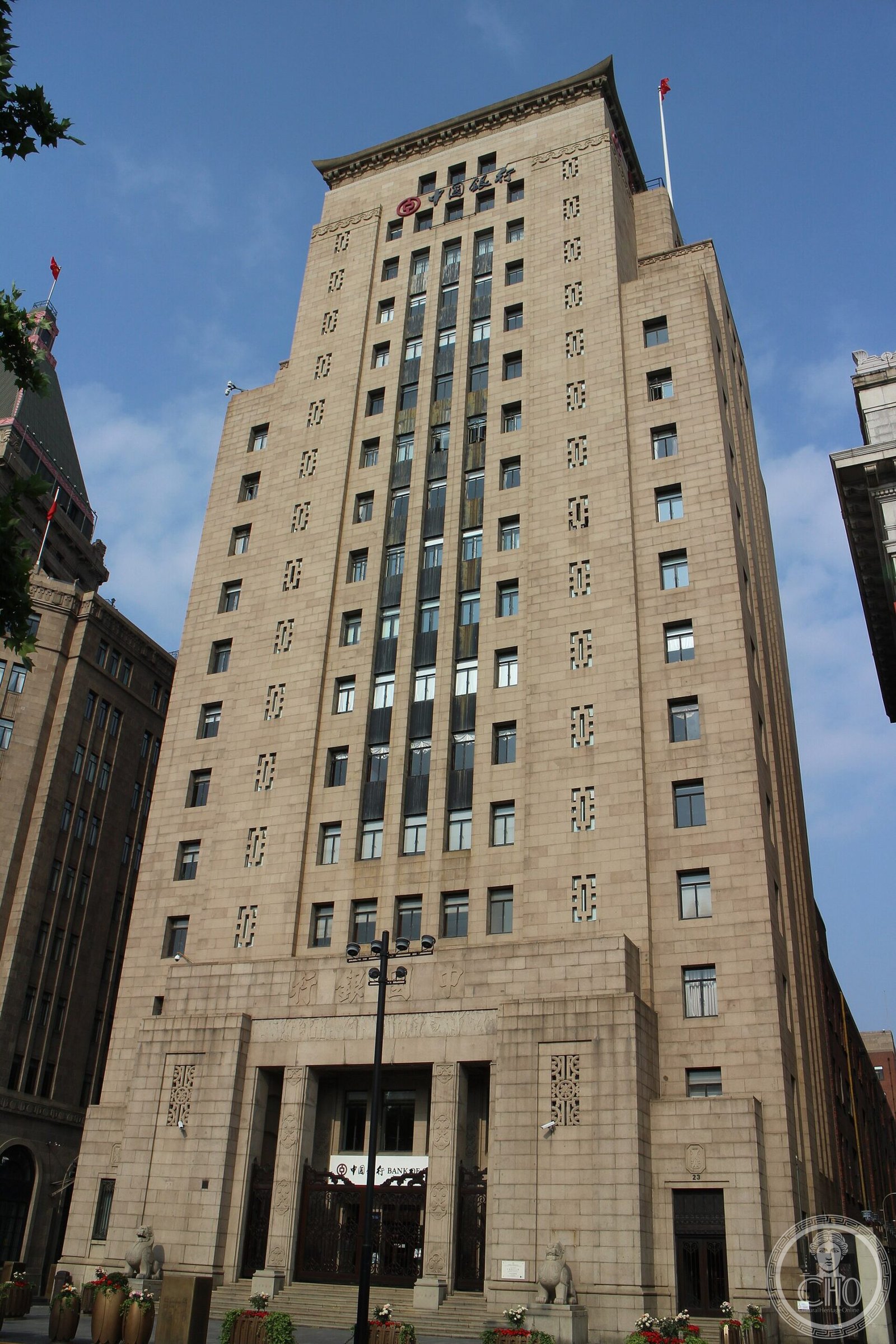
At No. 23 on the Bund, where Shanghai’s great financial row faces the Huangpu River, the Bank of China Building stands as one of the most sophisticated exercises in hybrid architectural identity of the entire twentieth century. Completed in 1937 by Palmer & Turner with Lu Qianshou serving as the Bank of China’s chief architect, it wears its Art Deco framework with Chinese authority: the upper storeys taper toward a roof of traditional green glazed tiles with upswept corners, a gesture that anchors this thoroughly modern tower within a millennia-old visual language. Its truncated silhouette — reduced from a planned 34 storeys to 18 under pressure from Victor Sassoon of the neighbouring Peace Hotel — makes it a building whose history is as dramatic as its facade. First occupied by the Bank of China in 1946 after wartime disruption, it remains today one of the Bund’s most intellectually compelling landmarks.
At a glance
- Type
- Commercial office building
- Period
- 1936–1937 (occupied 1946)
- Style
- Art Deco with Chinese classical roof elements
- Location
- No. 23, the Bund, Huangpu District, Shanghai, China
- Coordinates
- 31.2395° N, 121.4897° E
- Architect(s)
- Palmer & Turner; Lu Qianshou (Bank of China chief architect)
Overview
The Bank of China Building occupies a singular position in the history of modern Chinese architecture: it is among the first major commercial buildings in China to consciously fuse Western structural modernity with Chinese decorative tradition as a political and cultural statement. Standing on the Bund — Shanghai’s celebrated mile of international finance — it rises eighteen storeys to a green-tiled roof whose upswept eaves signal Chinese ownership of a district long dominated by foreign banks. Built to project what the Bank of China explicitly described as “modernity, soundness and international credit,” the building achieved all three while establishing a visual language that would influence Chinese institutional architecture for decades.
History
The site had previously housed the German Club (circa 1907), seized as enemy property during the First World War. In 1934, the Bank of China resolved to build its headquarters here, commissioning what was to be the tallest building in the Far East at 34 storeys. Victor Sassoon, owner of the adjacent Sassoon House (now the Peace Hotel), enforced a covenant preventing any neighbouring building from exceeding his spire — and the design was dramatically cut to 18 floors, ending up just one foot shorter than the Peace Hotel. Construction began 10 October 1936 but the Second Sino-Japanese War halted progress; the building was only occupied by the Bank of China in 1946. It now serves as the Shanghai branch of the bank.
Architecture & Design
The building’s Art Deco body follows the conventions of the style with confident authority: setbacks at the upper storeys, vertical emphasis through continuous stone piers, geometric ornament at the entrance portal. What distinguishes it is the roof: traditional Chinese glazed green tiles with deeply upswept corners crown the tower, a deliberate cultural flag planted atop an international commercial typology. The granite facade steps in controlled recessions as the building rises, creating shadow and movement. The banking hall interior combined Art Deco metalwork and geometry with Chinese decorative motifs in a synthesis that was entirely intentional — a building that refused to choose between its two inheritances.
Cultural significance
The Bank of China Building is a landmark in the history of architectural identity politics. Built by a Chinese institution on a stretch of river that had been, in effect, a foreign enclave, it used architecture to make a claim: that Chinese modernity was capable of standing equal to any international standard while remaining distinctively itself. The forced reduction of its height by Sassoon has become one of Shanghai’s best-known architectural anecdotes — a story of commercial rivalry that inadvertently produced a more interesting building. As part of the Bund ensemble, the building contributes to one of the finest concentrations of early twentieth-century commercial architecture anywhere in the world.
Visiting today
The building operates as the Shanghai branch of the Bank of China and is open during banking hours on weekdays. The Bund promenade in front of all the historic buildings is open at all hours and is best visited at dawn or dusk when the lighting is most dramatic. The building exterior and ground-floor lobby areas are generally accessible to visitors. The Bund as a whole is one of Shanghai’s principal tourist destinations, with good walking access to all eighteen historic facades.
Getting there
The Bund is served by metro Line 2 (East Nanjing Road station) and Line 10 (Yuyuan Garden station), both within a ten-minute walk. Numerous bus lines run along Zhongshan East Road (the Bund road itself). From Nanjing Road Pedestrian Street — Shanghai’s main shopping axis — the Bund is a five-minute walk east. The Huangpu River ferry connects the Bund to Pudong on the opposite bank.
Sources & resources
Find it on the map
See this place and what’s around it →Record researched and written by Luigi De Marchi for Cultural Heritage Online, 2026.
📷 Become a Cultural Heritage Online photographer
Share your photos of places: they stay published under your name as the author. The more they're seen, the more you get noticed — and soon a contest will reward the most appreciated photos.
Log in or sign up free to add a photoIs this page about you?
This page is read by travellers and heritage enthusiasts who find it on Google. Tell us how you are connected to this place and we will take it from there.