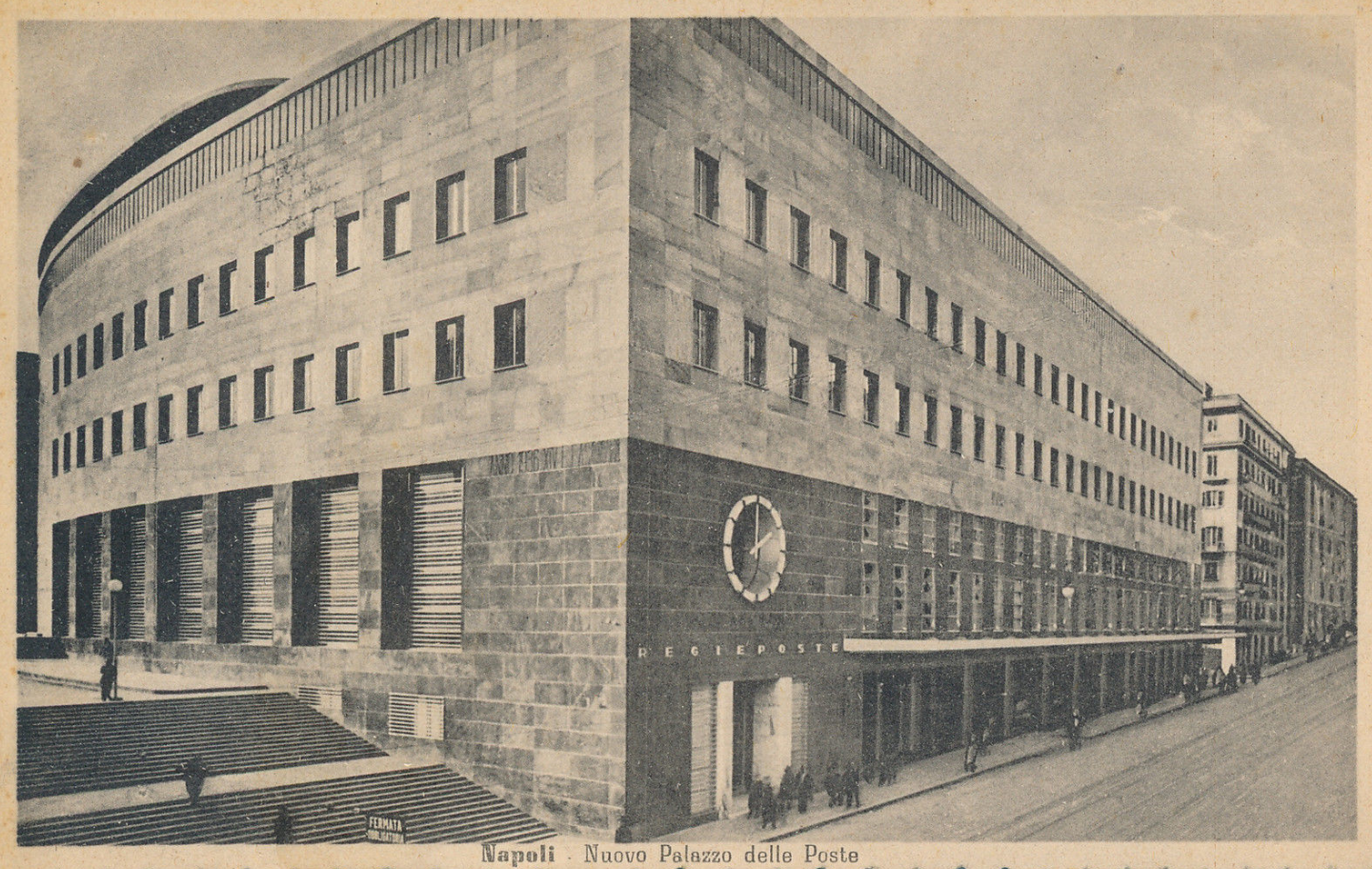
The Palazzo delle Poste in Naples was designed by architects Giuseppe Vaccaro and Gino Franzi and completed between 1933 and 1936. The building exemplifies Italian Rationalist architecture, a movement that dominated institutional design during the interwar years.
Vaccaro, born in Bologna in 1896 and trained at the city’s Academy of Fine Arts, had already established himself as a leading Rationalist practitioner. His collaborative work with Franzi on the postal palace represents a significant public commission, part of the broader modernization of Italian civic infrastructure during the 1930s. The building’s design reflects the functional clarity and geometric precision characteristic of Rationalism, adapting these principles to the practical requirements of a major postal facility.
About Giuseppe Vaccaro
Vaccaro pursued a prolific career spanning the fascist era and the postwar decades. Beyond the Palazzo delle Poste, his Rationalist works included the Casa del Fascio in Vergato and the Faculty of Engineering in Bologna (1931–35). He remained active in architectural practice after 1945, notably leading the reconstruction of the historical center of Alfonsine and designing the Train of Barca in Bologna. He died in Rome in 1970.
Details
- Architects: Giuseppe Vaccaro and Gino Franzi
- Year: 1933–1936
- Location: Naples, Italy
- Architectural movement: Italian Rationalism
- Building type: Postal palace
Explore more: 87 heritage places in Napoli
Frequently asked questions
Who designed the Palazzo delle Poste?
The building was designed by Giuseppe Vaccaro and Gino Franzi. Vaccaro, born in Bologna in 1896 and trained at the Academy of Fine Arts, was an influential proponent of Italian Rationalist architecture.
What architectural movement does it represent?
The Palazzo delle Poste exemplifies Italian Rationalism, a modernist approach that emphasized geometric clarity, functional design, and the elimination of ornament. This movement dominated institutional architecture during Italy’s interwar period.
When was it built?
Construction took place between 1933 and 1936, during the height of Rationalist influence on Italian public architecture.
Sources
- S1 — Ciucci, Giorgio. Gli architetti e il fascismo: architettura e città 1922-1944. Einaudi, 2002. ISBN 978-88-06-16310-5.
- S2 — Nicoloso, Paolo. Mussolini architetto: Propaganda e paesaggio urbano nell'Italia fascista. Einaudi, 2008. ISBN 978-88-06-19086-6.
Spotted an error? Write to editorial@culturalheritageonline.com and we correct it the same day.