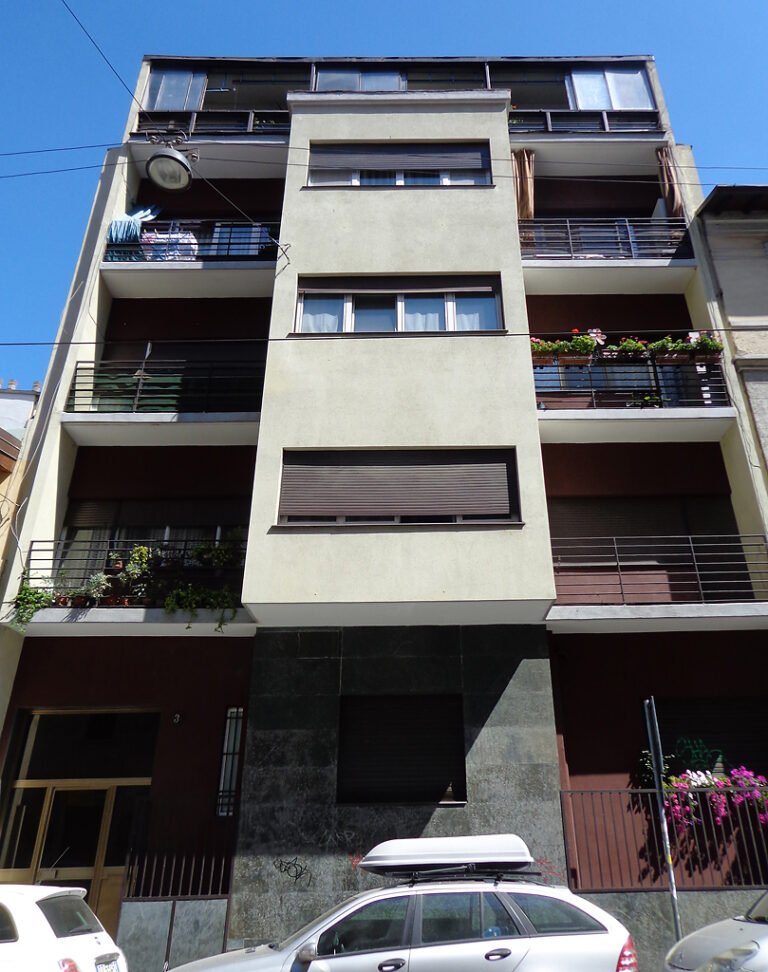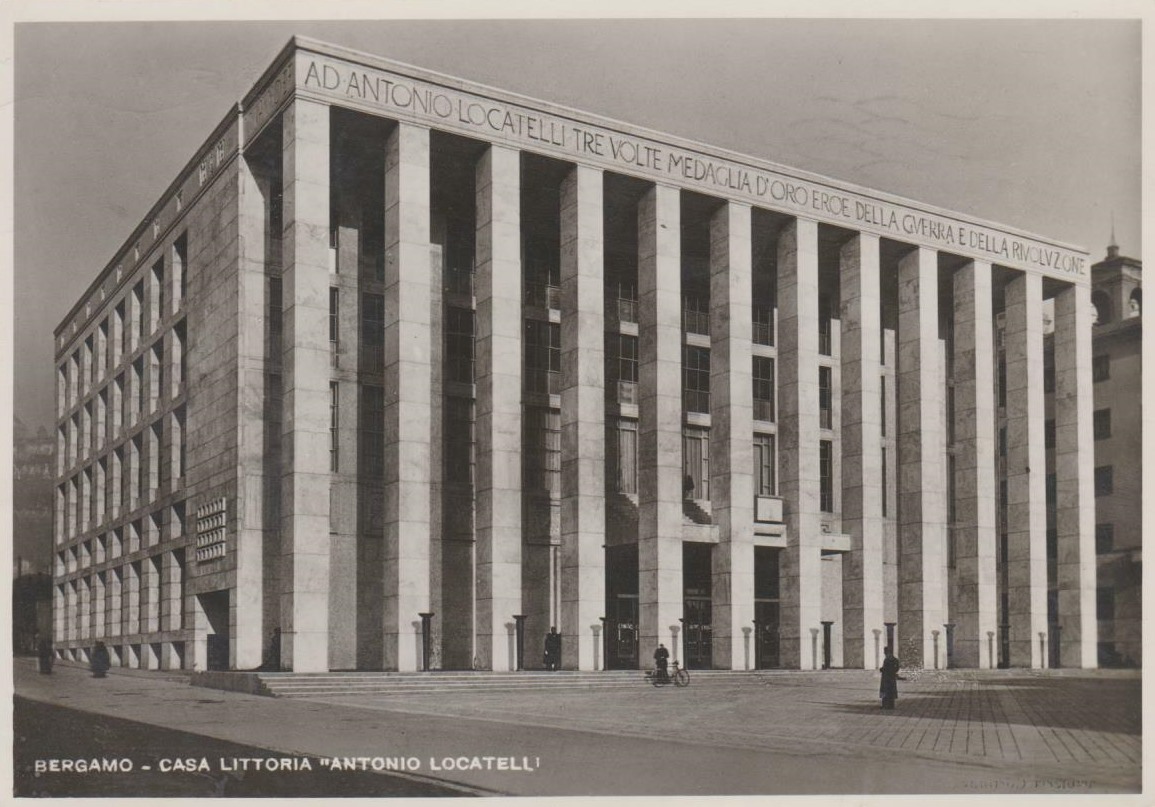
Casa Littoria in Bergamo is a residential building designed by architect Alziro Bergonzo between 1937 and 1940 for Antonio Locatelli, an Italian aviator and politician.
Bergonzo (1906–1997) was an architect and painter whose primary style was the rationalized Stile Littorio. After graduating from the Polytechnic University of Milan in 1933, where he studied alongside Franco Albini and Giancarlo Palanti, he established himself in his father’s studio in Bergamo, where he received commissions from both public and private clients. Casa Littoria exemplifies the rationalist architectural language that characterized much professional work in Italy during the 1930s.
About Alziro Bergonzo
Bergonzo studied at Milan’s Faculty of Architecture from 1925, his education informed by contact with leading figures in the decorative and architectural fields through his father Luigi’s established practice. The quality of his early commissions led to wider professional recognition. During the Second World War, he relocated his studio to Rome and collaborated with Luigi Moretti on projects including the Foro Italico. Following the war, after a period of professional suspension, he was reinstated in 1946 and continued to design significant buildings in the Venetian region and Bergamo.
Details
- Architect: Alziro Bergonzo
- Dates: 1937–1940
- Location: Bergamo, Lombardy
- Style: Rationalism (Stile Littorio)
- Patron: Antonio Locatelli
Explore more: 13 heritage places in Bergamo
Frequently asked questions
Who designed Casa Littoria?
Alziro Bergonzo, an Italian architect and painter specializing in rationalist Stile Littorio, designed the building between 1937 and 1940.
For whom was the house built?
Casa Littoria was commissioned by Antonio Locatelli, an Italian aviator and politician who served as a deputy to Parliament and Podestà of Bergamo.
What architectural movement does it represent?
The building exemplifies rationalism in Italian architecture of the 1930s, a style Bergonzo practised throughout his early career.
Sources
- S1 — Ciucci, Giorgio. Gli architetti e il fascismo: architettura e città 1922-1944. Einaudi, 2002. ISBN 978-88-06-16310-5.
- S2 — Nicoloso, Paolo. Mussolini architetto: Propaganda e paesaggio urbano nell'Italia fascista. Einaudi, 2008. ISBN 978-88-06-19086-6.
Spotted an error? Write to editorial@culturalheritageonline.com and we correct it the same day.