
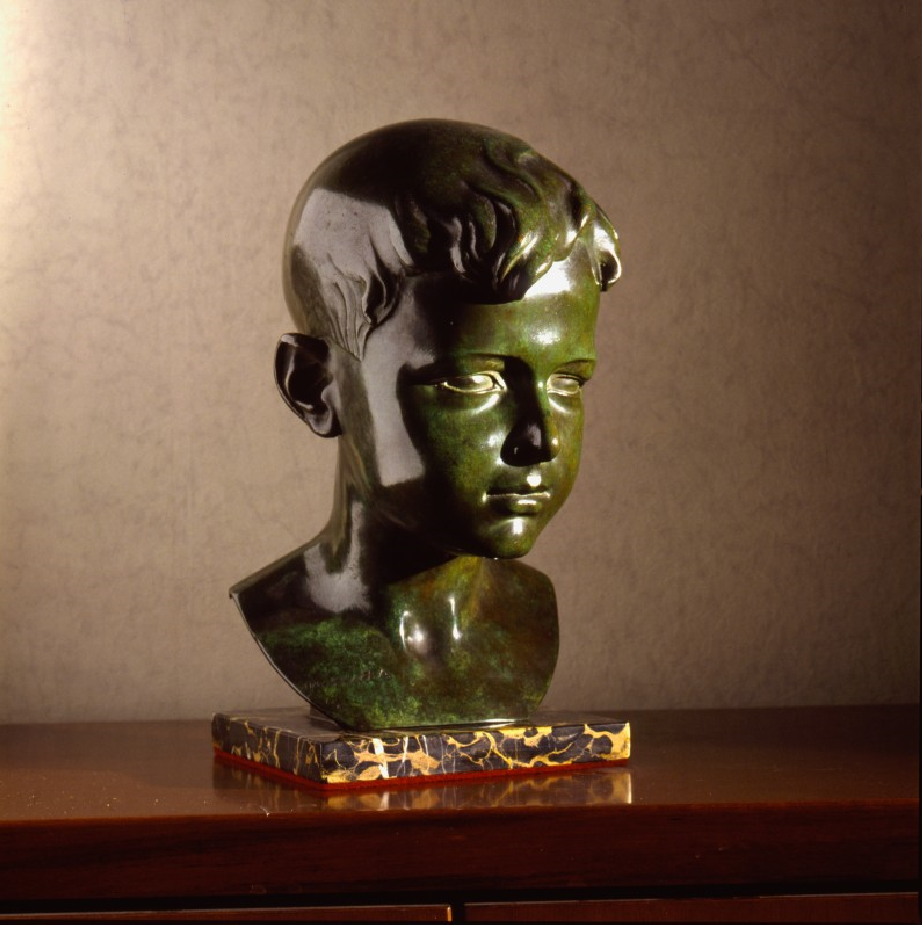
Testa di bimbo is a sculptural work by Italian sculptor Alberto Bazzoni, created in 1940. The piece represents a portrait of a child’s head, executed during Bazzoni’s established career in Milan.
Bazzoni (1889–1973) was trained at the Academy of Fine Arts in Parma and later became known for public monuments and private commissions. His artistic practice drew on his close study of Roman sculpture, evident in his figurative works. In 1936 he travelled to Paris, where he produced small bronzes for private collectors before returning to Milan, where this work was made.
About Alberto Bazzoni
Alberto Bazzoni settled in Milan in 1926 after establishing himself in Parma with public commissions including fountains and war memorials. His formal training and engagement with classical sculptural tradition shaped his approach to portraiture and monumental forms. Between 1946 and 1950 he made a second extended stay in Paris before concluding his career in Milan.
Details
- Creator: Alberto Bazzoni
- Year: 1940
- Type: Sculptural portrait
- Subject: Child’s head
Frequently asked questions
Who was Alberto Bazzoni?
Alberto Bazzoni (1889–1973) was an Italian sculptor trained at the Academy of Fine Arts in Parma. He worked primarily in Milan from 1926 onward, creating public monuments, ecclesiastical works, and private bronze sculptures, drawing influence from Roman sculptural tradition.
When was this work created and where?
Testa di bimbo was created in 1940, during Bazzoni’s established period in Milan. The work belongs to his mature practice of portraiture and figural sculpture.
What materials and scale characterize Bazzoni’s practice?
Bazzoni worked in bronze and stone, ranging from monumental public commissions to small bronzes for private collectors, particularly during his time in Paris in the late 1930s.
Sources
- S1 — Panzetta, Alfonso. Nuovo dizionario degli scultori italiani dell'Ottocento e del primo Novecento. AdArte, 2003. ISBN 978-88-422-1158-7.
- S2 — Pontiggia, Elena. Il Novecento Italiano. Abscondita, 2003. ISBN 978-88-8416-048-5.
Spotted an error? Write to editorial@culturalheritageonline.com and we correct it the same day.


