
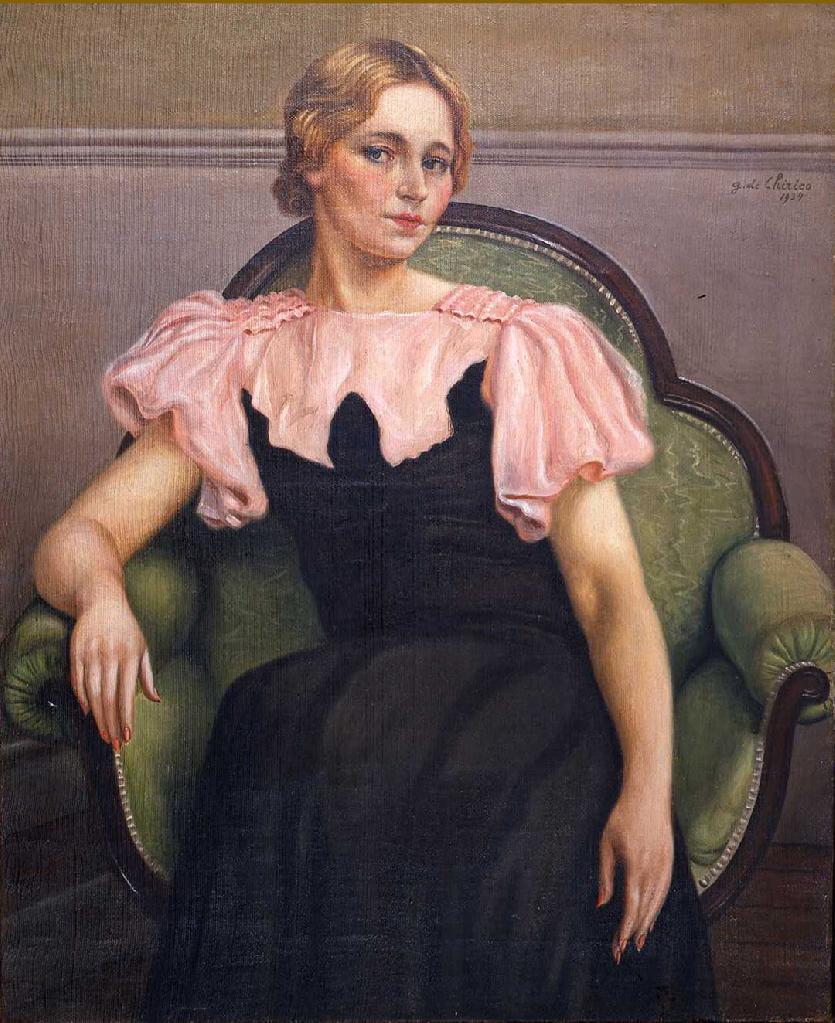
Giorgio de Chirico painted Isa in Pink and Black Dress in 1939. The work is a portrait executed during the Metaphysical Art period, the movement the Greek-Italian artist had founded in the years before the First World War.
De Chirico’s career established him as a pivotal figure whose imagery—featuring unexpected spatial relationships, elongated shadows, and enigmatic compositions—shaped twentieth-century visual culture and influenced Surrealist development. His artistic vocabulary drew from philosophical inquiry and classical iconography, reflecting the influence of Schopenhauer and Nietzsche as well as the mythological traditions of his Greek birthplace.
About Giorgio de Chirico
De Chirico was born in Volos, Greece, and became a Greek-Italian artist and writer whose Metaphysical Art movement emerged in the pre-war years and left a lasting imprint on modern art. His signature formal vocabulary—arcades, mannequins, trains, and dislocated perspective—created dreamlike scenes that challenged rational spatial logic.
Details
- Artist: Giorgio de Chirico
- Year: 1939
- Subject: Portrait of a figure in pink and black dress
- Movement: Metaphysical Art
On video
Frequently asked questions
Who was Giorgio de Chirico?
De Chirico was a Greek-Italian artist born in Volos who founded the Metaphysical Art movement before the First World War. His work profoundly influenced Surrealism and featured distinctive imagery of arcades, mannequins, and illogical perspective.
What is Metaphysical Art?
Metaphysical Art is the movement de Chirico established, characterized by dreamlike compositions that challenged rational spatial logic and conventional perspective, drawing from philosophical traditions including Schopenhauer and Nietzsche.
When was this portrait painted?
The work was completed in 1939, placing it in the mature period of de Chirico’s career and the Metaphysical Art movement.
Sources
- S1 — Pontiggia, Elena. Il Novecento Italiano. Abscondita, 2003. ISBN 978-88-8416-048-5.
- S2 — De Fusco, Renato. Storia del design. Laterza, 2002. ISBN 978-88-420-6623-1.
Spotted an error? Write to editorial@culturalheritageonline.com and we correct it the same day.


