
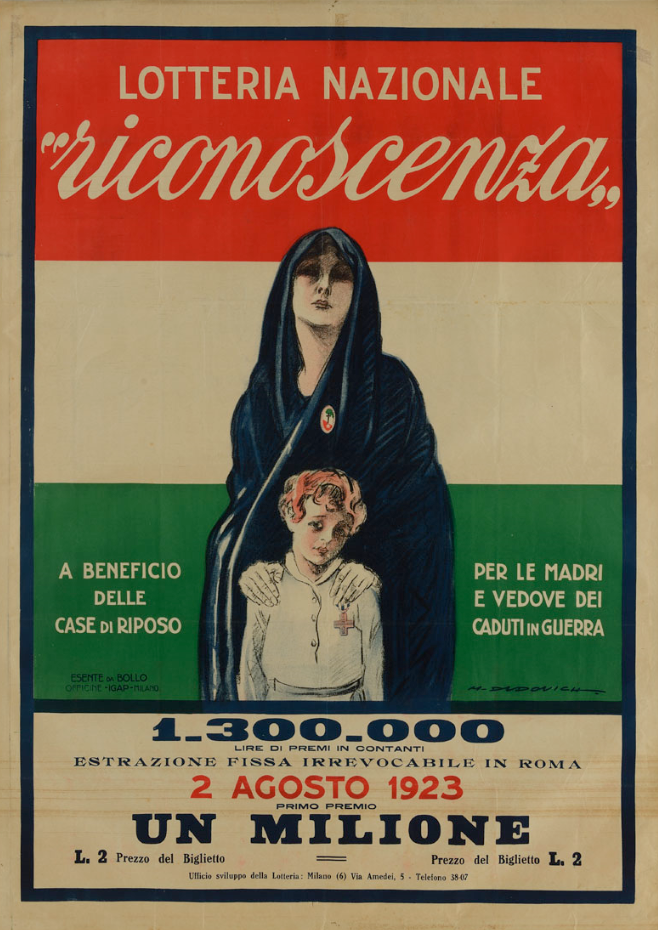
An advertising poster designed by Marcello Dudovich in 1923. Dudovich was among the principal figures who shaped Italian poster design in the early twentieth century, working across lithography, illustration, and commercial art.
Born in Trieste in 1878, Dudovich began his career in his father’s lithography workshop before relocating to Milan in 1897 to work for Ricordi, the music publisher. He later moved to Bologna and established himself as a designer of considerable originality, creating posters for major manufacturers and cultural institutions across Italy. His work synthesized bold typography, elegant figuration, and the chromatic sensibilities characteristic of the era’s commercial art.
About Marcello Dudovich
Dudovich (1878–1962) stands alongside Leonetto Cappiello, Adolfo Hohenstein, Giovanni Maria Mataloni, and Leopoldo Metlicovitz as one of the progenitors of Italian poster design. His career spanned from the 1890s through the mid-twentieth century, during which he became known for distinctive compositions that combined modernist simplification with narrative clarity, serving advertising, publishing, and theatrical clients across Italy.
Details
- Creator: Marcello Dudovich
- Year: 1923
- Object type: Advertising poster
- Movement: Italian poster design
Frequently asked questions
Who was Marcello Dudovich?
Marcello Dudovich (1878–1962) was an Italian painter, illustrator, and poster designer. He is recognized as one of the principal progenitors of Italian poster design, working across lithography and commercial art throughout his career in Milan, Bologna, and other Italian cities.
What period of poster design did Dudovich represent?
Dudovich was active from the 1890s through the mid-twentieth century, contributing significantly to the development of Italian poster art in the early twentieth century, when the medium underwent rapid modernization and commercial expansion.
Where did Dudovich work?
After training in Trieste, Dudovich relocated to Milan in 1897, where he worked for Ricordi music publisher. He subsequently moved to Bologna and continued designing posters for major manufacturers and cultural institutions across Italy.
Sources
- S1 — Menegazzi, Luigi. Il manifesto italiano: 1882-1925. Electa, 1995. ISBN 978-88-435-5134-7.
- S2 — De Fusco, Renato. Storia del design. Laterza, 2002. ISBN 978-88-420-6623-1.
Spotted an error? Write to editorial@culturalheritageonline.com and we correct it the same day.


