
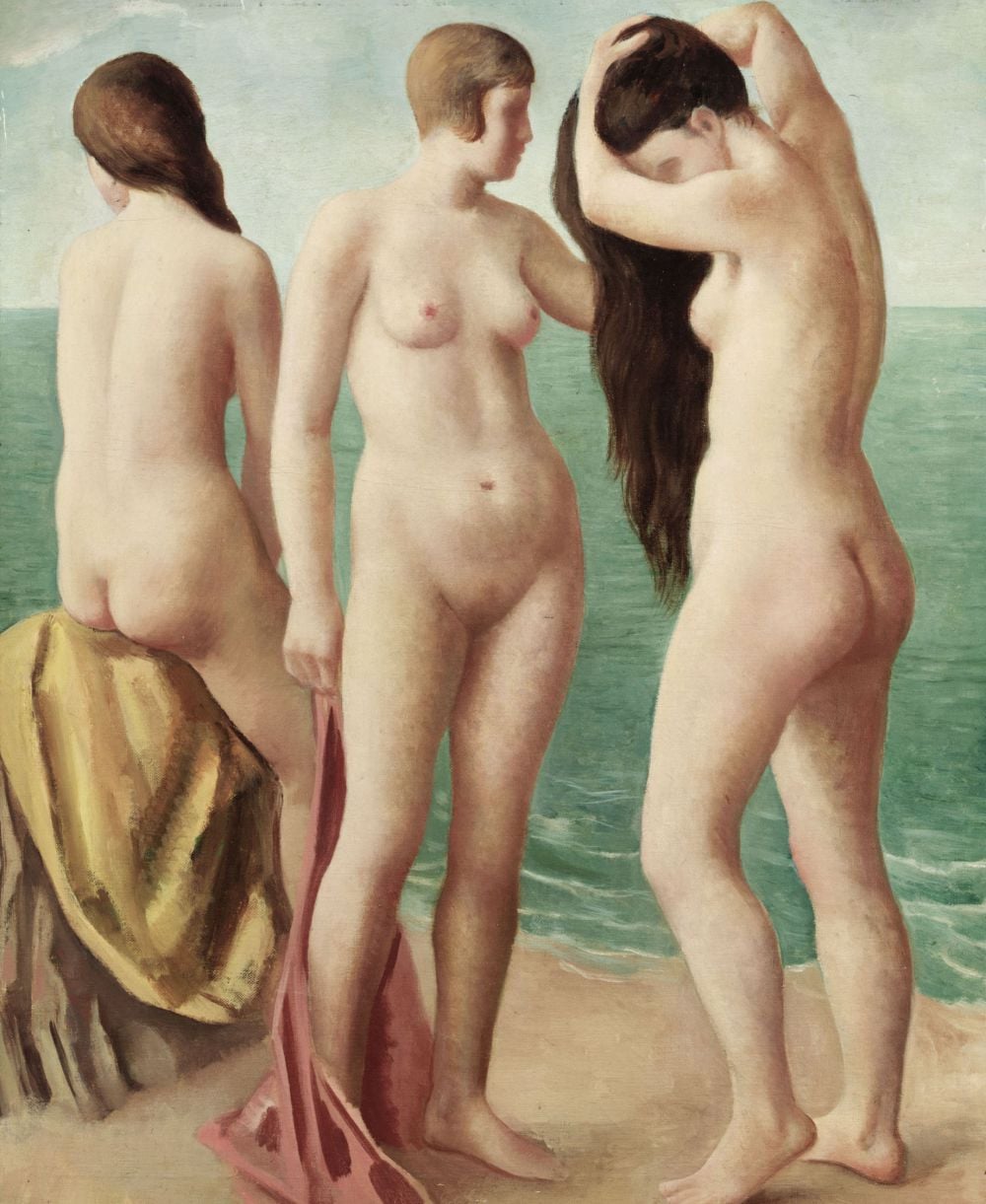
Bagnanti is a painting by Ubaldo Oppi, executed in 1927. Oppi was an Italian painter and one of the founders of Novecento Italiano, the modernist movement based in Milan that sought to recover classical formal discipline and figurative tradition in early twentieth-century art.
The work exemplifies Oppi’s neo-quattrocento realist approach, a style that drew on the principles of quattrocento Renaissance painting while engaging with contemporary artistic concerns. This method positioned him within the broader Novecento project of revitalizing Italian art through a return to measured form and humanistic subject matter.
About Ubaldo Oppi
Ubaldo Oppi was born in Bologna in 1889 and trained in Vienna under Gustav Klimt before settling in Milan as a central figure in Novecento Italiano. His career was marked by international exhibition activity, including participation in the 1924 Venice Biennale and the Salon des Indépendants in Paris. He died in 1942.
Details
- Artist: Ubaldo Oppi
- Year: 1927
- Movement: Novecento Italiano
- Style: Neo-quattrocento realism
On video
Frequently asked questions
Who was Ubaldo Oppi?
Ubaldo Oppi was an Italian painter born in Bologna in 1889 and a founding member of Novecento Italiano in Milan. He studied under Gustav Klimt in Vienna and exhibited internationally before his death in 1942.
What is Novecento Italiano?
Novecento Italiano was an Italian modernist movement based in Milan that sought to revive classical form and figurative tradition, moving away from avant-garde abstraction toward measured realism rooted in Renaissance principles.
What does neo-quattrocento mean?
Neo-quattrocento refers to a realist approach drawing inspiration from fifteenth-century Italian Renaissance painting, emphasizing disciplined form, humanistic subject matter, and classical proportion.
Sources
- S1 — Pontiggia, Elena. Il Novecento Italiano. Abscondita, 2003. ISBN 978-88-8416-048-5.
- S2 — Ciucci, Giorgio. Gli architetti e il fascismo: architettura e città 1922-1944. Einaudi, 2002. ISBN 978-88-06-16310-5.
Spotted an error? Write to editorial@culturalheritageonline.com and we correct it the same day.


