
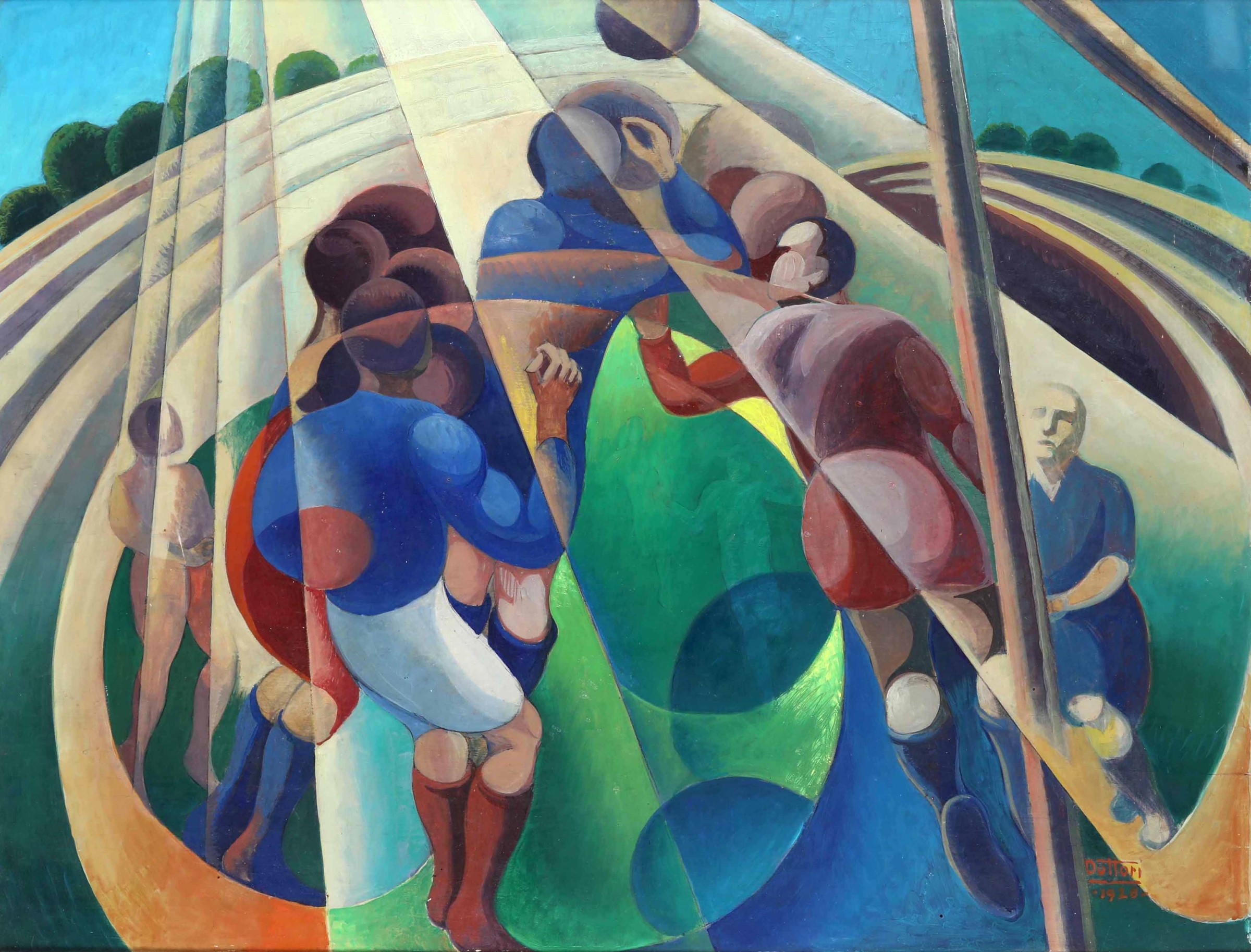
Partita di calcio is a painting by Italian Futurist artist Gerardo Dottori, created in 1928. The work captures a football match, employing the dynamic formal language characteristic of Futurism’s engagement with speed, movement and modern life.
Dottori was a principal figure in Futurist painting, later signing the Futurist Manifesto of Aeropainting in 1929. While best known for his aerial and elevated perspectives on Umbrian landscapes, this composition demonstrates the movement’s broader interest in contemporary subjects and kinetic energy. The painting dates from Dottori’s residence in Rome between 1926 and 1939, a period of intensive artistic development. His work gained significant recognition during this era, with pieces selected for the art competitions at both the 1932 and 1936 Summer Olympics.
About Gerardo Dottori
Dottori maintained a lifelong association with Perugia while studying briefly in Milan and working in Rome during the late 1920s and 1930s. His principal artistic output consisted of landscapes and visions of Umbria, typically rendered from an elevated viewpoint that aligned with Futurist ideals of dynamic perspective. Many of his works are held in the Museo civico di Palazzo della Penna in Perugia.
Details
- Creator: Gerardo Dottori
- Year: 1928
- Medium: Oil painting
- Movement: Futurism
- Subject: Football match
On video
Frequently asked questions
Who was Gerardo Dottori?
Gerardo Dottori was an Italian Futurist painter closely associated with Perugia who signed the Futurist Manifesto of Aeropainting in 1929. His work was included in the art competitions at the 1932 and 1936 Summer Olympics.
When did Dottori paint this work?
The painting was completed in 1928, during Dottori’s residence in Rome between 1926 and 1939.
What is Futurism?
Futurism was an early twentieth-century artistic movement that celebrated speed, dynamism, and modern subjects, employing bold formal innovations to capture movement and energy.
Sources
- S1 — Pontiggia, Elena. Il Novecento Italiano. Abscondita, 2003. ISBN 978-88-8416-048-5.
- S2 — De Fusco, Renato. Storia del design. Laterza, 2002. ISBN 978-88-420-6623-1.
Spotted an error? Write to editorial@culturalheritageonline.com and we correct it the same day.


