
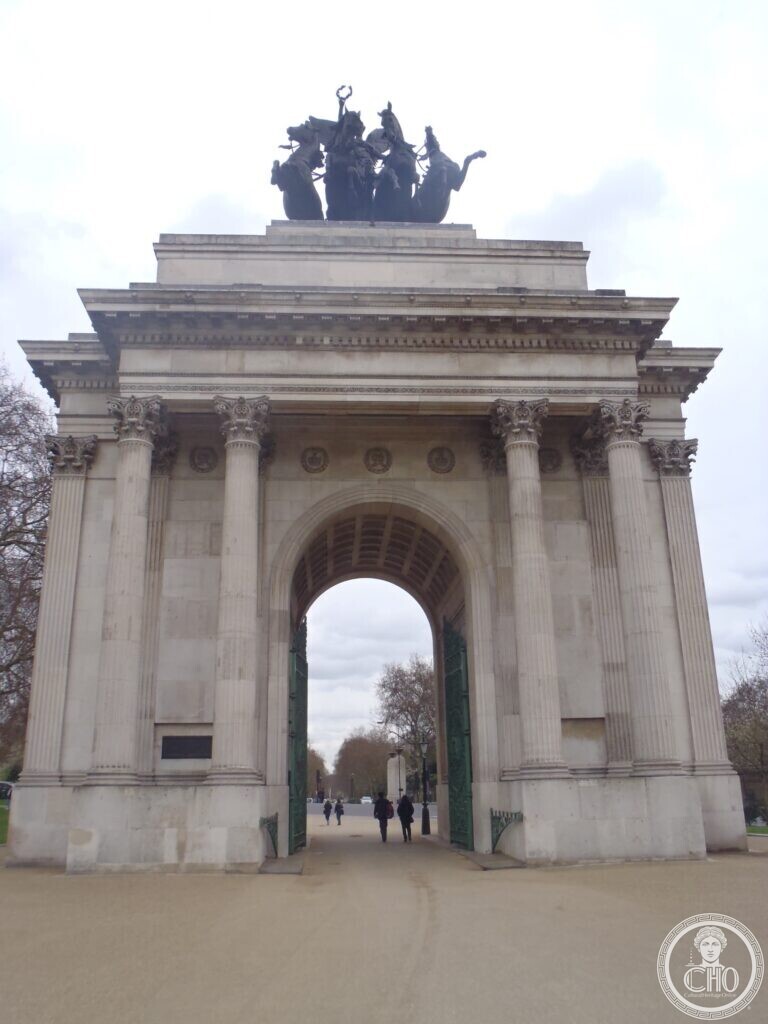
Decimus Burton designed it as an outer gate to Buckingham Palace, saw it crowned with a statue he had not wanted, and never saw the bronze quadriga that finally arrived in 1912.
At a glance
The Wellington Arch, also called the Constitution Arch or the Green Park Arch, stands on a traffic island at Hyde Park Corner. It was commissioned in 1824 from Decimus Burton, then in his mid-twenties, by the Office of Woods and Forests, and built between 1825 and 1827 as part of a ceremonial approach to Buckingham Palace. It faced the Hyde Park Screen, also by Burton, at the end of Piccadilly. It is Grade I listed and has been in the care of English Heritage since 1999.
Key facts
- Architect: Decimus Burton (1800–1881), commissioned 1824
- Built: 1825–1827
- Moved: dismantled from February 1883, rebuilt on the present site by about 1885
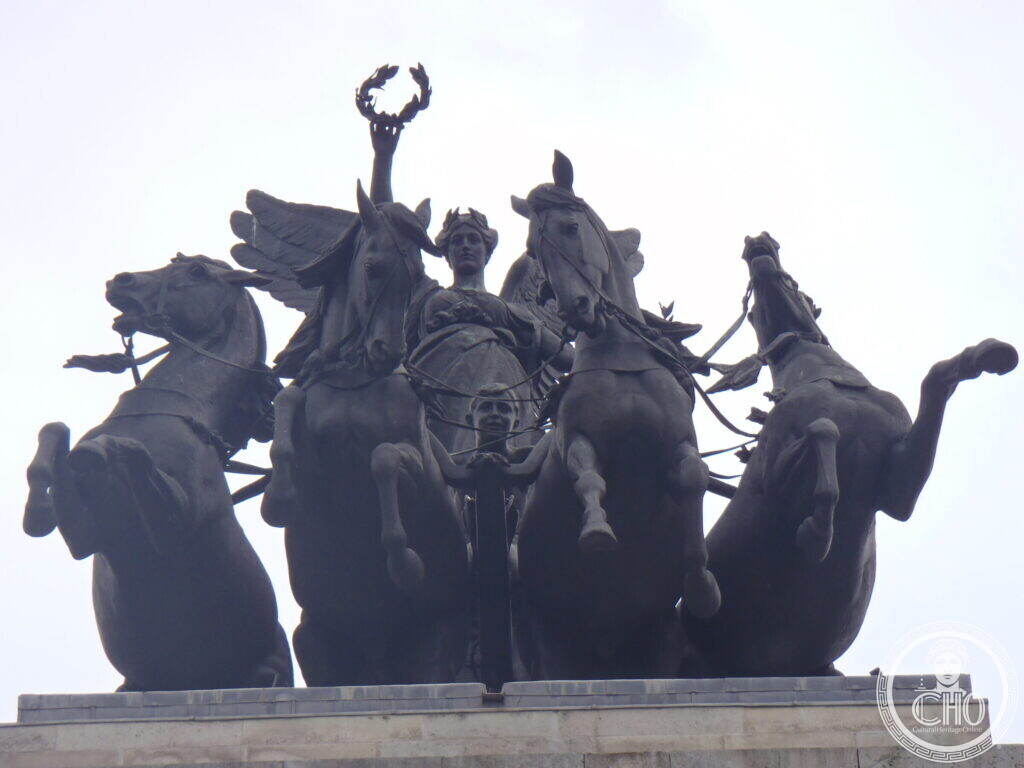
- Crowning sculpture: Peace descending on the Quadriga of War, Adrian Jones, erected January 1912
- Paid for by: an anonymous gift of some £20,000 from the banker Sir Herbert Stern
- Listing: Grade I
- In the care of: English Heritage since 1999; open to the public since 2001
- GPS: 51.5025, -0.1508 · Open in Google Maps (OpenStreetMap)
History
Burton’s first scheme was a gate; his second, whose estimate was approved in May 1826, was openly a triumphal arch, and his drawing already showed it crowned by a gilded chariot and four horses. The chariot was not built. What arrived instead, in 1846, was Matthew Cotes Wyatt’s colossal equestrian statue of the Duke of Wellington, placed on top — English Heritage notes — supposedly for a trial period. It stayed for thirty-seven years and was eventually taken away to Aldershot, where it was re-erected near the Garrison Church. A new Wellington statue, by Joseph Boehm, went up opposite Apsley House in 1888.
The arch itself did not stay either. Road widening at Hyde Park Corner in the 1880s required it to move: dismantling began in February 1883 and the arch was rebuilt on its present site by about 1885.
What you see
A single Portland stone archway framed by coupled Corinthian columns, with a deep attic storey above and green iron gates in the opening. On top, in dark bronze, four horses plunge outwards from a chariot: a winged figure of Peace steps down on to it, holding out a laurel wreath, while a boy holds the reins. Adrian Jones modelled it himself — English Heritage observes that the subject answers to no established myth, but appears to be the sculptor’s own invention — and it was put in place in January 1912, with the money given anonymously by the banker Sir Herbert Stern. The inside of the arch is largely empty; the southern pier was hollowed out to serve as a ventilation shaft for the road underpass.
Why it matters
Hyde Park Corner was conceived in the 1820s as a formal entrance to London from the west, and the Wellington Arch and the Hyde Park Screen are what survives of that plan. The arch is also a record of how public monuments are argued over: the chariot Burton drew in 1826, the statue that displaced it for a generation, and the quadriga that finally fulfilled the original idea in 1912 are three different answers to the same question about what should stand on top.
Nearby
- Wellington Museum (Apsley House) — the Duke’s London home, across the corner
- Palace of Westminster — east along Constitution Hill and Birdcage Walk
Gallery
Sources
- English Heritage, History of Wellington Arch: the commission of 1824 by the Office of Woods and Forests, the approval of the second design in May 1826, Wyatt’s equestrian statue of 1846 and its removal to Aldershot, Boehm’s statue of 1888, the dismantling from February 1883 and the rebuilding by about 1885, Adrian Jones’s quadriga erected in January 1912, Sir Herbert Stern’s anonymous gift of some £20,000, the hollowed southern pier, and English Heritage’s guardianship from 1999 and opening in 2001
- The Victorian Web, Decimus Burton: the Hyde Park Corner Screen and the Constitution Arch: the Grade I listing, the building dates of 1825–27, the original position facing the Hyde Park Screen at the end of Piccadilly, the gilded quadriga in Burton’s approved second design, the move of the 1880s for road widening, and the installation of Peace descending on the Quadriga of War in 1911–12
Find it on the map
See this place and what’s around it →📷 Become a Cultural Heritage Online photographer
Share your photos of places: they stay published under your name as the author. The more they're seen, the more you get noticed — and soon a contest will reward the most appreciated photos.
Log in or sign up free to add a photoIs this page about you?
This page is read by travellers and heritage enthusiasts who find it on Google. Tell us how you are connected to this place and we will take it from there.