

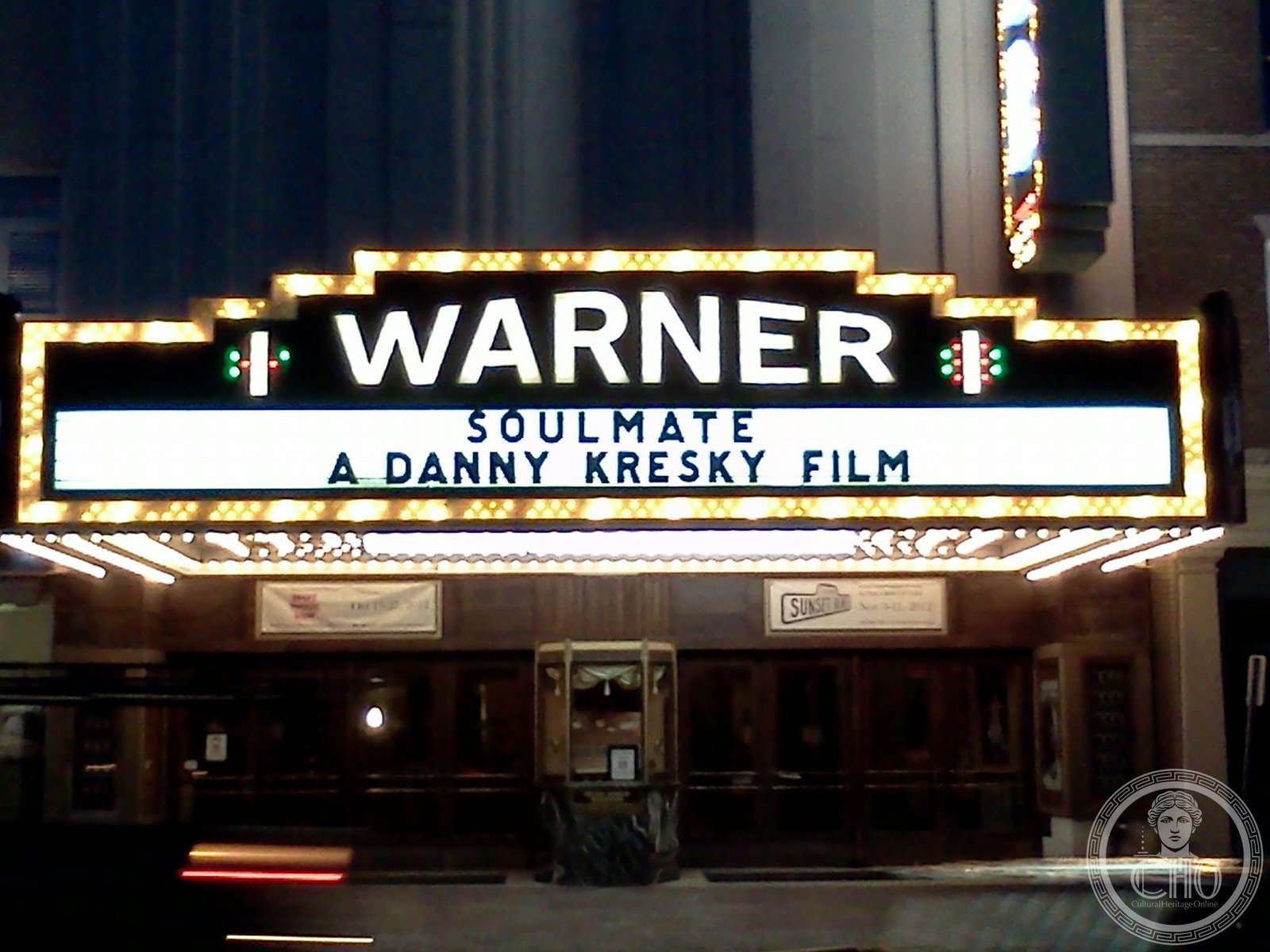
The premier cultural landmark of Connecticut’s Naugatuck Valley, the Warner carries a Warner Bros. circuit name and a 1931 Art Deco pedigree into the heart of New England’s historic Brass Valley.
At a glance
The Warner Theatre has anchored Main Street in Torrington, Connecticut, since 1931, when it opened as part of the Warner Bros. theater circuit during the final years of the great movie palace era. Torrington sits in the Naugatuck River Valley in the Litchfield Hills of northwestern Connecticut — an industrial corridor known historically as the “Brass Valley,” where precision manufacturing companies turned out the brass fittings, needle bearings, and hardware that supplied markets worldwide. The theater today operates as a full-service performing arts center under the management of the Northwest Connecticut Arts Council, presenting Broadway touring productions, symphony concerts, dance performances, and film events throughout the year.
Key facts
- Address: 68 Main Street, Torrington, CT 06790
- Built: 1931
- Style: Art Deco
- Circuit: Warner Bros. Theatres
- Current operator: Northwest Connecticut Arts Council
- County: Litchfield County, Connecticut
- NRHP: Listed on the National Register of Historic Places
- Coordinates: 41.8004° N, -73.1213° W (Google Maps)
History
Torrington at the turn of the 1930s was a company town writ large. The Torrington Company — manufacturer of precision needle roller bearings whose components went into automobiles, aircraft engines, and machine tools — anchored the local economy alongside smaller brass and hardware firms that had operated in the Naugatuck Valley since the mid-19th century. Industrial prosperity in the 1920s funded civic improvements, and the arrival of a Warner Bros. first-run theater on Main Street was one expression of that prosperity: a signal that Torrington belonged to the network of American cities that could support and sustain a major circuit venue.
The timing of the 1931 opening was not comfortable. The stock market crash of October 1929 had already begun to erode the industrial orders that kept the valley’s factories running, and the Depression would deepen through the 1930s. Yet the Warner survived and continued to attract audiences, in part because cinema offered affordable entertainment at a moment when more expensive amusements were out of reach. The theater became a fixture of community life in Litchfield County, an anchor that outlasted the manufacturing decline of the postwar decades.
By the late 20th century the Warner had weathered the transition from movie palace to multiplex competition, and a series of restoration and renovation campaigns over the years — the most extensive in the 1990s and 2000s — preserved the Art Deco fabric while modernizing the stage and technical infrastructure for live performance. Today the Warner is the leading performance venue between Hartford and the Berkshires.
What you see
The Warner Theatre presents a characteristic 1931 Art Deco commercial facade to Main Street: the cantilevered marquee projects over the sidewalk at cornice height, framing the changeable-letter sign that has announced performances in this spot since the theater opened. The facade above the marquee transitions to geometric ornament at the roofline, where vertical pilasters and stylized reliefs mark the theater as belonging to a distinct phase of American architecture — the moment when the ornamental exuberance of the 1920s gave way to a more restrained, machine-age vocabulary.
Inside, the single-balcony auditorium retains the essential proportions of the 1931 design. The proscenium stage, deep enough for touring Broadway productions, anchors a hall whose sightlines and acoustic geometry reflect the expertise accumulated by theater architects of the late silent-film era in designing spaces that could serve both projected and live performance.
Practical information
- Programming: Broadway touring productions, concerts, dance, film. Check the Northwest Connecticut Arts Council website for current schedule.
- Tickets: Available online and at the box office prior to performances.
- Season: Year-round, with concentrated programming in fall and spring.
- Climate: Litchfield Hills winters are snowy; allow extra travel time from November through March.
- Parking: Municipal lots on Church Street and surrounding blocks; metered street parking on Main Street.
Getting there
Bradley International Airport (BDL) in Windsor Locks, approximately 24 miles east-northeast of Torrington, is the closest major airport, with direct services to major US hubs. Torrington lies about 25 miles west of Hartford via US Route 44 through the Farmington River Valley. The city does not have direct Amtrak or Metro-North rail service; the nearest connections are Amtrak’s Hartford station to the east and Metro-North’s Waterbury branch terminus approximately 18 miles south via CT-8. By road, CT-8 north from Waterbury runs directly into Torrington, and US-44 links the town eastward to Hartford and westward into New York State via the Taconic hills.
Nearby
- Litchfield Historic District — the preserved 18th- and early-19th-century village green of Litchfield, 10 miles west, one of the finest examples of Federal-period New England streetscape in the state.
- Harriet Beecher Stowe Center, Hartford — 25 miles east, the preserved home of the author of Uncle Tom’s Cabin, adjacent to the Mark Twain House in the Nook Farm literary complex.
- Tanglewood, Lenox MA — summer home of the Boston Symphony Orchestra in the Berkshire Hills, approximately 45 miles north, the foremost outdoor classical music venue in New England.
- Yale University campus, New Haven CT — approximately 45 miles south, with James Gamble Rogers’s Gothic revival collegiate architecture and the Yale University Art Gallery.
Sources
- National Register of Historic Places — Connecticut historic properties inventory, Warner Theatre, Torrington.
- Northwest Connecticut Arts Council — venue history and programming documentation.
- Connecticut State Historic Preservation Office — Litchfield County industrial history records.
- Wikimedia Commons — The Warner Theatre in Torrington, CT2.jpg and associated images, Public Domain and CC BY 4.0.
Find it on the map
See this place and what’s around it →Record researched and written by Luigi De Marchi for Cultural Heritage Online, 2026.
📷 Become a Cultural Heritage Online photographer
Share your photos of places: they stay published under your name as the author. The more they're seen, the more you get noticed — and soon a contest will reward the most appreciated photos.
Log in or sign up free to add a photoIs this page about you?
This page is read by travellers and heritage enthusiasts who find it on Google. Tell us how you are connected to this place and we will take it from there.