
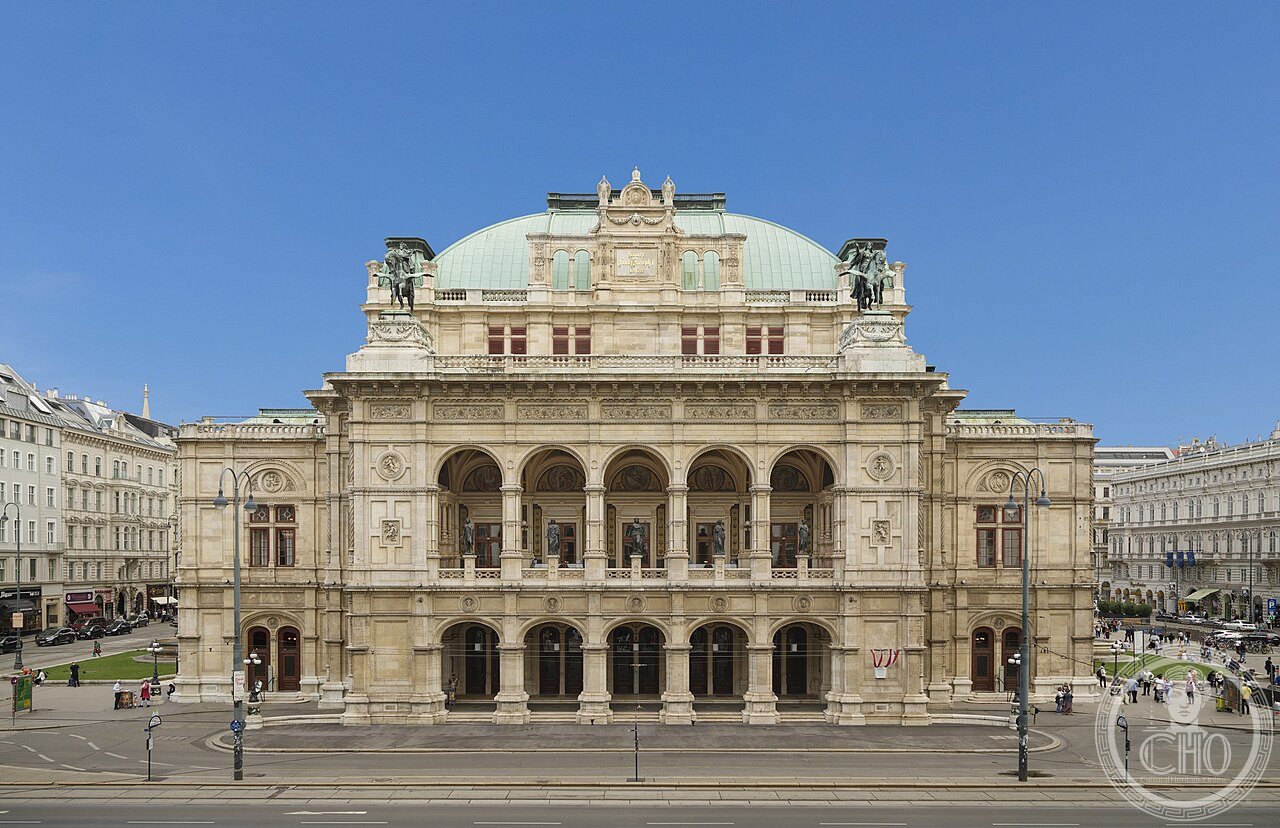
The Ring’s first palace – Mahler’s decade, the standing room’s nightly democracy, and the Opera Ball’s imperial waltz reborn from 1945’s ashes.
At a glance
- Type
- Opera house
- Period
- 1861-1869; rebuilt 1955
- Style
- Neo-Renaissance
- Location
- Ringstrasse, Vienna, Austria
- Coordinates
- 48.2025, 16.3692
- Architects
- van der Null and Sicardsburg
Overview
The Hofoper opened the Ringstrasse’s parade in 1869 with Don Giovanni – and drove architect van der Null to suicide under the emperor’s faint praise; Vienna’s opera neurosis was born with its house. Mahler’s reforming decade, Strauss’ co-direction, and the nightly standing-room queue (hundreds of places at pocket price) built the world’s most repertory-dense stage – 350 performances a year.
History
March 1945’s bombs gutted auditorium and stage; the 1955 reopening with Fidelio – weeks after the State Treaty – staged Austria’s rebirth. The televised Opera Ball each February turns the stalls to ballroom – debutantes’ white against the boxes’ jewels.
Architecture and Design
The loggia’s Schwind frescoes and the grand stair survived the fire – imperial procession’s frame; the rebuilt hall’s clean tiers hide modern machinery beneath tradition’s look. Tea-salon gilt and the Gustav Mahler hall’s tapestries serve intermission’s promenade.
Cultural significance
The Staatsoper is opera’s working capital – the Philharmonic rising from its pit, the canon’s nightly census – and Vienna’s self-image singing.
Visiting today
Standing tickets sell 80 minutes before curtain – the initiation; tours run daily. The Albertina and Sacher’s torte flank the block.
Getting there
Karlsplatz/Oper U-Bahn junction surfaces at the loggia.
Sources and resources
Find it on the map
See this place and what’s around it →Record researched and written by Luigi De Marchi for Cultural Heritage Online, 2026.
📷 Become a Cultural Heritage Online photographer
Share your photos of places: they stay published under your name as the author. The more they're seen, the more you get noticed — and soon a contest will reward the most appreciated photos.
Log in or sign up free to add a photoIs this page about you?
This page is read by travellers and heritage enthusiasts who find it on Google. Tell us how you are connected to this place and we will take it from there.