
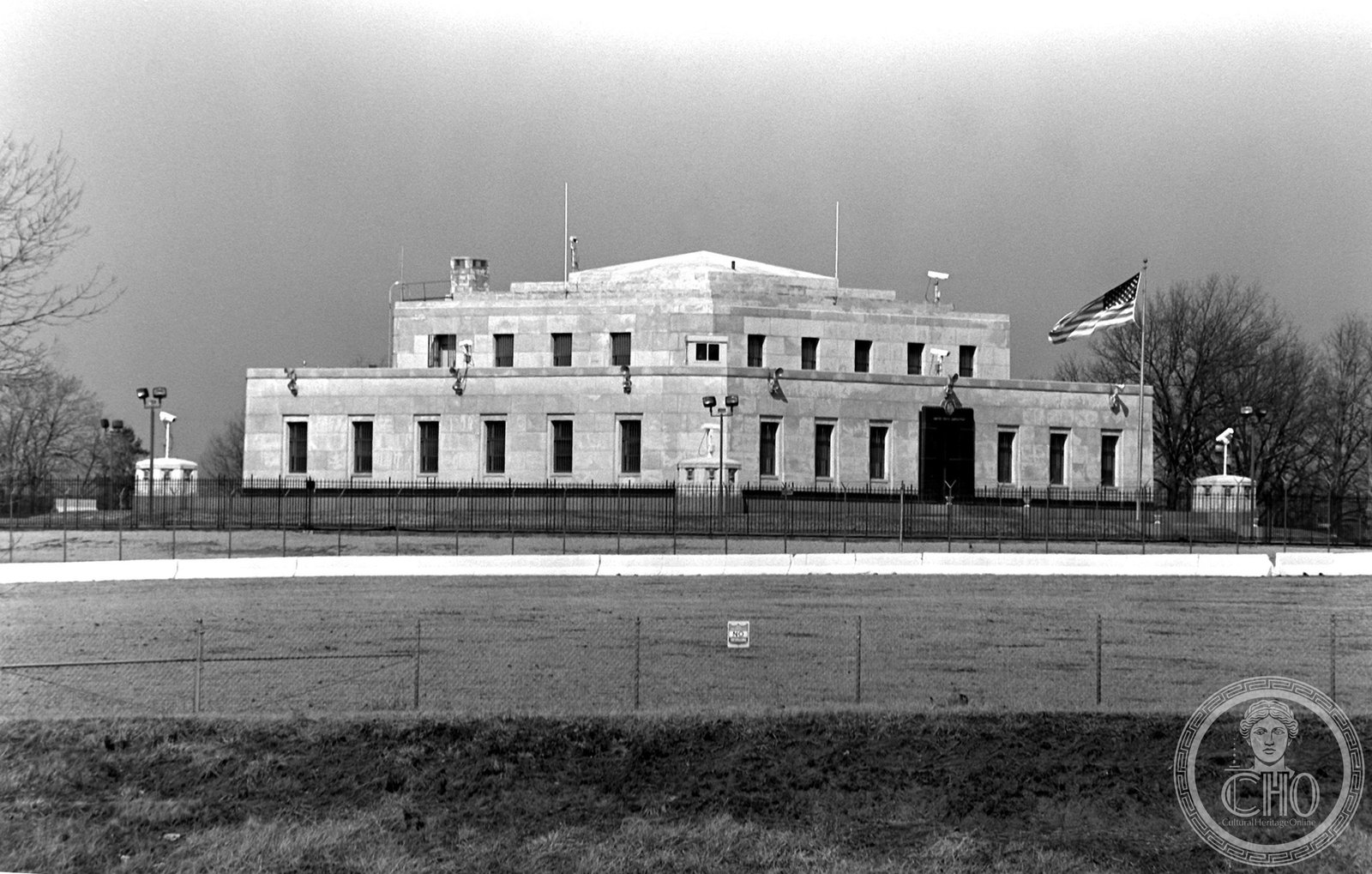
Built in 1936 to hold America’s gold reserves away from vulnerable coastal cities, this granite-clad Art Deco vault stores 147 million troy ounces of gold behind a 21-inch, 20-ton door — and sheltered the original Declaration of Independence, Constitution, and a Gutenberg Bible during World War II.
At a glance
The United States Bullion Depository on the grounds of Fort Knox, Kentucky, is the nation’s primary gold storage facility, holding approximately 147.3 million troy ounces of gold bullion — a little over half of all gold held by the federal government. Designed by Supervising Architect of the Treasury Louis A. Simon and completed in December 1936 at a cost of $560,000, the building is a striking example of Art Deco federal architecture: granite-lined concrete construction with a subterranean vault enclosed by steel plates, I-beams, and cylinders. Listed on the National Register of Historic Places in 1988 for its exceptional significance in American economic history, the depository is operated by the US Department of the Treasury and protected by the United States Mint Police.
Key facts
- Completed: December 1936
- Architect: Louis A. Simon (Supervising Architect of the Treasury)
- Engineer: Neal A. Melick
- Builder: Great Lakes Construction
- Style: Art Deco (Federal)
- Construction cost: $560,000
- Gold held: 147.3 million troy ounces (approx. half of U.S. federal gold reserves)
- Vault door: 21 inches thick, 20 short tons; 100-hour time lock
- Address: Gold Vault Road and Bullion Boulevard, Fort Knox, Kentucky
- NRHP: February 18, 1988 (ref. 88000056)
- Operator: U.S. Department of the Treasury / U.S. Mint Police
History
In June 1935, the U.S. Treasury announced plans to build a gold depository at Fort Knox, Kentucky. The purpose was strategic: to move gold reserves held in New York City and Philadelphia away from coastal cities considered vulnerable to foreign military attack. The Appalachian Mountains formed a natural barrier to any attacking force approaching from the Eastern Seaboard; isolation from railways and highways added further security. The Army’s only fully mechanized cavalry unit was stationed at the adjacent Fort Knox post, providing an immediate military response force.
Construction began in 1936 on land transferred from the Army to the Treasury. The building was completed in December 1936 for $560,000 — somewhat over the initial $450,000 estimate. Gold shipments from New York and Philadelphia, overseen by the US Post Office Department, arrived in two waves: the first during the first half of 1937, the second completed in 1941. Together, these shipments totaled roughly 420,000 troy ounces — nearly two-thirds of the nation’s total gold reserves at the time.
During World War II, the depository stored treasures far beyond gold: the signed original Constitution of the United States, the Declaration of Independence, the Articles of Confederation, Lincoln’s Second Inaugural Address, draft copies of the Gettysburg Address, a Gutenberg Bible, and an exemplified copy of the Magna Carta. After the war, the Crown of St. Stephen — Hungary’s royal crown — was held here from 1945 to 1978, along with stockpiles of opium and morphine held in government reserve. Today the vault is known to hold ten 1933 Double Eagle gold coins, a 1974-D aluminum cent, and twelve 22-karat gold Sacagawea dollars that flew aboard Space Shuttle Columbia on mission STS-93 in 1999.
What you see
The United States Bullion Depository presents a compact, purposeful Art Deco exterior in Tennessee granite — a material whose weight and warmth contrast with the industrial severity of the security apparatus around it. The building’s massing is resolved without ornament: the Art Deco character emerges from the proportion of the facade, the clean geometry of openings, and the quality of materials rather than from applied decoration. Supervising Architect Louis A. Simon brought the same no-nonsense Deco vocabulary he applied to other Treasury Department structures of the 1930s: clear forms, durable construction, an expression of federal authority without excess.
Perimeter security layers visible from outside the installation include razor wire fencing, armed guard posts, and high-resolution night vision cameras and microphones covering the grounds. The subterranean vault itself — accessible only via the 21-inch-thick, 20-short-ton door whose 100-hour time lock requires multiple staff members each dialing separate combinations — is invisible from outside, as is the concrete and steel structure that makes it “torch-and-drill resistant.” No civilian visitor has entered the vault since a congressional delegation did so in 1974, the last known public inspection.
Practical information
- Address: Gold Vault Road & Bullion Boulevard, Fort Knox, Kentucky
- Interior access: None; the depository is not open to visitors under any circumstances
- Exterior viewing: The building is visible from public roads near the Fort Knox military installation; the Fort Knox base itself restricts access
- Nearby museum: The Patton Museum of Cavalry and Armor (now the National Armor and Cavalry Museum) is located on Fort Knox and is accessible to the public
Getting there
Fort Knox is located approximately 35 miles south of Louisville on U.S. Highway 31W (Dixie Highway). Louisville International Airport (SDF) is the nearest major airport. The installation straddles Hardin and Meade counties; the depository itself is signposted from the main highway. Access to the Fort Knox base requires military ID or prior authorization; the depository’s perimeter is not accessible to the general public. The Vine Grove and Radcliff exits from US-31W bring visitors closest to the installation boundary.
Nearby
- National Armor and Cavalry Museum (Fort Knox) — on-base; traces the history of American armored warfare from World War I through the present
- Lincoln’s Birthplace National Historical Park (Hodgenville, KY) — 25 miles southeast; the symbolic log cabin birthplace of Abraham Lincoln, inside a Neoclassical granite memorial (1911)
- Louisville Slugger Museum & Factory — 35 miles north in Louisville; where the famous baseball bats have been made since 1884
- Bernheim Arboretum and Research Forest — 25 miles northeast; 16,000-acre forest and garden open to the public
Sources
- Wikipedia: United States Bullion Depository
- National Register of Historic Places nomination form (ref. 88000056, February 18, 1988)
- U.S. Mint — Fort Knox Bullion Depository official page
- National Archives and Records Administration — historical photographs and documents
Find it on the map
See this place and what’s around it →Record researched and written by Luigi De Marchi for Cultural Heritage Online, 2026.
📷 Become a Cultural Heritage Online photographer
Share your photos of places: they stay published under your name as the author. The more they're seen, the more you get noticed — and soon a contest will reward the most appreciated photos.
Log in or sign up free to add a photoIs this page about you?
This page is read by travellers and heritage enthusiasts who find it on Google. Tell us how you are connected to this place and we will take it from there.