
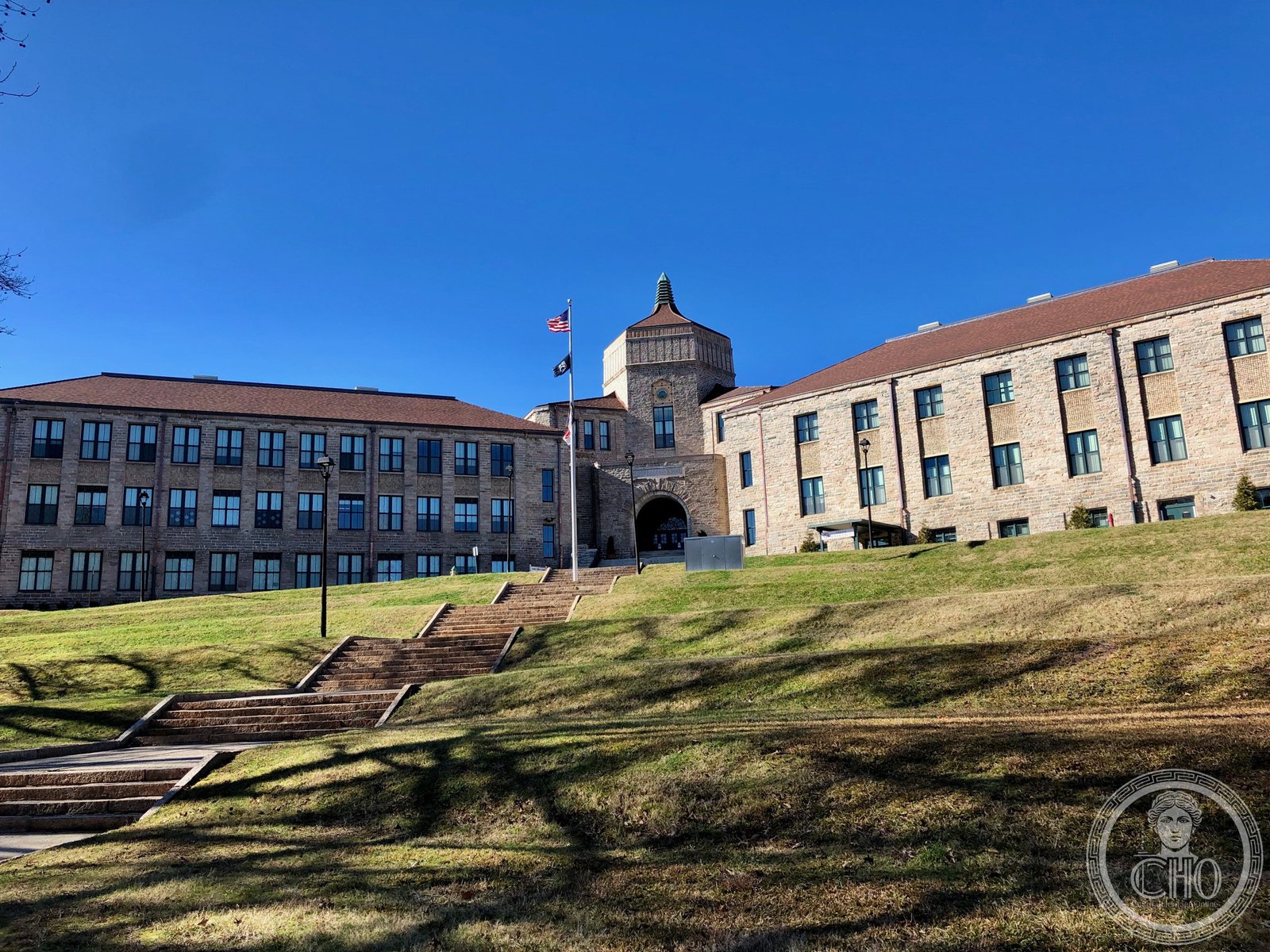
Douglas Ellington’s $1.3 million public school — the same architect who gave Asheville its Art Deco City Hall — opened in 1929 as a regional model combining Deco geometry with Italian Renaissance refinement across a campus designed as a civic monument to education.
At a glance
Asheville High School at 419 McDowell Street is a landmark public high school whose original 1929 building was designed by Douglas D. Ellington, Asheville’s most celebrated Art Deco architect. Selected from seven competitors by majority vote, Ellington — working with educational planning consultant Nickolaus Louis Englehardt of Columbia University — designed what regional commentators immediately recognized as a model facility both architecturally and educationally. Construction began in 1927; the building opened on February 5, 1929, at a cost of $1.3 million, the equivalent of approximately $18.8 million in 2016 dollars. Listed on the National Register of Historic Places in 1996, it remains a functioning high school and a key stop in understanding Asheville’s extraordinary concentration of interwar Art Deco architecture.
Key facts
- Opened: February 5, 1929
- Architect: Douglas D. Ellington
- Educational consultant: Nickolaus Louis Englehardt, Columbia University
- Style: Art Deco, Italian Renaissance
- Construction cost: $1.3 million (approx. $18.8M in 2016 dollars)
- Address: 419 McDowell Street, Asheville, NC 28803
- NRHP: April 26, 1996 (ref. 96000481)
- Status: Active high school; Asheville City Schools district
History
Asheville’s railroad connection from 1881 drove the city’s population from 2,000 to 10,000 in short order, and a public school system followed in 1888. By the mid-1920s, however, the city’s multiple scattered school campuses — Hall Fletcher in West Asheville and the David Millard campus downtown — could no longer accommodate the growing student body. In 1926, the school board agreed that “a large, central high school plant” was needed. A site committee reported that only one parcel of sufficient size and reasonable price existed within city limits: the tract between Victoria Road and the new McDowell Street.
Seven architects submitted proposals. Douglas D. Ellington — who had already demonstrated his facility with Deco forms in the Asheville City Hall and other civic commissions — was selected by majority vote. Ellington brought in Columbia University’s Nickolaus Louis Englehardt as educational planning advisor. The resulting collaboration made the new Asheville High not only architecturally impressive but organizationally forward-looking. Construction began in 1927 and the building was completed two years later. At the dedication ceremony on February 5, 1929, speakers included the Mayor of Asheville and the Superintendent of Schools.
A 1970 addition expanded the campus, and a new cafeteria was finished in 2006. A second school, the School of Inquiry and Life Sciences at Asheville (SILSA), now occupies part of the same address. Notable alumni include guitarist Warren Haynes and actress Bellamy Young.
What you see
Ellington applied the hybrid vocabulary the NRHP nomination describes as “Art Deco, Italian Renaissance” to the challenge of a large civic school building. The main facade rises from McDowell Street in a balanced composition whose vertical emphasis — characteristic of Ellington’s Deco work — is tempered by the horizontal banding and rusticated base typical of the Italian Renaissance idiom. A central tower marks the primary entrance, its stepped profile drawing the eye upward in the manner of the ziggurat setback towers then fashionable in American commercial architecture.
The ornamental program combines Deco geometric detailing — stylized capitals, flat-relief panels, incised patterning — with the masonry weight and arched openings more associated with Renaissance precedent. The result is a building that reads simultaneously as modern and authoritative: appropriate for a civic school intended to project both progressivism and institutional permanence. The interior layout, shaped by Englehardt’s educational planning expertise, reflects contemporary thinking about school organization, with a full auditorium and facilities designed for community as well as academic use.
Practical information
- Address: 419 McDowell Street, Asheville, NC 28803
- Status: Active public high school — interior not accessible to general visitors
- Exterior viewing: The McDowell Street facade is fully visible from the public sidewalk
- Access: Best viewed from the street; do not enter campus during school hours without prior arrangement with the school office
Getting there
Asheville High School stands on McDowell Street on the south side of downtown Asheville. Asheville Regional Airport (AVL) is approximately 12 miles southeast. Downtown Asheville is compact and walkable; the school is a short distance from the central business district where Ellington’s other Art Deco masterworks — Asheville City Hall (1928) and the S&W Cafeteria building — are concentrated. Parking is available on nearby streets.
Nearby
- Asheville City Hall (1928) — 0.4 miles north; Douglas Ellington’s most celebrated Art Deco commission, with pink granite and polychrome tile
- S&W Cafeteria Building (1929) — 0.5 miles north; another Ellington Art Deco work on Patton Avenue
- Biltmore Estate — 3 miles south; George Vanderbilt’s 8,000-acre Châteauesque estate completed in 1895
- Black Mountain College Museum + Arts Center — downtown; honors the radical arts college (1933–1957) that brought Josef Albers and Buckminster Fuller to western North Carolina
Sources
- Wikipedia: Asheville High School
- National Register of Historic Places nomination form (ref. 96000481, April 26, 1996)
- Asheville City Schools district records
- National Center for Education Statistics — Asheville High School profile
Find it on the map
See this place and what’s around it →Record researched and written by Luigi De Marchi for Cultural Heritage Online, 2026.
📷 Become a Cultural Heritage Online photographer
Share your photos of places: they stay published under your name as the author. The more they're seen, the more you get noticed — and soon a contest will reward the most appreciated photos.
Log in or sign up free to add a photoIs this page about you?
This page is read by travellers and heritage enthusiasts who find it on Google. Tell us how you are connected to this place and we will take it from there.