
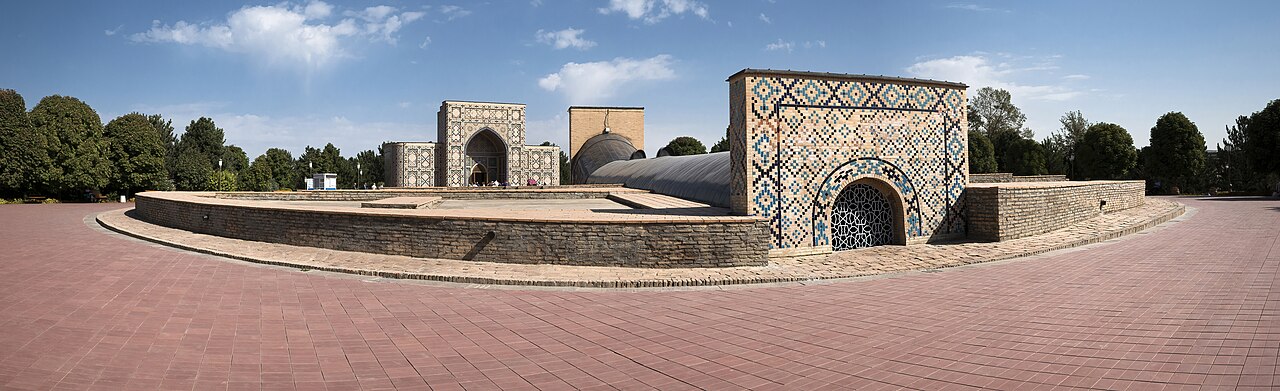
The astronomer-king’s buried sextant – a 40-metre arc in the rock that fixed the stars to the minute, a century before Europe’s instruments matched it.
At a glance
- Type
- Observatory remains and museum
- Period
- c. 1420-1449
- Style
- Timurid scientific architecture
- Location
- Afrasiyab edge, Samarkand, Uzbekistan
- Coordinates
- 39.6753, 67.0050
- Founder
- Ulugh Beg, Timurid sultan-astronomer
Overview
Ulugh Beg – Timur’s grandson who preferred stars to conquest – sank a meridian sextant of forty metres’ radius into Samarkand’s rock around 1424: the great arc’s marble-faced trench, rediscovered in 1908, survives from the round observatory where his team fixed 1,018 stars and the year’s length within a minute – precision unequalled until Tycho Brahe a century and a half later.
History
The sultan’s Zij-i Sultani catalogue travelled west to Oxford’s presses; his religious opponents had him murdered in 1449 на his pilgrimage road, and the observatory was razed – science’s martyrdom Central Asia still mourns. Soviet archaeologist Vyatkin’s trench-find returned the instrument to light; the museum beside displays the catalogue’s pages and the prince’s court of mathematicians (al-Kashi, Qadi-zada).
Architecture and Design
The surviving arc’s twin marble parapets curve down eleven metres below grade – the underground portion of an instrument whose superstructure rose three storeys; sightline slots fixed solar transits to seconds. The drum’s foundation circles trace the building’s 46-metre diameter.
Cultural significance
The observatory crowns Islamic science’s late golden age and Uzbekistan’s identity as learning’s steppe capital – Registan’s Ulugh Beg madrasa, where he taught astronomy himself, completes the astronomer-king’s memorial.
Visiting today
Site and museum open daily on the Tashkent road’s rise; combine Afrasiyab’s museum and Shah-i-Zinda’s avenue nearby.
Getting there
Ten minutes by taxi from the Registan; city buses pass the Afrasiyab slope.
Sources and resources
Find it on the map
See this place and what’s around it →Record researched and written by Luigi De Marchi for Cultural Heritage Online, 2026.
📷 Become a Cultural Heritage Online photographer
Share your photos of places: they stay published under your name as the author. The more they're seen, the more you get noticed — and soon a contest will reward the most appreciated photos.
Log in or sign up free to add a photoIs this page about you?
This page is read by travellers and heritage enthusiasts who find it on Google. Tell us how you are connected to this place and we will take it from there.