
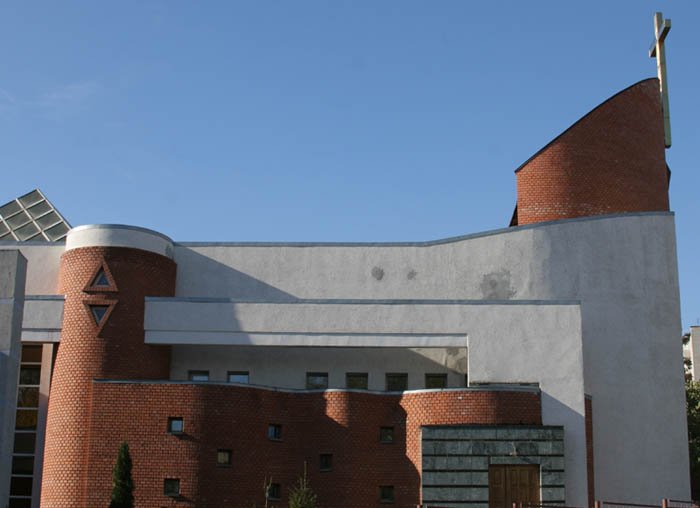
A modernist cathedral built from scratch after the Soviet collapse, standing where an older Catholic community once worshipped and then vanished from the map.
At a glance
The Cathedral of St. Peter and St. Paul serves the Catholic Diocese of Saint Clement at Saratov. Its inception dates to 1995, with construction and consecration completed by 2000. The building is modernist in style, a deliberate break from the region’s older brick parish churches. It sits in Saratov Oblast, in southwestern Russia along the Volga.
History
Catholic life in Saratov stretches back further than this building. From the mid-nineteenth century the city served as the seat of the Bishop of Tiraspol, a diocese whose jurisdiction stretched across southern Russia and Siberia, even though the bishop resided elsewhere. Ethnic Poles and Volga Germans, many settled since the late eighteenth century, filled the pews. A first Catholic church rose in 1805, serving a town swelling with imperial settlers.
The Soviet era ended that continuity. Persecution of the Catholic Church shuttered congregations across the country, and Saratov’s original church site was lost. After the Soviet Union dissolved, authorities did not return that historic property to the Catholic community. The parish had to start over. A new church, dedicated to Saints Peter and Paul, was consecrated in 2000, with the apostolic nuncio present. Two years later it became a cathedral, when the Diocese of Saint Clement was established.
What you see
Nothing here echoes the ornate parish churches of Volga German settlements. The cathedral’s modernist design speaks instead of a fresh institutional start, built for a rebuilding congregation rather than inherited from empire. Its forms are plain and functional, prioritizing worship space over historic ornament. The result reads less as a monument to the past than a working church for a small, resilient community.
Cultural significance
The cathedral embodies survival. It marks a Catholic presence in Russia that outlasted confiscation, closure, and decades without a building to call its own. Its 2002 elevation to cathedral status, alongside the diocese’s founding, signaled formal reestablishment of Catholic structure in the region after Soviet rupture. For the Poles and Volga Germans whose descendants remain, it is a rare visible anchor of continuity.
Key facts
- Location: Saratov, Saratov Oblast, Russia
- Style: Modernism
- Inception: 1995; consecrated 2000
- Elevated to cathedral status: 2002
- Seat of: Catholic Diocese of Saint Clement at Saratov
Practical information & getting there
Saratov lies on the Volga River, reachable by rail and air from Moscow. The cathedral functions as an active parish church, so visits should respect regular services. Check the diocesan website before traveling, since opening times and Mass schedules are set locally.
Sources & resources
Find it on the map
See this place and what’s around it →📷 Become a Cultural Heritage Online photographer
Share your photos of places: they stay published under your name as the author. The more they're seen, the more you get noticed — and soon a contest will reward the most appreciated photos.
Log in or sign up free to add a photoIs this page about you?
This page is read by travellers and heritage enthusiasts who find it on Google. Tell us how you are connected to this place and we will take it from there.