
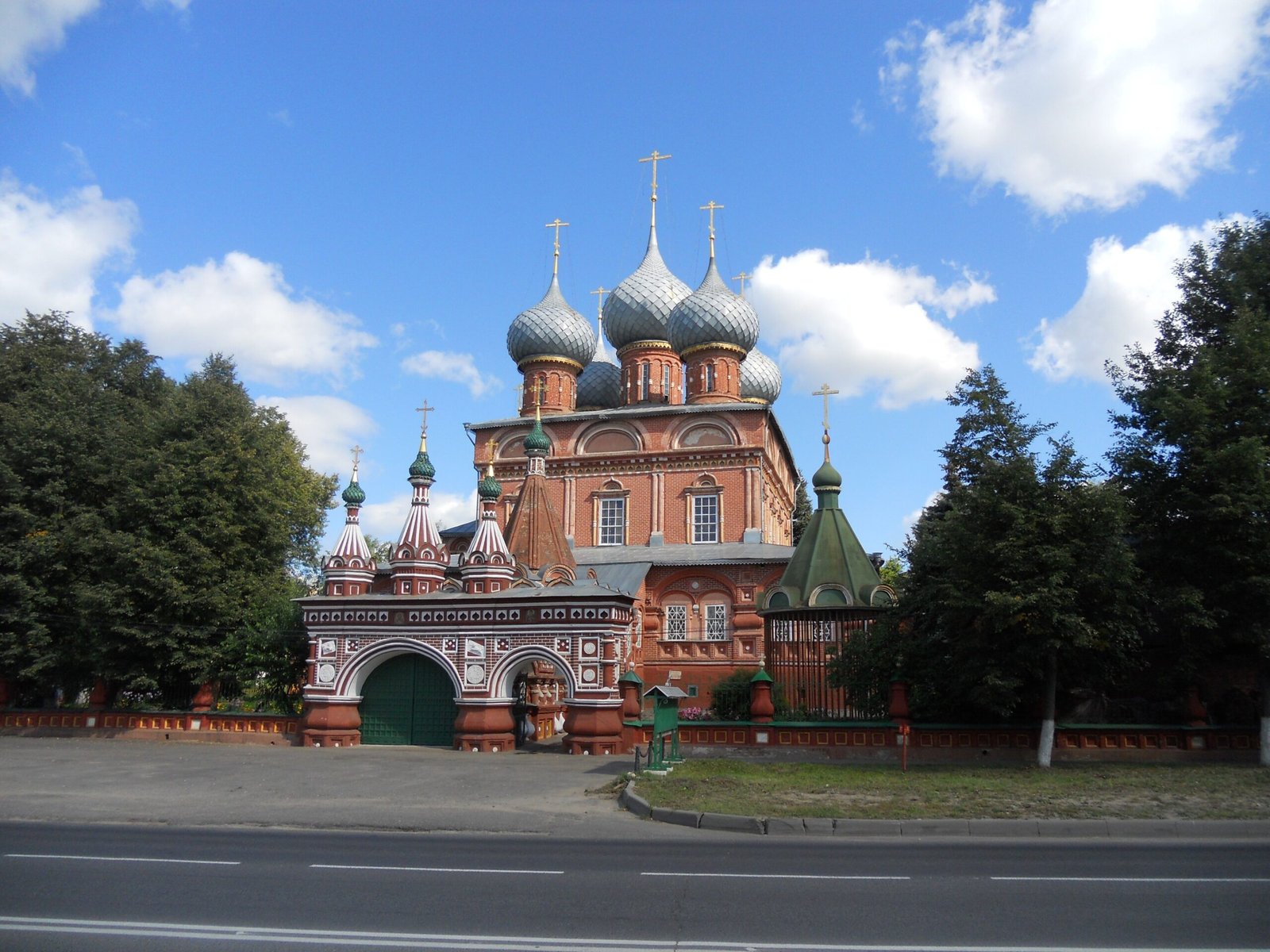
Set near the Volga in the old Debre quarter, this stone church has weathered fire, granary storage and Soviet closure since its completion around 1651.
At a glance
The Church of the Resurrection belongs to the Diocese of Kostroma of the Russian Orthodox Church. Built no later than 1652, it stands close to the riverbank. Legend traces the site’s first wooden church to Knyaz Vasily Yaroslavich, a 13th-century Prince of Kostroma. The present stone building reflects Russian architecture of the mid-1600s, shaped by builders drawn from Yaroslavl and Veliky Ustyug.
History
Construction finished by 1652. Painters set to work almost immediately. The interior murals date to 1650–1652, and tradition attributes some frescoes to Gur Nikitin and his team, alongside work presumed to be by the artel of Vasili Zapokrovsky. Change continued into the following century. In the 1740s workers painted new window surrounds, cut gallery openings and linked the west porch to the holy gates by a covered walkway. The original bell tower did not survive. It was pulled down in 1801 during rebuilding of the adjoining “warm” Znamensky temple, and a new tower rose beside that church instead, tying the two structures into one complex. Soviet rule brought harder years. The church functioned until 1930, then closed. Its nave became a granary; the basement held a military warehouse. Reopened in 1946, it stood stripped of floors, icons and window glass, by the accounts of those who saw it then. From 1964 the modest church served an unlikely role, functioning as the cathedral of the Kostroma diocese for a quarter century. Until 1991 it held one of the city’s most venerated objects, the Feodorovskaya Icon of the Mother of God, rescued from the ruined Assumption Cathedral in 1934. Restoration work ran from 1967 to 1969.
What you see
The building reads as part of a linked ensemble rather than a single freestanding church. Its west porch connects by covered walkway to the holy gates, a legacy of 18th-century alterations. The bell tower visitors see today is not original; it dates to 1801 and rises beside the neighboring Znamensky church rather than over the Resurrection church itself. Inside, painted surfaces from the 1650s remain the main draw. Fresco work traditionally linked to Gur Nikitin sits alongside painting attributed to the Zapokrovsky artel, though exact authorship stays a matter of tradition rather than record.
Cultural significance
For a quarter century this small parish church carried cathedral status for the entire Kostroma diocese. It sheltered the Feodorovskaya Icon, among the most revered images in the region, after the Assumption Cathedral fell to ruin in 1934. That custodianship, brief in the church’s long life, marks its deepest civic importance. The building also stands as physical testimony to the 20th century’s disruptions and reversals, moving from granary to warehouse to reopened sanctuary within two decades.
Key facts
- Location: Kostroma, Russia, near the Volga River
- Completed: no later than 1652 (inception dated 1651)
- Style: Russian architecture, 17th century
- Interior painting: 1650–1652, frescoes traditionally linked to Gur Nikitin
- Bell tower rebuilt: 1801, adjoining the Znamensky church
- Closed 1930–1946 under Soviet rule
- Served as Kostroma diocesan cathedral, 1964–circa 1991
- Restoration works carried out 1967–1969
- Heritage-listed status confirmed
Practical information & getting there
The church sits within Kostroma’s historic Debre district, a short distance from the Volga embankment. You can reach it on foot from the city center along streets that trace the old riverside quarter. As an active parish church under the Diocese of Kostroma, it keeps to regular services rather than fixed museum hours, so check locally before planning a visit.
Sources & resources
Find it on the map
See this place and what’s around it →📷 Become a Cultural Heritage Online photographer
Share your photos of places: they stay published under your name as the author. The more they're seen, the more you get noticed — and soon a contest will reward the most appreciated photos.
Log in or sign up free to add a photoIs this page about you?
This page is read by travellers and heritage enthusiasts who find it on Google. Tell us how you are connected to this place and we will take it from there.