
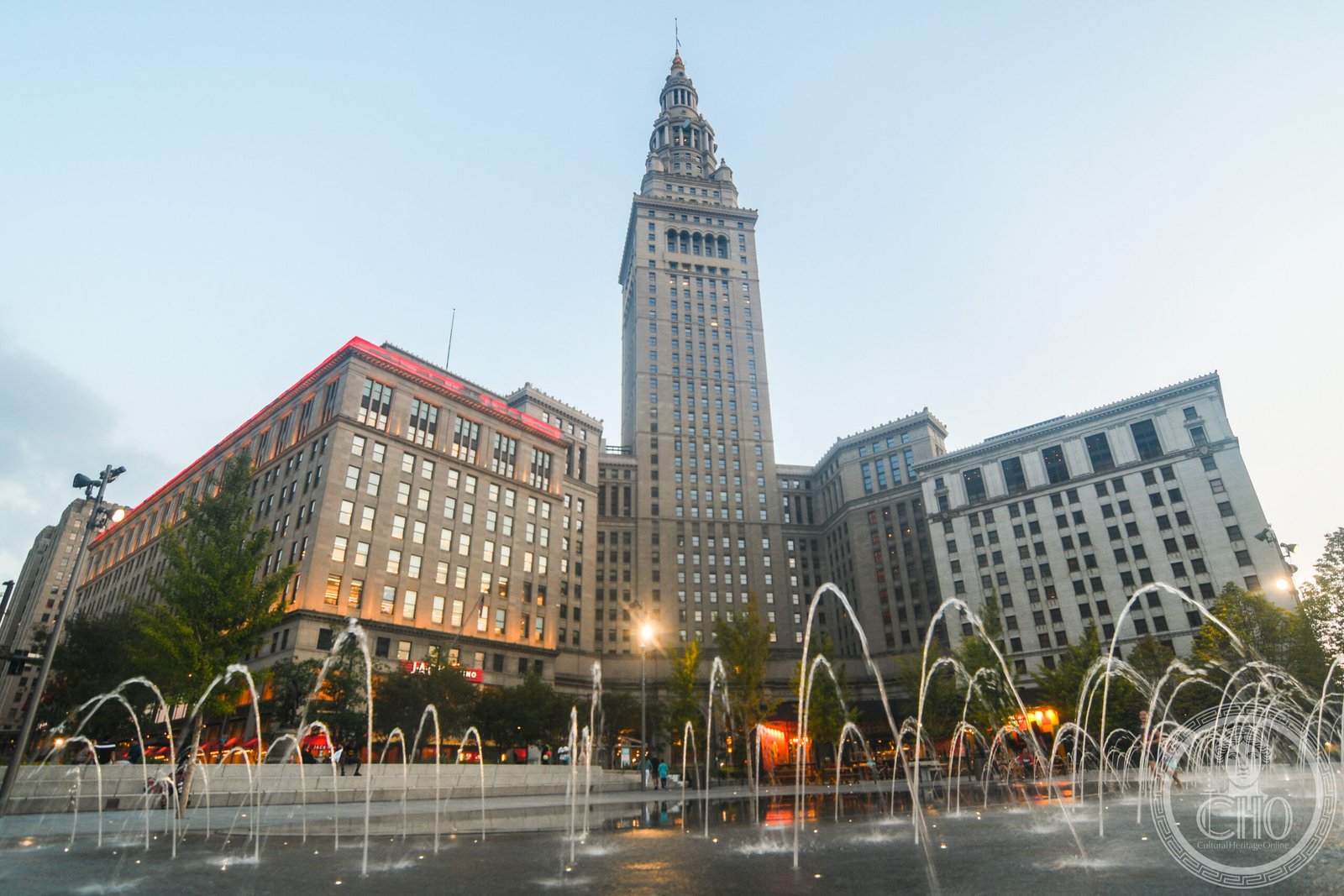
Rising 215 metres above Cleveland’s Public Square, Terminal Tower was the tallest building in the world outside New York City when it opened in 1930, a distinction it held for twenty-seven years. Commissioned by the Van Sweringen brothers — Oris and Mantis, the railroad developers who built Shaker Heights — as the centrepiece of a unified rail-and-real-estate empire, the tower presided over a complex that included hotel, offices, retail concourse, and the vast underground passenger terminal that once handled every major rail line entering the city. Today the complex operates as Tower City Center, a mixed-use hub of retail, entertainment, gaming, and rapid transit, its original Beaux-Arts concourse transformed and its tower restored to its copper-green crown. The ensemble represents one of the great exercises in American civic monumentalism, a Midwestern counterpart to New York’s Grand Central Terminal — though built around a skyscraper rather than a horizontal civic hall, asserting vertical ambition where New York celebrated horizontal grandeur.
At a glance
- Type
- Mixed-use rail terminal and skyscraper complex
- Period
- 1928–1930 (Terminal Tower); complex expanded 1934
- Style
- Art Deco / Beaux-Arts
- Location
- 50 Public Square, Cleveland, Ohio 44113, USA
- Coordinates
- 41.4978° N, 81.6942° W
- Architect(s)
- Graham, Anderson, Probst & White
Overview
Tower City Center occupies the western end of Public Square, Cleveland’s historic civic core. The 52-storey Terminal Tower anchors a campus that includes the Renaissance Cleveland Hotel (formerly Hotel Cleveland, 1918), two Landmark Office Towers, and the Tower City station serving the Greater Cleveland RTA. The underground concourse — once the largest railway station in the United States by platform count — connected the Van Sweringen brothers’ interurban and steam-rail lines. After passenger rail declined in the 1970s, the complex was redeveloped: the concourse became a shopping mall in 1990, and the Jack Cleveland Casino opened in 2012 in the former retail space.
History
Oris Paxton Van Sweringen and Mantis James Van Sweringen began planning the terminal complex in 1916, acquiring air rights above the Cleveland Union Terminal rail yard. Graham Anderson Probst & White — the same firm that designed Chicago’s Merchandise Mart and Union Station — designed the scheme. Construction began in 1923 and the Terminal Tower opened on 1 June 1928 for offices; full rail operations commenced in 1930. At 708 feet (216 m), it was the second-tallest building in the world at opening. The tower’s observation deck on the 42nd floor became a beloved Cleveland attraction. The Van Sweringens’ empire collapsed in the Depression; the complex passed through several owners before Forest City Enterprises purchased it in 1982 and executed the major retail conversion completed in 1990. A $272 million renovation in the 2010s revived the concourse and public spaces.
Architecture & Design
The Terminal Tower’s shaft rises in graduated setbacks from its broad base, following the 1916 New York zoning envelope aesthetic even on a Midwestern site. The exterior is clad in Indiana limestone with terracotta detail at the upper floors. A steel lantern at the crown, illuminated at night, has been a Cleveland landmark for nearly a century. The Beaux-Arts concourse beneath the tower featured vast coffered barrel vaults, travertine floors, and bronze fittings — a passenger environment intended to rival European rail termini. The 1990 retail conversion by Ellerbe Becket retained the vaulted ceilings while introducing escalators and shop fronts. Tower City station, the RTA rapid transit hub, operates in the lower level and connects to Cleveland Hopkins International Airport by light rail.
Cultural significance
Terminal Tower was the emblem of Cleveland’s industrial ambition during the boom years of the 1920s, and its silhouette remains the city’s most recognisable skyline element. It was listed on the National Register of Historic Places in 1976 and designated a National Historic Landmark in 1977. For generations of Clevelanders, the tower’s observation deck was the city itself seen whole: an anchor for civic identity in the way that the Gateway Arch is to St Louis or the Space Needle to Seattle. The complex’s survival and adaptive reuse as Tower City Center — retail, transit, casino, hotel — has made it a study in the challenge of repurposing monumental Beaux-Arts infrastructure for post-industrial cities.
Visiting today
Tower City Center is open daily; the retail and food-court areas follow standard mall hours. Jack Cleveland Casino operates 24 hours. The observation deck of Terminal Tower, closed for many years, has reopened on select weekends — check the Terminal Tower website for current schedules and admission. The Renaissance Cleveland Hotel, connected directly to the complex, offers rooms that allow extended exploration of the historic corridors and lobby. The RTA Tower City station is accessible at street level from Public Square.
Getting there
Tower City Center is the central hub of Cleveland’s RTA rapid transit network. The Red, Blue, and Green lines all terminate at Tower City station, making it reachable from University Circle, Shaker Heights, and Cleveland Hopkins Airport without a car. Public Square directly outside the complex is served by multiple bus routes. Parking garages adjoin the complex on Huron Road and West Huron Road. From downtown hotels, the complex is walkable; from the airport, the Red Line takes approximately 20 minutes direct.
Sources & resources
Find it on the map
See this place and what’s around it →📷 Become a Cultural Heritage Online photographer
Share your photos of places: they stay published under your name as the author. The more they're seen, the more you get noticed — and soon a contest will reward the most appreciated photos.
Log in or sign up free to add a photoDo you manage this place?
This page is read by travellers and heritage enthusiasts who find it on Google. Keep it accurate — and make it work for you. Free for non-profit heritage institutions.