

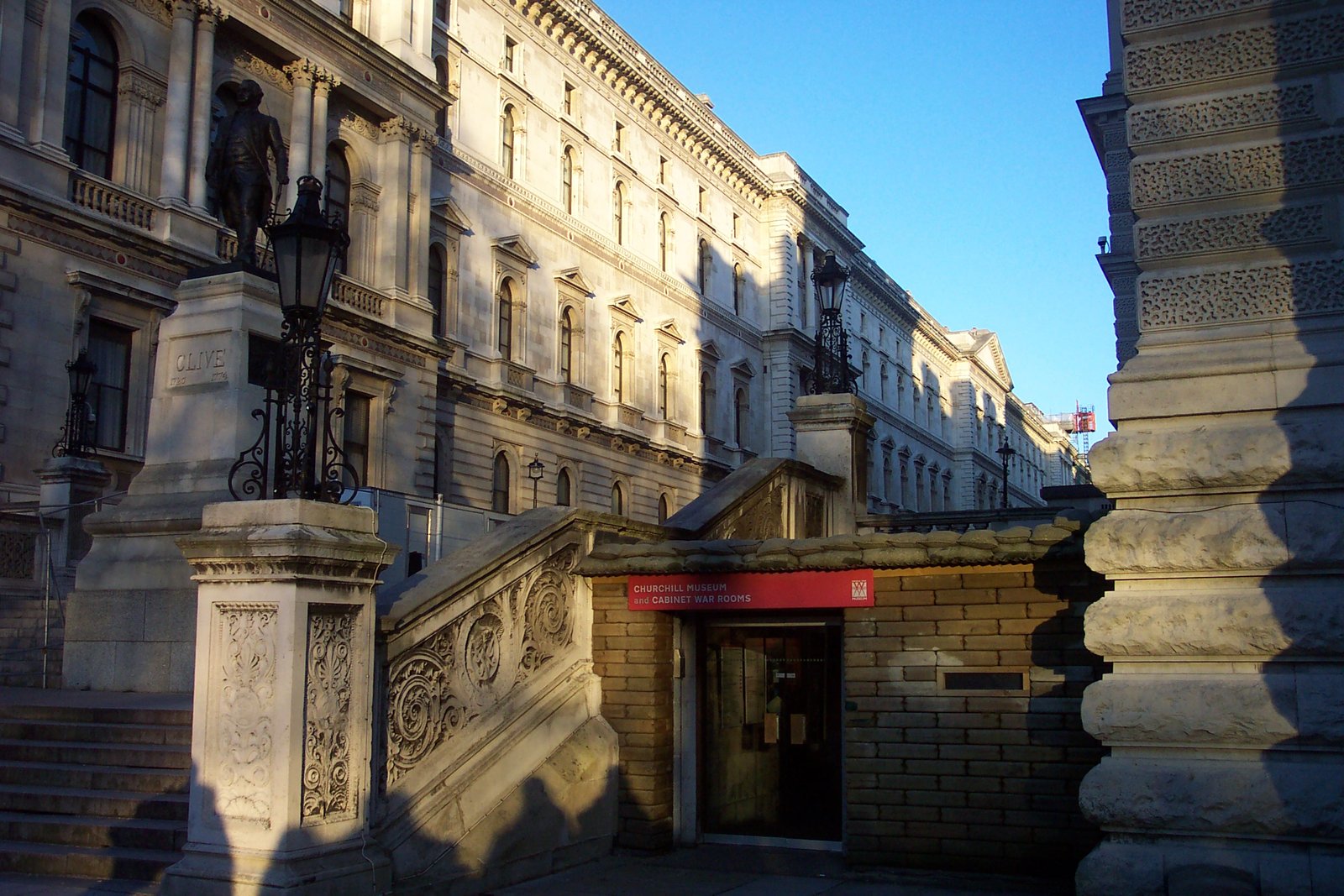
A telephone cupboard disguised as a toilet, a map room staffed around the clock for six years without a single day closed, and a prime minister who, by his own security staff’s frustration, kept climbing back upstairs to watch the raids from the roof.
At a glance
Converted from the basement of the New Public Offices in Whitehall from June 1938, the War Rooms became operational on 27 August 1939, a week before Britain declared war. From here Winston Churchill and the War Cabinet met 115 times over the course of the war, mostly during the Blitz and the V-weapon campaign, coordinated by a Map Room that was staffed continuously, day and night, by Royal Navy, Army and RAF officers for the entire war without ever closing.
Key facts
- Converted: from June 1938; operational from 27 August 1939
- Reinforced: after the Blitz began, additional concrete protection — «the Slab» — was added from October 1940, roughly tripling the bunker’s protected footprint by the following spring
- War Cabinet: met in the Rooms 115 times, concentrated in the periods of heaviest bombing
- Map Room: staffed 24 hours a day by Royal Navy, Army and RAF officers for the entire war
- Transatlantic Telephone Room: a small cupboard beside the Map Room, disguised as Churchill’s personal toilet, housing the SIGSALY secure speech system for direct calls to President Roosevelt
- Closed: the day after Japan’s surrender, 16 August 1945, when the Map Room’s lights were switched off for the last time
- Coordinates: 51.5022° N, 0.1293° W
How it was built
The Rooms were ready a week before the war they were built for began, and stayed exactly as urgent for the whole of it: the reinforced concrete «Slab» added after the Blitz started was a retrofit, a government discovering under bombardment that its own bunker was not yet as safe as it needed to be. The technical centrepiece was the Transatlantic Telephone Room, a converted cupboard beside the Map Room disguised as a private lavatory, which used a system called SIGSALY — racks of equipment and a synchronised noise-masking disc at each end — to let Churchill speak to Roosevelt without the Germans listening in.
Not as safe as it looked
The bunker’s own wartime history includes an uncomfortable discovery: during the Battle of Britain, it became clear that a bomb of more than about 227 kg landing directly on the Rooms would have penetrated the original protection — a bunker built to keep the government safe that was not, in fact, safe from a direct hit until the Slab was added. Churchill’s own behaviour compounded the risk his staff were trying to manage: he slept in the underground quarters only a handful of times in the whole war, generally preferring Downing Street or the flat above it, and during air raids he was known to go up to the roof to watch rather than stay below — a habit his security detail only curbed after a direct hit on the Downing Street kitchen made the danger impossible to argue away.
Who tells it, and where the accounts diverge
The image most associated with this site — Churchill directing the war from a bombproof bunker — is only partly accurate, and the Imperial War Museum’s own record of the site is the source that complicates it. The bunker was not fully bombproof until well into the war; the man it was built to protect used it as little as he reasonably could, by choice rather than necessity; and its most technically remarkable feature, the secure telephone line to Washington, was housed in a broom cupboard dressed up as a toilet rather than in anything resembling a purpose-built communications suite. The Rooms functioned, for six years, less like an impregnable command centre and more like an improvised, constantly adjusted response to a threat that kept changing faster than the building could.
What you see today
- The Map Room, preserved as it was left in August 1945, including the wall maps and telephone banks used throughout the war.
- The Cabinet Room, where the War Cabinet met, and the Transatlantic Telephone Room disguised as a toilet.
- The Churchill Museum, an adjoining exhibition on Churchill’s life, run together with the War Rooms by the Imperial War Museum.
Getting there
The Churchill War Rooms are on King Charles Street, Westminster, a short walk from Westminster and St James’s Park underground stations.
Nearby
- 10 Downing Street and Whitehall, immediately adjacent
- The Houses of Parliament and Westminster Abbey, a short walk south
Sources
- Imperial War Museum, «A Short History of the Cabinet War Rooms», «9 Secrets from Churchill War Rooms» and «Churchill’s Top-Secret Hotline to the President» — construction, the Slab, the Map Room, the Transatlantic Telephone Room, SIGSALY.
- Wikipedia, Churchill War Rooms — cross-checked for dates and structural detail.
- HistoryNet, on the bunker’s bomb vulnerability and Churchill’s rooftop habit during raids.
Find it on the map
See this place and what’s around it →📷 Become a Cultural Heritage Online photographer
Share your photos of places: they stay published under your name as the author. The more they're seen, the more you get noticed — and soon a contest will reward the most appreciated photos.
Log in or sign up free to add a photo