

Sussex’s largest Victorian fortification, built against an invasion fear that turned out to be unfounded, was still standing and still armed eighty years later when a real one arrived from the other direction.
At a glance
Newhaven Fort was built between 1864 and 1871, one of the «Palmerston Forts» raised across southern England after an 1859 Royal Commission warned of French invasion. Designed by a 22-year-old lieutenant, John Charles Ardagh, it used 250 workers, six million bricks and one of the first significant uses of concrete in a British fortification — the largest single defensive work ever built in Sussex. The invasion it was built against never came.
Eighty years later, the fort was rearmed and garrisoned again, this time against Germany — the ally, by then, of the country it had originally been built to face.
Key facts
- Built: 1864–1871, designed by Lieutenant John Charles Ardagh; 250 workers, six million bricks, a 12-metre ditch
- Context: one of the Palmerston Forts, raised after the 1859 Royal Commission on the Defence of the United Kingdom identified French invasion as the principal threat
- WWII garrison: the 521st (Kent and Sussex) Coast Regiment, Royal Artillery; original guns replaced in 1941 by a battery of BL 6-inch Mark 24 guns sited west of the fort
- Wartime action: bombed by the Luftwaffe in 1940 — described in the fort’s own history as the only enemy action it saw in a century of active use
- Dieppe Raid, 19 August 1942: Newhaven’s harbour served as an embarkation point for landing craft; overall command and coordination for the raid ran from HMS Forward, a separate secret underground base 1.5 km away at South Heighton, not from the fort itself
- Memorial: the fort today holds a permanent memorial, with the flags of Canada, Britain and France, to the roughly 3,500 Allied casualties of the Dieppe Raid
- Coordinates: 50.7829° N, 0.0542° E
How it was built, and rebuilt
Ardagh’s design gave Newhaven a fort scaled to a threat that, in the event, never materialised: the expected French invasion of the 1860s stayed a fear rather than a fact, and the fort’s first eight decades passed without ever firing a shot in anger. What kept it relevant was not the accuracy of the original threat assessment but the durability of the structure itself — thick enough, large enough and well enough sited over Newhaven’s harbour that when a real war did reach the Sussex coast in 1939, the same walls simply needed new guns.
Coastal defence, then a staging point
Through the Second World War the fort’s rearmed battery covered the Channel approach to Newhaven’s harbour, one link in the chain of coastal artillery defending southern England. The harbour itself took on a larger role in August 1942, when landing craft departed from Newhaven for the raid on Dieppe — a costly, largely unsuccessful assault that nonetheless shaped Allied planning for the Normandy landings two years later. The operational command for that raid, radar and communications included, ran not from the fort but from a purpose-built secret bunker at South Heighton nearby; Newhaven’s role was as an embarkation point, not as the raid’s command centre.
Who tells it, and where the accounts diverge
No source consulted for this piece explicitly frames Newhaven Fort as an irony — a fortress built against France, reused against an enemy allied with a free France fighting alongside Britain. It is a plausible observation, but it belongs here as a reflection, not as a documented claim any historian has made about the site. What is documented, and worth being precise about instead, is a smaller correction to a common conflation: Newhaven Fort hosted the Dieppe Raid’s departure, and today its memorial; the raid’s actual command and control operated from a different, purpose-built site close by. Telling the story accurately means keeping the fort’s role — a staging point and, since, a place of memory — distinct from a command function it did not perform.
What you see today
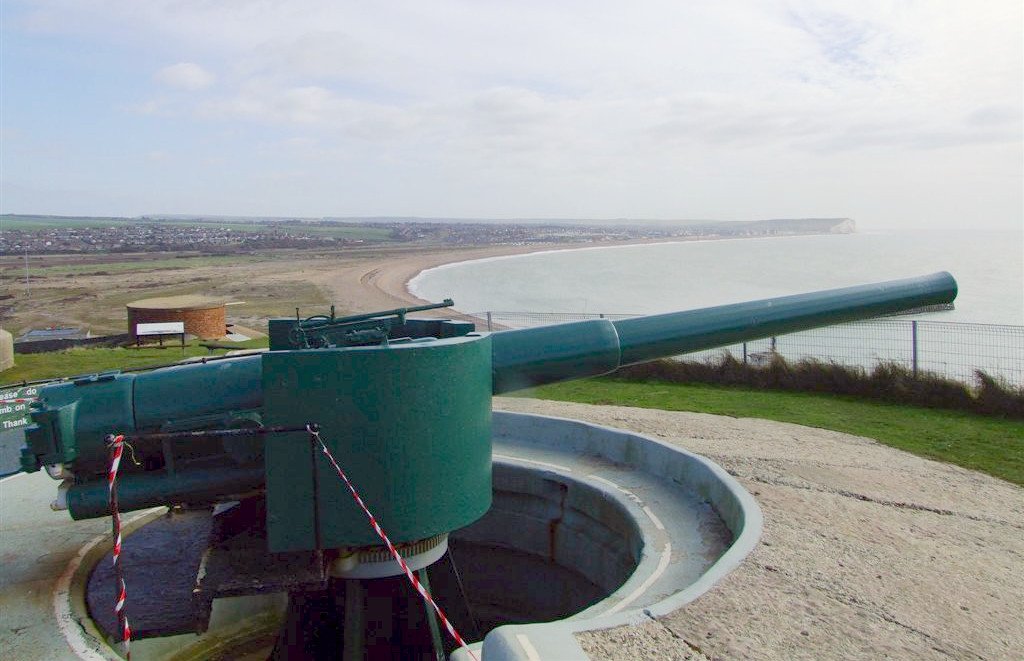
- The Victorian fort structure, now run as a museum, with original and restored gun positions including a BL 6-inch gun.
- The Dieppe Raid memorial, with the flags of the three principal Allied nations involved.
- Exhibits spanning the fort’s Victorian origins through its Second World War garrison years.
Getting there
Newhaven Fort overlooks Newhaven Harbour, East Sussex, a short walk from Newhaven Town railway station.
Nearby
- Seaford and the Sussex Heritage Coast, immediately east
- South Heighton, site of the HMS Forward underground command bunker for the Dieppe Raid
Sources
- Wikipedia, Newhaven Fort — construction, WWII garrison and armament, Dieppe Raid connection.
- Newhaven Fort, official site (history and timeline pages) — construction detail, wartime bombing.
- Sussex Express and Subterranea Britannica, on HMS Forward — the separate command site for the Dieppe Raid, clarifying its role versus the fort’s.
Find it on the map
See this place and what’s around it →📷 Become a Cultural Heritage Online photographer
Share your photos of places: they stay published under your name as the author. The more they're seen, the more you get noticed — and soon a contest will reward the most appreciated photos.
Log in or sign up free to add a photo